


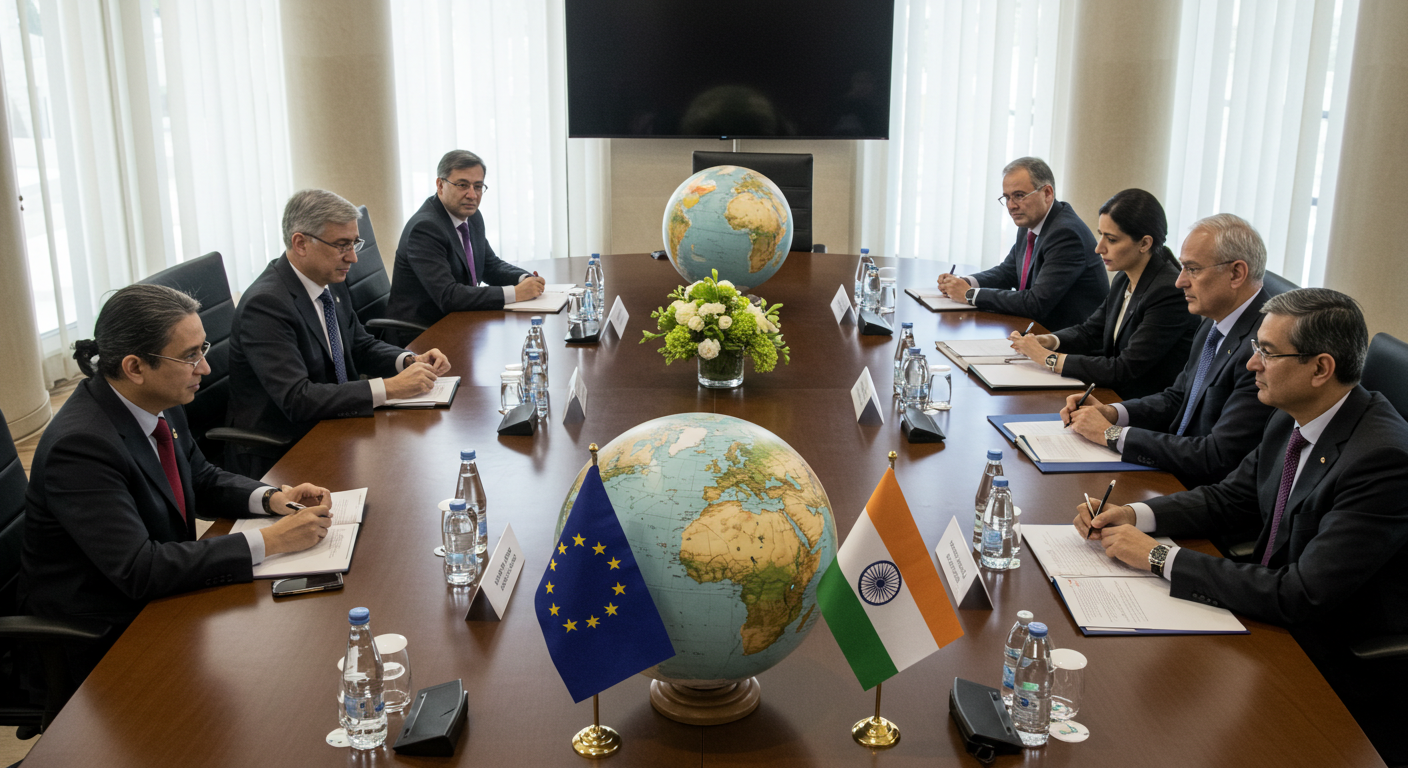


The relationship between India and the European Union (EU) is strategically important; encompassing political, economic, and cultural dimensions. As one of the EU’s largest trading partners, India plays a critical role in shaping the EU’s economic outlook, particularly in sectors such as technology, pharmaceuticals, renewable energy, and machinery. Shared democratic values, a commitment to the rule of law and a belief in multilateralism underpin their growing political cooperation, enabling both sides to engage on major global issues including climate change, regional security, and counterterrorism. The EU supports India’s development through a combination of diplomatic engagement, investment, and educational partnerships. Cultural ties, particularly through the well-established Indian diaspora across Europe, enhance mutual understanding and contribute to the people-to-people connection that bolsters bilateral relations.
The historical relationship between India and Europe, particularly the United Kingdom (UK), is rooted in the colonial era. While marked by exploitation, this period also introduced systems that would shape India’s modern institutions—such as the English language, legal frameworks, and higher education infrastructure. These legacies have played a role in India’s post-independence development and its engagement with European nations. Following independence in 1947, India adopted a more assertive and sovereign foreign policy, coinciding with the emergence of the EU in the post-World War II era. This parallel development set the stage for renewed diplomatic and economic engagement. As India sought to modernise and assert its global standing, it found a like-minded partner in an EU that was consolidating its political and economic influence. In 2018, the EU adopted a new strategy to deepen its partnership with India, emphasising enhanced cooperation in foreign policy, security, and defense. This was followed by the 2020 India-EU Roadmap 2025, which outlined a comprehensive framework to guide bilateral engagement. These efforts culminated in the first-ever EU-India leaders’ meeting in Porto in 2021, where both sides reaffirmed their commitment to resuming trade negotiations and advancing joint goals.
Today, the EU remains one of India’s foremost trade and investment partners. Bilateral trade spans critical sectors such as digital technology, agriculture, and green infrastructure, while EU-based companies continue to invest heavily in India’s rapidly growing economy. Negotiations for a comprehensive India-EU Free Trade Agreement (FTA) aim to reduce tariff and regulatory barriers, protect intellectual property, and improve market access for businesses on both sides. These two powers also collaborate extensively in multilateral forums such as the United Nations, World Trade Organization, and G20. Their partnership has advanced global efforts on climate action, pandemic response, and sustainable development. In the Indo-Pacific region, both sides are increasingly aligned on maritime security, supply chain resilience, and counterterrorism, reflecting shared strategic interests in maintaining a stable and rules-based international order.
Cultural and academic ties are another important dimension of this relationship. Thousands of Indian students have benefited from EU programmes like Erasmus+, which facilitate higher education opportunities and intercultural exchange. Simultaneously, Indian and EU universities are collaborating on joint research initiatives in science, technology, and the humanities—fostering innovation and reinforcing shared values of academic freedom and inquiry.
Despite growing alignment, several challenges persist. India’s neutral stance on Russia’s invasion of Ukraine has drawn criticism from some EU member states, who expected a stronger condemnation of Moscow’s actions. Additionally, new EU trade policies such as the Carbon Border Adjustment Mechanism and Deforestation-Free Products Regulation have been contentious, with India arguing they disproportionately affect its exporters. Concerns over human rights in India, particularly regarding religious minorities and regional unrest in areas like Manipur, have also been raised by EU policymakers. Nevertheless, both parties have shown resilience and a willingness to engage in dialogue to overcome these differences.
A significant milestone was reached on February 27, 2025, when Indian Prime Minister Narendra Modi and European Commission President Ursula von der Leyen met in New Delhi to reaffirm their commitment to the India-EU Strategic Partnership. The leaders agreed to finalise the long-pending Free Trade Agreement by the end of 2025, with a renewed focus on green energy, digital cooperation, and defense. They also discussed the India-Middle East-Europe Economic Corridor (IMEC), a major infrastructure initiative designed to enhance intercontinental connectivity.
As global dynamics shift and new alliances take shape, the India-EU partnership is increasingly vital. With shared democratic values, economic complementarities, and a commitment to multilateralism, the two powers are well-positioned to drive the future of global governance, regional security, and sustainable development. Their deepening ties reflect not just mutual interests, but a shared vision for a more stable, equitable, and prosperous world.
Sources
- https://www.thehindu.com/news/national/russia-ukraine-have-to-negotiate-india-willing-to-give-advice-if-they-want-jaishankar-in-germany/article68625998.ece
- https://www.thehindu.com/news/national/russia-ukraine-have-to-negotiate-india-willing-to-give-advice-if-they-want-jaishankar-in-germany/article68625998.ece/amp/
- https://www.eunews.it/en/2025/02/28/eu-india-outline-strategy-for-new-cooperation-modi-trade-agreement-by-the-end-of-this-year/