



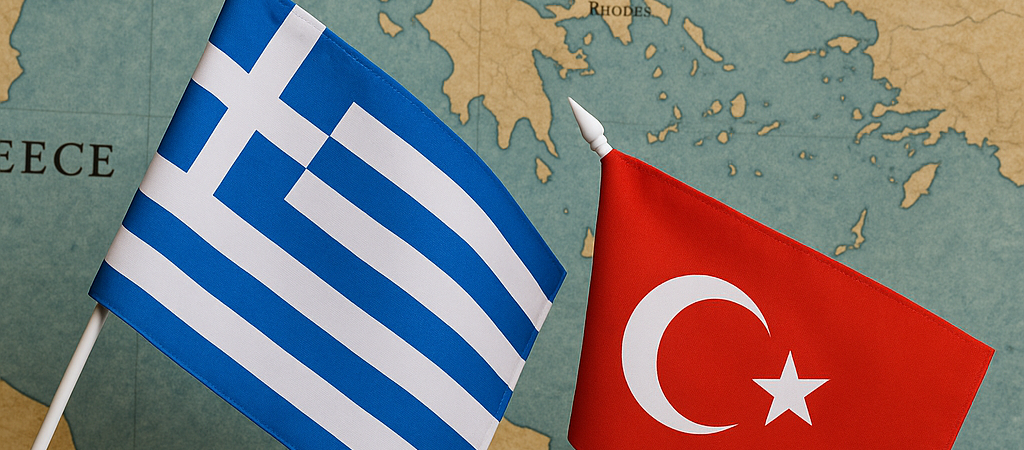


The Aegean Sea is once again choppy—not by natural currents, but by a geopolitical storm triggered by Turkey’s decision to publish a new maritime map that unilaterally redefines its territorial waters. On 17 June 2025, Turkey submitted an official maritime spatial planning document to the Intergovernmental Oceanographic Commission of UNESCO. Drafted by Ankara University, the map challenges the maritime boundaries in the heart of the Aegean, rejecting the territorial rights of several Greek islands, including some of the most populated and strategically located.
According to the Turkish proposal, the Eastern Aegean islands — Chios, Samos, Rhodes, Kastellorizo among them — do not possess rights to their own exclusive economic zones (EEZs) but are instead limited to territorial waters extending only six nautical miles. This interpretation is consistent with the “Blue Homeland” Doctrine (Mavi Vatan), a geopolitical vision increasingly prominent in Turkish military and diplomatic circles. The doctrine aims to reassert Turkey’s control over key maritime routes and energy resources in the Eastern Mediterranean. The recently published map is not a mere academic exercise—it assigns maritime zones for future energy exploration to Turkey’s state oil company, TPAO, and outlines military areas (naval and aerial training zones) extending close to Greek territorial waters.
The Greek government responded swiftly and firmly. In an official statement, it declared the Turkish map legally baseless and announced plans to bring the matter before all relevant international bodies. The Greek Foreign Minister reiterated that international law — specifically, the UN Convention on the Law of the Sea (UNCLOS) — clearly affirms the maritime rights of islands, regardless of their size or location. Greece, a signatory and active participant in UNCLOS, finds itself in direct legal and political opposition to Turkey, which has never ratified the convention and instead promotes a median-line principle that largely disregards the maritime zones of islands.
This latest move is widely seen as part of a broader Turkish strategy to assert its dominance in the East Mediterranean at a time of heightened geopolitical uncertainty. Turkey appears to be capitalising on the global energy crisis, the ongoing war in Ukraine, and the escalating conflict between Israel and Iran to advance its maritime claims. The symbolism of this cartographic manoeuvre is not lost on regional observers: drawing new lines on a map, particularly in such a sensitive area, is a deliberate act of geopolitical signalling. It lays the groundwork for future legal claims and potentially more confrontational behaviour.
This new phase of tension comes just as Greece and Turkey had resumed cautious diplomatic engagement under NATO auspices, following years of verbal clashes, military standoffs, and near-incidents at sea. The confidence-building process — encouraged by both Washington and Brussels — aimed to establish de-escalation mechanisms for managing aerial and naval provocations. However, the new Turkish map threatens to derail months of diplomatic progress. Ironically, only a few months ago, the Greek government extended a special visa regime for Turkish citizens visiting certain Aegean islands, a gesture of goodwill welcomed on both sides of the Aegean.
The issue now extends beyond the bilateral sphere. The EU — already under pressure from challenges in the central Mediterranean and the Middle East — faces renewed calls for a clear position. As an EU member state, Greece is expected to seek strong political and diplomatic support from its partners. The stakes are not only symbolic: the stability of the EU’s southeastern borders, the security of maritime routes, and the viability of infrastructure projects like the EastMed gas pipeline and undersea digital and energy cables all hang in the balance.
At present, no formal bilateral meeting is scheduled, but diplomatic observers anticipate that multilateral channels will be activated in the coming weeks. Washington remains particularly concerned, as NATO unity is crucial in the context of rising global tensions between democratic and authoritarian regimes. Should Greece decide to bring the matter before the International Court of Justice or a UN body, the reactions of European and Atlantic allies will be decisive.
Yet, the impression remains that this crisis goes far beyond technical disagreements over maritime law. It represents an ideological and geopolitical confrontation over the future of the Mediterranean order and the ability of European countries to uphold international norms.