



Between the 9th and 11th centuries, Sicily emerged as one of the most vibrant crossroads of Mediterranean civilizations under Arab rule. The Arab period in Sicily, lasting roughly two centuries, left a deep imprint on the island’s language, architecture, agriculture, and urban life. Cities like Palermo and Catania blossomed into cosmopolitan hubs where Phoenician, Carthaginian, Greek, Latin, Byzantine, Arabic, Norman, French and later Spanish influences intertwined. Even after the Norman conquest in 1091 A.D., the legacy of Arab governance, irrigation systems, and intellectual exchange endured, shaping Sicilian society for centuries to come. The Arab presence in Sicily thus stands as a remarkable chapter in Mediterranean history; a moment when cultures converged, knowledge flourished, and the island became a bridge between East and West.
The story begins in 827 A.D., when Arab troops landed in Mazara del Vallo, marking the start of a conquest that would forever change the history of Sicily. The expedition set out from North Africa and found fertile ground for expansion. The Byzantine Empire, which had ruled Sicily from antiquity until then, was weakened by internal crises. After years of fighting, in 831 A.D. Palermo became the capital of the Emirate of Sicily. The final battle for full control of the island took place in 902 A.D. during which Taormina, the last Byzantine stronghold, fell to Arab forces.
For over two centuries, the island was an integral part of the Islamic world, leaving behind a legacy that can still be felt today — in the cities, the countryside, and even in the language.Sicily’s landscape, rich in cultivation, owes much to the advanced irrigation systems and the sustainable use of water introduced during contact with the Arab world. The Arabs brought advanced irrigation techniques such as the saqiyah — water wheels used to lift water — which made previously arid lands fertile. Thanks to these innovations, crops like lemons, oranges, sugar cane, eggplants, and pistachios thrived. The Sicilian countryside became a mosaic of gardens, orchards, and groves, making the island not only self-sufficient but also rich in valuable goods for trade.
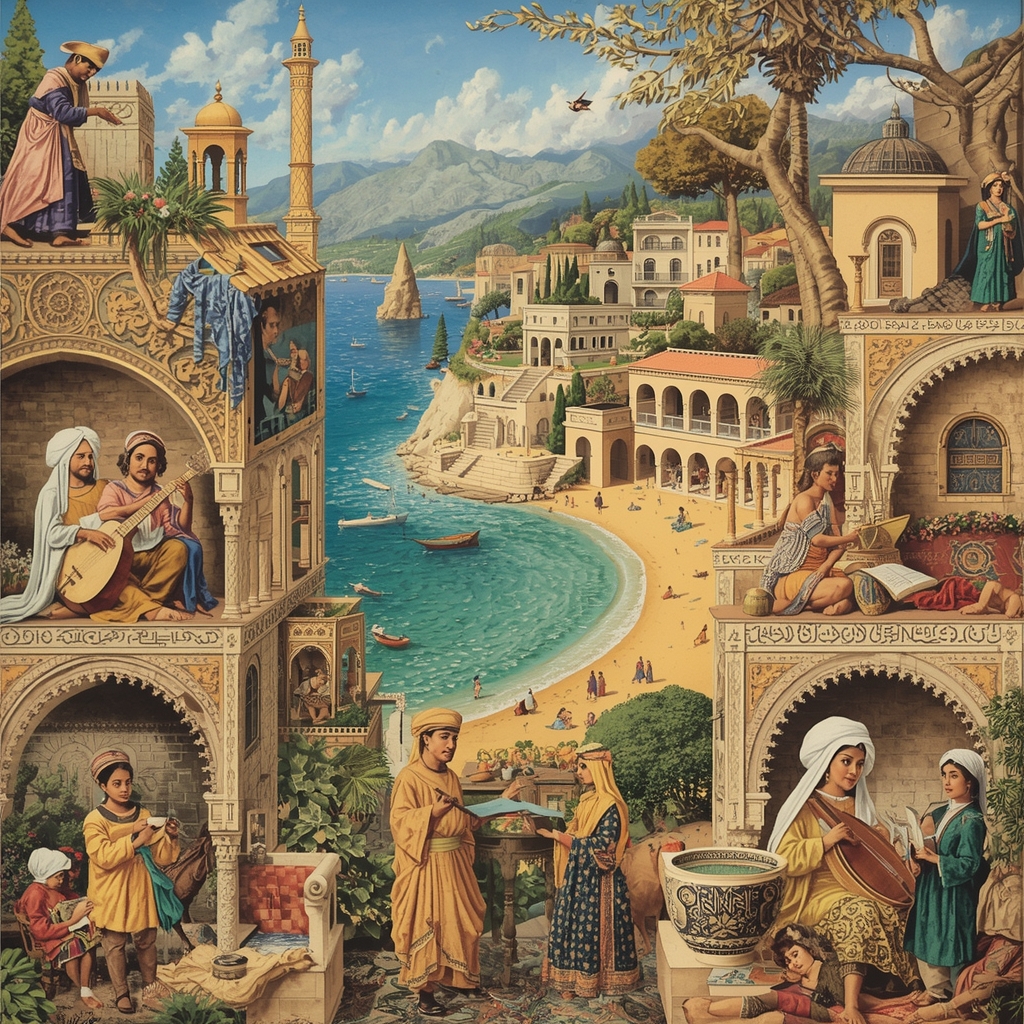
Yet, the wealth of the land is only part of the story. Under Arab rule, many cities absorbed elements of urban design, craftsmanship and architecture characterised by elegant vaults, light effects, inner courtyards, and the use of open courtyards as spaces for socialising. These features were not only found in religious or public buildings but also in noble palaces, converted mosques, covered markets, city gates and defensive walls — all reflecting a civilisation able to merge functionality and beauty.
A particularly significant part of Arab influence on Sicily was the art of surface decoration: geometric patterns, ornamental designs and scenes of everyday life covered walls and stone facades. These decorations were more than embellishments — they were a visual language expressing harmony and balance.
Palermo experienced its golden age as the capital of the Emirate of Sicily, ranking second only to Baghdad in size and cultural vitality in the Arab world. Mosques, markets, libraries, and gardens turned it into a cosmopolitan hub; a crossroads for merchants, scholars and travellers. The Arabs also brought new ideas, spreading scientific and philosophical texts that opened the doors of mathematics, astronomy, and medicine to the West. Their architecture left an indelible mark, incorporating interlaced arches, geometric motifs, luminous mosaics. When these elements were fused with Norman style, a unique artistic language was created that can still be seen today in monuments such as the Palatine Chapel and La Zisa.
Economically, Arab rule transformed Sicily into a central crossroad of Mediterranean trade routes. The presence of Arab merchants and artisans led to the specialisation of crafts: metalworkers, ceramists producing glazed pottery, and weavers skilled in fine textiles. The real innovation lay in the creation of a system of trust-based trade practices, commercial norms and exchange networks that turned markets and alleys into places of encounter and opportunity. This heritage also survived in cuisine. Foods introduced or refined through contact with the Arab world (toasted almonds, couscous, aromatic spices, rice, and almond-based sweets) became central to Sicilian taste, combining simple ingredients with the complex play of aromas and spices.
The Arab-Sicilian legacy also endures in language. Words, expressions, and idioms enriched the Sicilian language, especially in areas related to agriculture, administration, cooking and trade. Yet it’s not only about individual words — it’s about a shared sensibility.
On the social and religious levels, there was, of course, tension and conflict. Coexistence among different communities was not always peaceful, as evidenced by Berber Revolts against Arab rule 829-878 A.D. or during the wars between emirs, outbreaks of violence against Christian communities 1040-1050 A.D. Yet the Emirate managed to maintain a balance that fostered economic and cultural growth.
After more than two centuries of control, Arab rule in Sicily ended in 1091 A.D. with the Norman conquest of Noto and Butera. Yet the Arabs didn’t disappear from Sicily overnight: many Muslims continued to live under the new rulers, contributing to the island’s economy and culture. One striking example is the geographer Muhammad al-Idrīsī, who in the 12th century created the famous Tabula Rogeriana for King Roger II, one of the most advanced maps of the medieval world, which remained relevant until around the 15th century.
The so-called Arab-Norman art, now recognised as UNESCO World Heritage, stands as the clearest testimony to this fusion: the Normans chose not to erase the Arab legacy but to integrate it. This gave birth to masterpieces such as La Zisa, the Palazzo dei Normanni, and the Palatine Chapel,where Islamic architecture, Byzantine mosaics, and Norman-Latin aesthetics come together in a harmony unique in the world.
In the centuries that followed, as stricter Christian monarchies rose to power, the Arab presence gradually faded. Yet the memory endured; not only in monuments, but also in flavours, songs and family traditions.
Today, to speak of Arab Sicily is to reflect on the Mediterranean as a space of connection rather than division — an island that was not a periphery, but the centre of cultural exchange, a crossroad of cultures. In a time like ours, marked by walls and separation, the Sicilian legacy still speaks clearly: cultures do not cancel each other out, instead they intertwine. Sicily stands as one of the most extraordinary examples of this truth in European history.
SOURCES:
- Salvatore Tramontana “ L’isola di Allah. Luoghi, uomini e cose di Sicilia nei secoli IX-XI”. Torino, Einaudi, 2014
- Francesco Gabrieli “Gli Arabi in Italia”.Firenze, Sansoni,1979
- Michele Amari “Storia dei Musulmani di Sicilia”. Firenze: Felice Le Monnier. Dal 1854 al 1872.
- UNESCO, “Arab-Norman Palermo and the Cathedral Churches of Cefalù and Monreale” 2015