






Kuwait is a high-income GCC state with a population of around 4.3 million, of which the majority are expatriates. Its capital, Kuwait City, is the country’s political and economic center. Arabic is the official language and the Kuwaiti dinar (KWD) remains one of the world’s strongest currencies. Kuwait is governed as a constitutional monarchy and is a member of the GCC, OPEC, the UN, the Arab League, and the WTO.
Kuwait’s economy is among the most affluent in the Middle East. Nominal GDP in 2024 is estimated at roughly USD 170 billion, with GDP per capita around USD 30,000–35,000. Oil and gas dominate economic activity, accounting for over 85 percent of government revenue. Growth has stabilized in recent years as oil markets recovered, while inflation remains moderate. Public debt is relatively low, giving Kuwait a strong fiscal position. Demographic pressures, especially a young national labor force and reliance on expatriates, remain long-term challenges.
Hydrocarbons define Kuwait’s economic model, but services such as banking, logistics, retail, and real estate represent important non-oil sectors. Although diversification has progressed more slowly than in the UAE or Saudi Arabia, Kuwait continues to invest in infrastructure, digital transformation, and healthcare. Construction and ICT are emerging priority areas.
Kuwait is a major exporter of crude oil and refined petroleum products. Its imports include machinery, vehicles, electronics, food products, and pharmaceuticals. China, the United States, Japan, and several EU states are key trading partners. The EU remains a significant source of high-value goods. Inward FDI is modest, partly due to regulatory hurdles, whereas outward investment is substantial and globally diversified. Kuwait’s investment capacity offers opportunities for deeper engagement with Europe.
Kuwait Vision 2035 aims to transform the country into a regional commercial and financial hub. Priorities include diversification, infrastructure upgrades, private-sector growth, digitalization, and human capital development. Although reform progress has been gradual, Vision 2035 continues to shape investment and procurement priorities, creating openings for international partners.
Polish-Kuwaiti economic relations are developing gradually and show notable potential despite their moderate scale. Kuwait’s high purchasing power, reliance on imported goods, and investment ambitions create favorable conditions for Polish exporters. Bilateral trade has grown steadily over the past decade, although it remains lower than Poland’s exchanges with Saudi Arabia, the UAE, or Qatar.
Polish exports to Kuwait are dominated by machinery, electrical equipment, agri-food goods, pharmaceuticals, medical devices, chemicals, and furniture. Agri-food products, especially dairy, meat, and confectionery, constitute a dynamic part of Polish exports, reflecting Kuwait’s heavy dependence on imported foodstuffs. Industrial machinery and household appliances also perform well, supported by demand from Kuwait’s construction and infrastructure sectors. Pharmaceuticals and medical equipment gain importance in line with the country’s large healthcare budget.
Imports from Kuwait to Poland are minimal and primarily include chemical and petrochemical products. Kuwaiti exports to Poland are small due to Poland’s reliance on other suppliers for crude oil and LNG, combined with the structure of Kuwait’s export basket, which is heavily concentrated in hydrocarbons. This limits Kuwaiti export opportunities. As a result, trade flows consistently favor Poland.
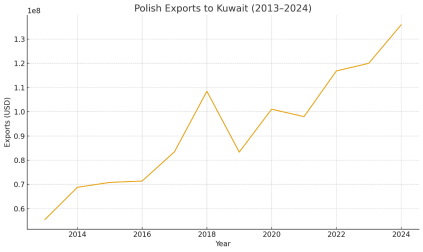
According to UN Comtrade mirror data and Polish statistical reporting, in 2023, Polish exports were estimated at USD 95–105 million, while imports from Kuwait reached USD 5–8 million. This reflects the structural complementarity between Polish exports and Kuwaiti import needs, particularly in machinery, agri-food products, and manufactured goods.
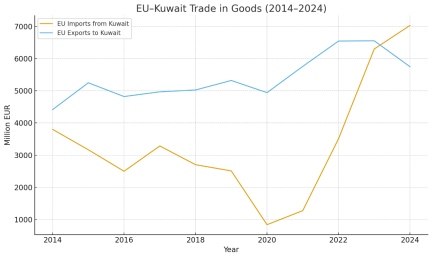
Since Kuwait’s direct exports to Poland remain minimal, broader trends can be observed through its trade with the EU as a whole. According to Eurostat and UN Comtrade, EU-Kuwaiti trade totaled around €11–12 billion in 2023–2024. EU exports reached approximately €7.5–8 billion and consisted mainly of machinery, vehicles, pharmaceuticals, and food products. EU imports amounted to €4–4.5 billion and were dominated by crude oil and petrochemicals.
Source: the European Commission / Eurostat Comext
In the period of 2014–2024, EU exports to Kuwait remained relatively stable, fluctuating between €4.4 billion and €6.6 billion, with a peak in 2022–2023 driven by strong demand for machinery, transport equipment, pharmaceuticals, and food products. EU imports from Kuwait show a more dynamic pattern, heavily influenced by global oil prices. Imports declined significantly between 2014 and 2020, reaching a low of €0.8 billion during the pandemic, before rebounding sharply from 2021 onward. By 2024, EU imports surpassed €7 billion for the first time, narrowing the long-standing trade surplus traditionally held by the EU. Overall, the graph highlights the resilience of EU exports and the oil-driven volatility of Kuwaiti shipments to the European market.
Source: UN COMTRADE Data Bank.
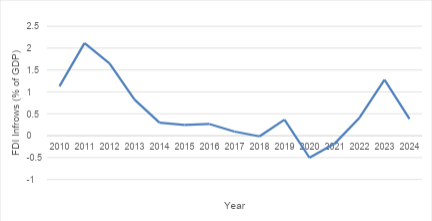
Investment cooperation is limited. Kuwait’s inward FDI remains modest, while its outward investment, managed by the Kuwait Investment Authority, has global reach, though limited presence in Poland. There is potential for attracting Kuwaiti investment to Polish infrastructure, renewable energy, logistics, and real estate markets. Similarly, Polish companies could develop their presence in Kuwait in areas such as engineering, medical technologies, IT services, and environmental solutions. Kuwait’s outward investments, however, are substantial, and opportunities exist to attract part of this capital to the Polish market.
Institutional engagement between the two countries has increased, and trade promotion initiatives have helped raise awareness of business opportunities. However, market entry in Kuwait requires compliance with local standards, halal certification, and reliable partnerships, which continue to pose challenges for new exporters.
Source: World Bank, World Development Indicators.
The structure of bilateral trade underscores Kuwait’s demand for imported consumer and industrial products and Poland’s competitive position in several key sectors. Growth in Polish exports is driven largely by agri-food products, machinery, and pharmaceuticals. The healthcare and construction sectors offer increasing potential, as Kuwait continues to expand hospital infrastructure and launch new development projects.
Digitalization and smart-city initiatives open opportunities for Polish ICT firms specializing in cybersecurity, cloud computing, and digital public services. Sustainability has also become a priority, creating demand for water treatment technologies, waste-to-energy systems, and renewable energy solutions, where Polish companies are increasingly active.
Polish-Kuwaiti trade shows steady growth but remains below its full potential. Poland has established a solid export position, particularly in agri-food goods, machinery, furniture, and pharmaceuticals. Awareness of opportunities is still limited on both sides, and logistical barriers, regulatory requirements, and certification procedures can constrain new exporters. Kuwait’s diversification agenda, however, aligns well with Polish and EU strengths, especially in technology, infrastructure, and healthcare. Investment ties remain weak but could expand if supported by stronger institutional frameworks.
In the short term, Polish exports to Kuwait are expected to continue gradual growth, potentially at a rate of 5–8 percent annually. Expansion will depend on trade promotion, sector-specific diplomacy, and stronger private-sector engagement. In the medium term,
Kuwait’s Vision 2035 projects and renewed EU-GCC dialogue may create opportunities for broader cooperation in renewable energy, transport infrastructure, digital technologies, and healthcare. Risks include slow reform implementation, oil market volatility, and regional tensions. Despite these challenges, Kuwait’s high purchasing power and investment capacity offer favorable prospects for increasing bilateral trade.
Enhancing economic relations between Poland and Kuwait will require a combination of institutional engagement, business support mechanisms, and targeted sectoral initiatives. Although bilateral trade has grown steadily, it remains far below potential, and both sides would benefit from a more strategic, structured approach to economic cooperation. Recommendations include:
- Strengthening institutional frameworks that support trade and investment. Poland could work with Kuwait to modernize existing bilateral agreements or initiate new instruments such as investment protection agreements, double taxation avoidance mechanisms, or memoranda of understanding in priority sectors. Regular economic dialogues, whether led by ministries, trade promotion agencies, or chambers of commerce, would provide a structured platform for identifying obstacles, sharing market intelligence, and matching sectoral needs with business capabilities. Establishing a Poland–Kuwait Business Council or similar platform could further institutionalize cooperation and facilitate regular contact between private-sector actors.
- Promotion and visibility of business opportunities require significant improvement: Polish exporters still face limited brand recognition in Kuwait, while Kuwaiti companies often lack detailed knowledge of Polish capabilities in manufacturing, technology, healthcare, and environmental services. To address this, both sides should increase participation in trade fairs, organize sector-specific trade missions, and promote B2B matchmaking. Poland’s presence at major exhibitions in Kuwait would help expand commercial outreach. Likewise, encouraging Kuwaiti investment delegations and sovereign wealth representatives to visit Poland could support long-term capital flows into Polish infrastructure, real estate, renewable energy, and industrial sectors.
- Launch of sector-specific initiatives: such actions should play a central role in deepening cooperation. Agri-food products remain one of Poland’s strongest export categories, and establishing long-term supply arrangements with Kuwaiti retailers, food-service operators, and state procurement bodies would stabilize market presence. In machinery and industrial equipment, cooperation could expand through joint ventures with Kuwaiti firms participating in infrastructure projects under Vision 2035. Poland’s strong pharmaceutical and medical equipment industries could pursue hospital partnerships, technology transfer
programs, and participation in Kuwait’s healthcare modernization initiatives. In the digital sector, targeted cooperation in cybersecurity, e-government services, and cloud infrastructure would align well with Kuwait’s digital transformation agenda. - Deeper cultural and market awareness: training programs, business seminars, and advisory materials tailored to Polish exporters should address Kuwait’s consumer preferences, regulatory environment, and business culture. Promoting Arabic-language marketing materials and facilitating meetings with key stakeholders would improve market penetration. Strengthening academic, cultural, and tourism links could also contribute indirectly to business confidence and long-term trust-building.
Together, these measures would establish a more dynamic, diversified, and resilient economic relationship between Poland and Kuwait, unlocking the significant but underused potential in bilateral trade and investment.