



Introduction
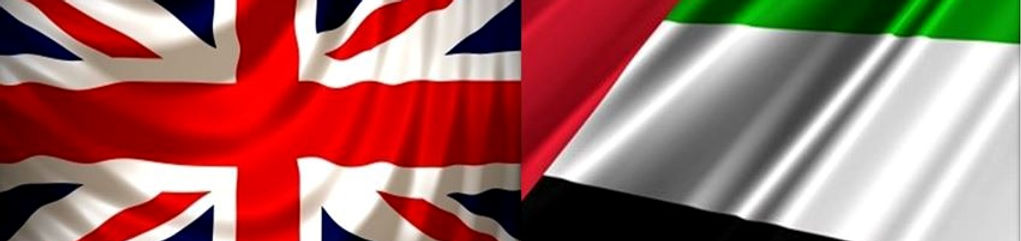
The United Arab Emirates (UAE) is thriving and its economy is enjoying a buoyant surge in activity. The IMF forecast its economy will grow by 4.25% in 2023 after an increase of more than 6% in 2022, spurred on by a rapid rebound in the construction and tourism sectors, along with higher oil prices that contribute so significantly to the UAEs export earnings. Times are clearly good in the UAE and the UK is keen to promote its trade ties with a country with whom it enjoys a long and illustrious history. The UAE is a major inward investor in the UK and leading soccer clubs, notably Manchester City, and other well-known national icons are closely entwined with the Emirates. Indeed, Arsenal football club has forged a brand partnership with the eponymous national flag carrier, Emirates. Over the next decade these close ties are set to become even firmer.
Dubai’s World Expo 2020 event, whose opening was postponed to September 2021 due to COVID-19 restriction, proved to be an eye-catching attraction where exhibitors — including many from the UK — set out their practical approach to realising the three themes of this major trade fair: Opportunity, Mobility and Sustainability, over the course of six months Expo 2020 attracted more than 24 million visitors.
Overview of the UAE
Over the last half century, the UAE has emerged as a major commercial and tourist hub in the Gulf. Its total population is relatively modest at just over ten million yet some 87.9% of the people living in the UAE are classified as immigrants, according to UN data. Hence, the country boasts a very cosmopolitan character with only 11.1% of the total population being Emirati citizens while those originally from South Asia make up almost 59.4% of the population. When disaggregated, this figure includes 38.2% Indian, 9.5% Bangladeshi, and 9.4% Pakistani. For their part, Egyptians make up a further 10.2%, while people from the Philippines account for 6.1% and others 12.8%. Also, the UAE is very urban: 2023 estimates suggest that some 87.8% of residents live in cities. In recent decades, a concerted development strategy has sought to add luxury apartments and villas to attract an expatriate community who support the country’s bustling commercial and tourist sectors.
Historical Perspective
From a historical standpoint, the UAE and UK are in a position to build on strong foundations. Through much of the 19th and20th centuries the UAE — previously known as the Trucial States — cooperated with the UK under a defence treaty which continued up until 1971 when the United Arab Emirates was created (Ra’s al Khaymah joined the other six members of the Federation a year later in 1972). Since the inception of the UAE, the UK has assiduously strengthened both its diplomatic and defence relationship with this thriving commercial hub in the centre of The Gulf.
It is also worth emphasising that the countries’ respective Royal families enjoy close ties, sustained each year by their mutual love of horse racing, particularly in respect of the English ‘flat’ season celebrated at such major events as the Epsom Derby. The Emirati royals have invested heavily in world class racing studs at Newmarket and elsewhere in the UK. Godolphin, owned by Sheikh Mohammed bin Rashid, Vice President and Ruler of Dubai, was established in 1992, and now ranks as the world’s largest thoroughbred horse-racing and breeding operation, based in Dubai, but with satellite operations in four continents and centred in England.[i]
The UAE Today
As noted, the UAE economy is currently enjoying a boom and boasts an open economy with a relatively high per capita income and a substantial annual trade surplus. Indeed, the UAE has one of the highest per capita income levels in the world (estimated at USD 77,272 in 2022 at PPP by the IMF) and a highly developed social welfare system. It also has one of the lowest rates of unemployment in the Middle East, at 3.4% in 2022 according to the World Bank (it is worth emphasising that Dubai enjoys the lowest unemployment level in the world, at around 0.5%).
The 2023 Index of Economic Freedom, published by the Heritage Foundation in Washington DC, rates the UAE highly. Its economic freedom score is 70.9, which ranks as the 24th freest worldwide in this authoritative Index. Furthermore, the UAE is ranked 1st out of 14 countries across the Middle East & North Africa region.
Although the share of GDP generated by the oil and gas sector has declined in recent years (it is currently around 30% of GDP), it remains a substantial source of export earnings.[ii] The UAE ranks as the world’s 8th largest oil producer with significant reserves of both oil and gas.
It is important to highlight the fact that the UAE has pursued a successful diversification policy over the last decade or more. Manufacturing activities, for instance, has gone from strength to strength with unprecedented growth in such sectors as metal processing, furniture, foodstuff preparation and packaging, aluminium production, construction materials, fertilisers, refined petrochemical products, fibreglass, and, of course, commercial and residential property. The industrial sector of the economy — referred to in the economic jargon as the secondary sector — now comprises 47.5% of GDP and employs 34% of the total workforce.
The tertiary sector. i.e. services, contributes 51.6% of GDP and employs 64% of the workforce. Within this sector, the principal sub-sectors are air transport, financial activities and tourism. The travel and tourism sector can be seen as the jewel in the crown as they make a combined GDP contribution of around 12%, mainly driven by the emirate of Dubai. This prosperous sector is poised to expand further as the global economy recovers from the impact of the pandemic. Chinese tourists, in particular, are likely to prove a lucrative source of foreign exchange: Citibank estimates Chinese tourists spent a total of $255 USD billion globally in 2019, the year immediately preceding the Covid clampdown.[iii]
Less significant as a contributor to national GDP is the agricultural or primary sector since agricultural land is only 4.6% of the total land mass of 83,600 sq km—a mere 898 sq km is under irrigation based on figures published in 2020. According to the latest data from the World Bank, agriculture contributes 0.9% of GDP and employs a mere 1% of the workforce. Apart from date cultivation and some coastal fishing, the UAE’s climate and terrain is not conducive to agricultural activities. Consequently, the country imports the vast majority of its food requirements. This is an expanding opportunity for countries such as the UK which has particular strengths in the dairy and processed food sectors.
Increased global uncertainty over the last year in the wake of the Ukrainian crisis and rising interest rates has led to larger financial inflows, which, in turn, have contributed to a rapid rise in real estate prices, particularly the luxury residential property favoured by expatriates.
Future Economic Prospects
Future prospects for the UAE are encouraging. In its latest country report the IMF notes that ongoing structural reforms, driven by the government’s ambitious ‘Project of the 50’ agenda, will promote private sector employment and female labour force participation. This should boost trade and foreign investment, which, in turn, leads to harnessing the benefits of technology, particularly ground breaking digital technology and renewable energy innovations. These structural reforms coupled with a commitment to new technological advances will help deliver sustainable and inclusive growth.
On the fiscal front, the government has opted to introduce a 9% corporate tax for the first time in its history. This measure will be implemented in June 2023. Five years ago, in 2018, the UAE introduced a sales tax of 5% to raise revenue and make the country less dependent on the taxation of hydrocarbons. Significantly, at the beginning of this year (2023), the UAE authorities chose to suspend, for at least a year, a proposed 30% tax on alcohol sales in order to bolster its thriving tourism sector.[iv]
In its latest staff report the IMF concluded that:
Looking ahead, the UAE economic outlook remains positive, supported by domestic activity. We expect non-hydrocarbon growth to be around four percent in 2023 and to accelerate over the medium-term with the implementation of ongoing reforms … Further development of domestic capital markets, including through the issuance of local currency debt by the federal government will also support growth [and] … Reforms under the UAE 2050 Strategy are welcome and should be sustained, with a focus on diversification of the economy, to ensure a balanced energy transition and strong long-term economic growth.[v]
It certainly appears that economic restructuring has underpinned efforts to strengthen the business climate, boost investment, and encourage the emergence of a vibrant private sector. This is proving a very promising chapter in the UAE’s history and is poised to open what promises to be a new era of exciting opportunity.
One such promising step was made in September 2020 when the UAE signed up to the Abraham Accords, a watershed treaty which has normalised diplomatic and commercial relations with the State of Israel. This agreement has already delivered substantial benefits including direct scheduled flights between the two counties (check the link for more information: https://www.egic.info/abraham-accords-generate-real-benefits).
As a result, the UAE has seen a surge in tourism from Israel and the forging of many new commercial initiatives, such as the development of deep water port facilities at Haifa on the Mediterranean coast.
Given all these bullish predictions, it is clear that the UAE is among the most promising export markets for the UK at a time when it is seeing to shape its post-Brexit trade strategy, and with it, a focus on strengthening ties outside the European continent.
The Trade Relationship between the UAE and the UK
In the year leading to 1 October 2022, total trade in goods and services between the UK and the UAE amounted to £18.9 billion ($23.45 billion). This was a substantial increase of 56.7% (£6.8billion = $8.44 billion) on the corresponding period to 1 October 2021. This considerable gain clearly shows the negative impact of Covid-19 in 2020/21 and also reflects the surge in oil prices through 2021/22.
UK total exports to the UAE amounted to £12.3 billion ($15.26 billion) in the year to 1 October 2022, which was an increase of 45.9%, equivalent to £3.9 billion/$4.84 billion) on the corresponding period to 1 October 2021. This export total was split 56.3% in terms of goods, while the remaining 43.7% was attributable to services. Exports of the former climbed by 58.2% or £2.5 billion (US$ 3.1 billion), over the same period to 1 October 2021, while the export of services grew less markedly, but were still nearly a third (32.6%) up on the year before, equivalent to £1.3 billion (US$ 1.61 billion).
In the four quarters to 1 October 2022, the UK’s total imports from the UAE amounted to £4.3 billion ($5.34 billion), which again was a substantial increase of over four fifths (81.9%) on the corresponding period in the year to 1 October 2021. This surge in imports, equivalent to £3 billion ($3.72 billion), reflects spiralling oil prices and the mounting inflationary pressures in the global economy, exacerbated by the conflict in Ukraine sparked in Spring 2022.
The UAE’s exports to the UK were split 65.7% in terms of goods, while the remaining third (34.3%) was attributable to services. The UK nearly doubled (87.3%) the total amount of goods it imported from the UAE over the twelve months to 1 October 2022 compared with the same period the year before. This steep increase in goods exported by the UAE was worth £2 billion ($2.48 billion). Services imported by the UK were also substantially up; in fact, they registered a gain of nearly three quarters (72.5%), equivalent to £952 million or $1181.23 billion compared to the twelve months up to 1 October 2021.
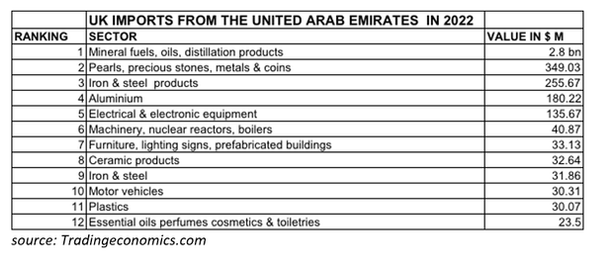
The following two tables provide a detailed breakdown of the top twelve categories of goods exported by both countries in the calendar year 2022. The first table — showing UK imports from the UAE — indicates that oil and mineral fuels were by far the leading category with $2.8 billion imported over the course of the year. It is interesting to note that jewellery and pearls ranked second, with a total of just under $350 million. This figure indicates the flourishing trade in jewellery and precious stones, and underlines the importance of this sector when it comes to evaluating trade relations between the two countries.
On a more mundane level, iron and steel products ranked third in this annual league table with a total import value of $256 million. Aluminium, a core pillar of the UAE’s manufacturing base, was ranked third with an import total of $180 million, followed by electrical equipment ($136 million), followed in sixth position by machinery at $ 41 million. A wide range of other products, spanning motor vehicles, plastics, furniture, essentials oils and ceramics, occupied the second half of the league table. It is also worth noting that further down the league table of UK imports, significant sums were earned by the UAE from such categories as glassware ($10.3 million ranked 17th) and soaps and lubricants ($6.2 million ranked 19th). This broad diversity reflects an impressive depth to the spectrum of manufactured products exported to the UK from the UAE.
Turning to what the UK exported to the UAE in 2022, the table reveals that pearls and jewellery were by far the biggest export earner for the UK with more than $5.5billion sold. This figure is testament to the attractions of London as an international centre for luxury goods with prestigious marques such as Graff, based in Bond Street.
Machinery, in particular mechanical power generators, proved the second most important export earner for the UK while telecoms and sound equipment, included within the electrical and electronic equipment category, ranked as the third highest source of UK export earnings. Motor vehicles won fourth place in the rankings with a strong showing from luxury brands, such as Jaguar, Land Rover and Rolls Royce, which have proved a notable source of export revenues for the UK.
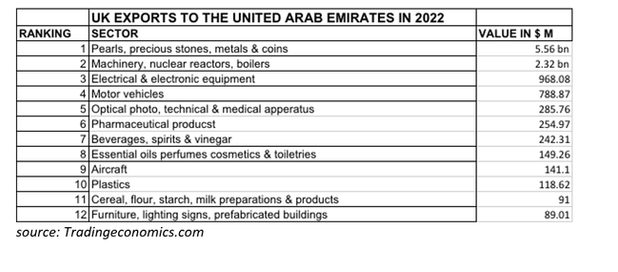
The second part of the UK exports league table is made up of a wide range of categories spanning beverages, essential oils, plastics and aircraft. It is worth remembering that Emirates airline, the world’s largest carrier, operates 269 aircraft and is the world’s largest operator of Airbus A380 aircraft which are partly assembled in the UK.
The table also shows that cereal, flour and dairy products are export generators for the UK. As noted earlier, the UAE has few agricultural resources and it needs to import most of its food including milk products, so this is a capability which UK ministers and farming bodies are keen to promote, particularly in Gulf countries.
It would be rash to ignore the importance of the UAE as a future export market for the UK. In overall terms the UK achieved a total trade surplus of £5.7billion in its buoyant trading relationship with the UAE, a significant increase of almost a fifth on the £4.8 billion trade surplus it earned in the year to 1 October 2021. The UAE now ranks as the UK 20th largest trading partners, accounting for 1.2% of its total trade, and the UAE is the 16th most important export market for the UK worldwide.
Likewise, the UK is an important market for exporters based in the UAE. Official UK statistics indicates that the UK increased its imports of goods from the UAE by 57.5% over the twelve months to 1 January 2023, compared with the same period in the previous year.[vi] In fact, the UAE is the UK’s is the 25th largest import market. These statistics certainly indicate a flourishing trading relationship between the two countries.
Future Opportunities
The UK is currently focusing on specific opportunities in the UAE, prioritising green renewable energy, infrastructure development and the UAE’s rapidly expanding tourism sector. For its part, the UAE through its Sovereign Wealth Fund and central bank, is looking to increase its investments across the UK economy. The Abu Dhabi Investment Fund (ADIA), is one of the world’s largest investment funds (ranked fourth worldwide) with assets estimated at $790 billion (USD) in March 2022.[vii]
Green Renewable Energy
In January 2023, The Clean Energy Memorandum of Understanding (MoU) was signed by the UK and UAE which confirmed their mutual ambition to promote clean energy investment and cooperation. It was signed in anticipation of COP28, which is being hosted by the UAE in Dubai in November and December 2023. The MoU will help facilitate the sharing of technical knowledge and expertise on energy and climate related issues, for example, through cooperation on low carbon hydrogen technology, which has already attracted significant UAE investment in the shape of a 25% stake, agreed in 2022, in the design stage of BP’s blue hydrogen project on Teesside in the North East of England.
Over the next five years, UAE investment in the UK will focus on key sectors such as digital technology, infrastructure, and energy transition, as well as support for an existing programme of investment in life sciences. The sums to be invested are considerable: the UAE has already committed at least £10 billion (US$ 11.31 billion).
The UAE, is also interested in supporting the UK’s efforts to develop new nuclear power stations through its Great British Nuclear vehicle, including the government’s £700mn investment in the Sizewell C nuclear plant in Suffolk. This commitment to invest in renewables chimes in with the recommendation that is a the heart of the most recent review of the UAE economy by the IMF. This stressed the importance of moves to diversity the UAE’s energy generation and supply sector. The IMF team observed that:
“Although the UAE has made significant progress on climate initiatives, prioritisation should be given to low-carbon investments with the greatest economic significance and highest potential to reduce emissions and energy intensity. This will be aided by ongoing major investments in renewable energy sources and work to develop a green taxonomy and mainstream green and sustainable finance.” [viii]
Since the UAE can only draw on relatively limited domestic expertise — simply on account of its population size — this opens up tremendous potential for leading UK based specialist firms and energy suppliers in this field, such as BP.
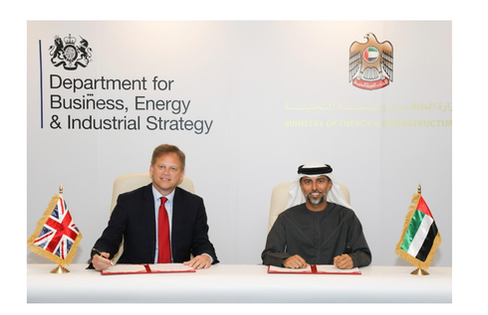
Business and Energy Secretary Grant Shapps MP signs The Clean Energy MoU with his UAE counterpart, H.E. Suhail Mohammed Al Mazrouei, during the Abu Dhabi Sustainability Week in January 2023.
Infrastructure, Architecture, Civil Engineering & Construction
The UK can point to a long history of cooperation with the UAE with respect to innovative architecture, building and infrastructure development. Arup, well known for its work on Dubai airport’s new Terminal 3, along with other major British civil engineering companies, are at the forefront of infrastructure development in the UAE. A remarkable example of a project which illustrates the UK’s prowess in architecture and construction is BEEAH’s new HQ building in Sharjah. BEEAH, which means environment in Arabic, is a fast expanding and award winning environmental management company which aims to invest in the latest waste management and digital technology. This ambition fits well with the UAE government’s strategy to diversify its economy away from core hydrocarbon activities. The BEEAH HQ complex, was opened on 30 March 2022 by H.H. Dr. Sheikh Sultan bin Muhammad Al Qasimi, Ruler of Sharjah. The building is entirely powered by renewable energy utilising solar panels and an innovative waste energy system. Designed by the renowned British Iraqi architect, Dame Zaha Hadid (who sadly died in 2016), founder of Zaha Hadid Architects, this complex is one of the most sophisticated ‘smart offices’ in the world. The project has been completed with the help of a $31 million $35.05 million) loan from UK Export Finance.
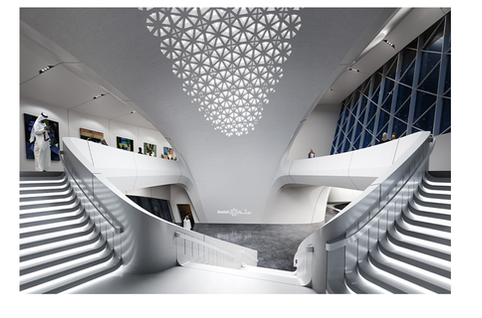
BEEAH HQ in Sharjah, designed by Dame Zaha Hadid
Tourism
Tourism is among the UAE’s most successful sectors and a major employer. Following the lifting of travel restrictions in the first half of 2022, the UAE’s total revenues from tourism exceeded $5 billion as it managed to attract nearly six million visitors who spent a total of 25 million hotel nights in the country. This was 10% higher than the number of nights recorded in the first six months of 2019, immediately prior to the pandemic. Tourism has become a more significant pillar of the economy as the country seeks to Emeratise the hospitality industry, focusing on attractive well paid jobs for younger citizens. As the two main tourist centres, Dubai and Abu Dhabi, seek to develop and enhance their offer to tourists from across the world, most notably from China, British expertise in luxury grade hospitality and marketing will have a great deal to offer. This expertise is also exemplified in the field of Formula One motor racing where British based teams excel.
Free Trade Agreement
The UK is actively negotiating a new free trade agreement (FTA) with the six members of the Gulf Cooperation Council (GCC) of which the UAE is a member. The UAE’s present trade-weighted average tariff rate is 3.5 percent, but non-tariff barriers add to the cost of trade. [ix]
An FTA between the UK and GCC would prove particularly important for small and medium sized enterprises in the UK as they account for 85% of all goods exported to Qatar, Saudi Arabia and the UAE. The UK government estimates that a comprehensive FTA with the GCC could be worth an additional $1.98 billion annually to the UK economy; and, it would prove particularly worthwhile for trade in respect to motor vehicles and machinery. The main goal for the UK would be to offer a range of consultancy and specialist engineering skills in the rapidly developing technologies focused on combatting problems triggered by climate change. As discussed, the UK has shown that it is well positioned to provide value added services in the field of renewable energy, most notably in the wind power sector, where hefty tariffs are currently applied.[x]
Future cooperation between the UAE and the UK promises to open up a wide range of new opportunities and the progress made over the last few years, exemplified by the MoU signed in January this year, bodes well for the future.
Resources
- Source: https://www.thenationalnews.com/sport/2021/10/15/how-uae-investment-transformed-uk-football-and-horseracing/, 15 October 2021.
- Note: In 2022, higher oil prices contributed to an increase in government revenues (almost half of total fiscal revenues are derived from the hydrocarbon sector) and to an improved budget surplus estimated at 9.4% of GDP by Fitch Ratings. The UAE government’s consolidated debt-to-GDP ratio decreased from 34.7% in 2021 to 30.7% of GDP in 2022 (source: Standard Bank).
- Source: ‘There is a lot of pent-up demand’: world awaits return of Chinese tourists, Financial Times, 6 January 2023.
- Source: ‘Dubai pauses alcohol tax in bid to remain Gulf’s party capital’, Financial Times, 3 January 2023.
- IMF Staff Completes 2022 Article IV Mission to United Arab Emirates, November 21, 2022
- Source: Data collected by the UK office for National Statistics and published by the Department for Business & Trade (https://assets.publishing.service.gov.uk/government/uploads/system/uploads/attachment_data/file/1144314/united-arab-emirates-trade-and-investment-factsheet-2023-03-28.pdf)
- Source: SWF Institute, 100 Largest Sovereign Wealth Fund Rankings by Total Assets
- Source: IMF Staff Completes 2022 Article IV Mission to United Arab Emirates, November 21, 2022
- Source: 2023 Index of Economic Freedom, Heritage Foundation, Washington DC, https://indexdotnet.azurewebsites.net/index/country/unitedarabemirates
- ‘UK-GCC Trade Negotiations’, Deloitte, https://www2.deloitte.com/uk/en/pages/tax/articles/uk-gcc-trade-negotiations.html