


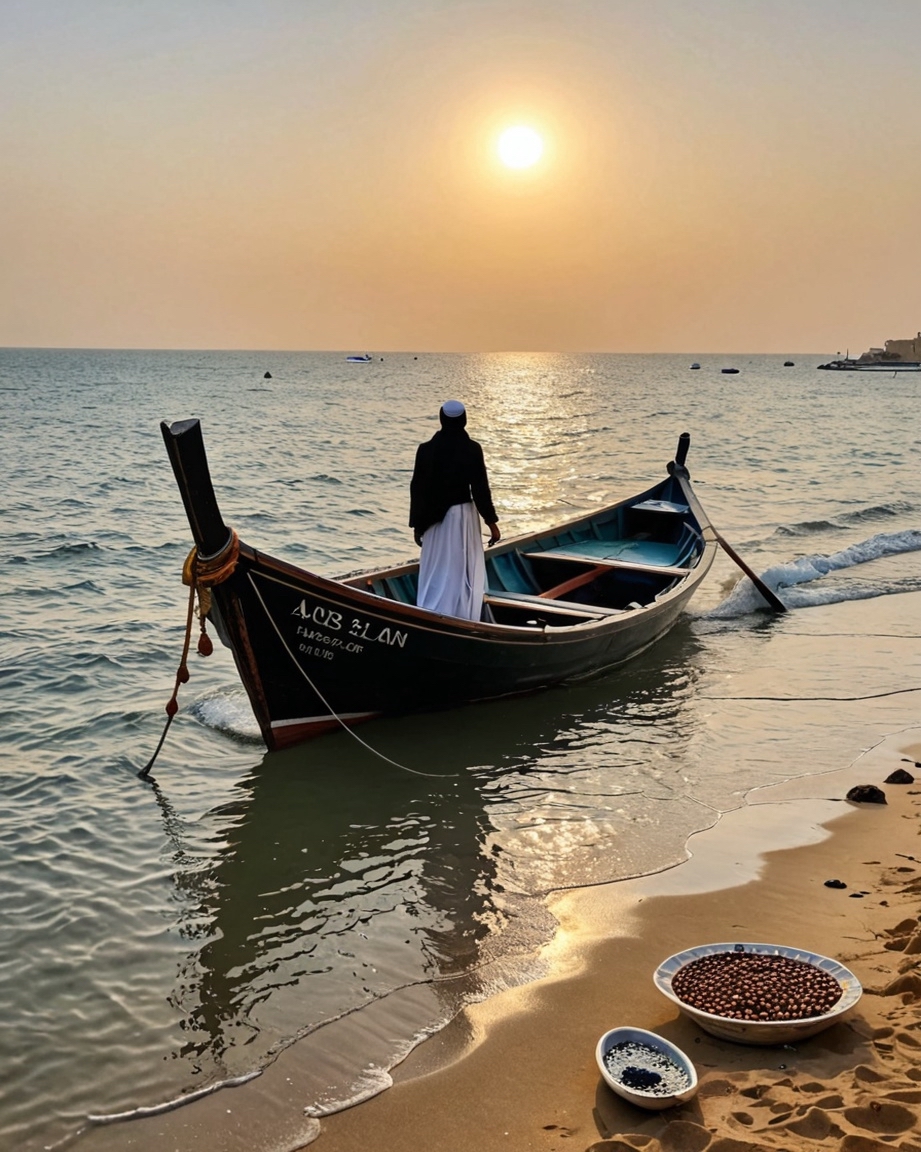


Bahrain is a connoisseur of the pearling industry. Known in antiquity as Dilmun, Bahrain served as a vital trade centre as early as 4,500 years ago.[1] By the early 20th century, pearls were the dominating export of Bahrain, representing up to 90% of total exports. At some points, nearly 50% of the island’s men worked in pearling and ship building because of the high demand for pearls. However, the presence of pearls in the Bahraini economy as a majority export would later change when oil was discovered in the Gulf region in the 1930’s.[2] Nevertheless, Bahrain continues to hold a respectable position in the top 33 exporters of pearls.[3] Still today, Bahrain honours their ancient 5,000 year old history of their moniker as the Island of Pearls through a UNESCO World Heritage Site, which celebrates the history of pearling. Although Bahrain’s pearl industry no longer comprises the majority of their export economy, pearls continue to occupy a prominent role historically, culturally, and economically in the country.
2000 years ago, pearling in the Red Sea, Indian Ocean, and the Gulf area were topics of fascination for early classical writers like Isidorous of Charax who referred to Bahrain—then known as Tylos to the Greeks—as a key pearling location.[4] The Persian Sasanian Empire (224- 651 A.D.) elevated pearling as a cornerstone of maritime commerce with many coastal towns thriving on the trade.[5] In Philip Wood’s Chronicle of Seert, King Khosrau I sent the Nestorian bishop Ezekiel of Seleucia-Ctesiphon to the Gulf with divers in search of pearls to fish.[6] In the Islamic period (7th-15th century A.D.), Bahrain’s pearling industry flourished further.. Ibn Battuta, a renowned explorer and scholar of the 14th century, noted that spring, particularly April and May, was the peak season for oyster diving.
Bahrain’s pearl-rich waters attracted fishermen from across the Arabian Peninsula and Persia, with the Sultan collecting a fifth of the revenues as tax.[7][8]
In the 12th century, another pearling centre was becoming increasingly popular – Julfar, modern day Ras Al-Khaimah in the U.A.E. Julfar’s pearling reputation is worth noting, however it was not substantial enough to challenge Bahrain’s pearling position at the time.. In 1580, a Venetian jeweller and author, Gasparo Balbi, remarked that ‘the best pearls were to be found at Bahrain and Julfar.’[9]Navigator, Ahmed ibn Majid, writing in the 15th century, cited an impressive 1,000 ships being engaged in pearling around Bahrain’s waters, a testament to the industry’s scale.[10]
Approaching the 18th-19th centuries, more concrete data appears regarding the revenues of pearling yields. In 1775, English traveler, Abraham Parsons, stated that the minimum yield was as low as £112,500 and as high as £187,500 during a productive year.[11] By 1829, another figure shows a larger increased estimate of £200,000-£240,000, demonstrating a [nearly] doubling of revenue from the later half of the 18th century and into the first quarter of the 19th century.[12] It is important to note that these figures do not take into consideration inflation.
During the early 20th century, Japan began surpassing Bahrain in the pearling industry due to their specialisation in cultured pearls. In the post-World War I era, the Great Depression began to burrow its way into almost every part of the world. While poor economic conditions and record unemployment levels were felt on a global scale, pearls were not a necessary product that people needed, but rather an unaffordable luxury product that was impractical given many’s financial circumstances. Shortly after the Great Depression, World War II followed, which also led to devastating economic consequences on the shrinking pearling industry. The Gulf states boasted a population of which many Gulf men were overwhelmingly dependent on pearling and related industries. This demographic, when faced with increased prices in many necessary sectors, such as food, had to make important decisions in terms of survival and supporting their families. The maintenance and properly equipping of their workboats were costly, leading to some being unable to pursue pearling, consequently causing a decrease in pearling employees.
By 1946, only around 300 pearling boats were in operation while, in contrast, in previous years there had been well over 3,000.[13] With fewer people actively pursuing pearling, Bahrain’s pearling revenue continued to decrease towards the mid-20th century.
During the 1930’s,Bahrain experienced an economic transformation, shifting from pearls to oil. While it was not unusual for Bahrain to export pearls to India, the above mentioned landscape brought to an unfruitful economy for pearling, which led to 500 Bahraini pearl merchants shifting their businesses to India.[14] The peak years of the Great Depression saw the rapid drop in the value of pearls. In 1929-1930, the value of pearling was £141,178, in 1930-1931 the value dropped to £42,672, steadily picking up in 1932-1933 at £51,904, and showing great promise in 1932-1933 at £577,560 before later dropping in the1940s. Towards the end of the 19th century in 1896, figures estimated that Bahrain’s revenue went from $1,500,000 down to just $200,000 by 1946. The low figures and revenue output by pearling are clear reasoning as to why the pearl market became overtaken by larger powers like Japan and India, where there were more flexible markets compared to a smaller nations, like Bahrain, which could not recover as smoothly.
In today’s economy, Bahrain ranks in the top 33 exporters of pearls and 19th in pearling importing. Bahrain exported $231,000 worth of pearls in 2022 with India importing $76,900, the UAE $54,900, Japan $26,100 and Hong Kong $2,380 worth of Bahraini pearls.[15] To boost these figures and manage oyster beds, The Bahrain Institute for Pearls and Gemstones (DANAT) carried out a research study, which followed the conditions of Bahrain pearling beds, pearl yields, and pattern changes in pearl yields. In 2023, DANAT collaborated with the Rapaport Group, a global entity focused on boosting the sales of natural pearls to wholesalers and other businesses. This is beneficial to Bahrain’s economy, as it stands that they are the only country in the entire world who has banned the sales and cultivation of artificial pearls, instead only exclusively focusing on the production of its world-renowned natural pearls.[16]
Although no longer a top producer of pearls, Bahrain operates diligently to keep their pearling history present through tourism and interactive measures. In 2012, Bahrain’s Pearling Path was announced as a UNESCO World Heritage Site. The Pearling Path, entailing a 3.5 kilometre tour, includes several stops at notable houses, mosques, and buildings with significant ties to Bahrain’s pearling history. The route begins at the Bu Mahir Fort, historically being the port where pearl fishers would depart towards beds of oysters.[17] This pearling path also includes a pearling heritage archive, where one can learn about the importance and longevity of pearling in Bahrain. UNESCO describes this site as
The last remaining complete example of the cultural tradition of pearling and the wealth it generated at a time when the trade dominated the Gulf economy (2nd century to the 1930s, when Japan developed cultured pearls). It also constitutes an outstanding example of traditional utilisation of the sea’s resources and human interaction with the environment, which shaped both the economy and the cultural identity of the island’s society.[18]
In order to blend the preservation of history with modern tourism, Bahrain allows tourists to experience pearl diving, with seasoned guides, who provide all necessary equipment, and who offer visitors the chance to take a pearl home with them.[19] Bahrain’s commitment to preserving its pearling legacy highlights it’s respect for its cultural and identity. Through initiatives like the Pearling Path and interactive experiences such as pearl diving, Bahrain not only safeguards this integral part of its heritage but also transforms it into a dynamic driver of tourism and cultural diplomacy. These efforts ensure that the legacy of Bahrain as the “Island of Pearls” continues to inspire on both a regional and global scale.
Resources
[1] Shaikh Abdullah bin Kalid Al-Khalifa, Michael Rice ed., Bahrain Through the Ages: The History (London and New York: Kegan Paul International, 1993), 355.
[2] Shaikh Abdullah bin Kalid Al-Khalifa, Michael Rice ed., Bahrain Through the Ages: The History (London and New York: Kegan Paul International, 1993), 349.
[3] https://oec.world/en/profile/bilateral-product/pearls/reporter/bhr
[4] Robert Carter, “The History and Prehistory of Pearling in the Persian Gulf”, Journal of the Economic and Social History of the Orient, 2005, Vol. 48, no. 2 (2005): 144.
[5] Robert Carter, “The History and Prehistory of Pearling in the Persian Gulf”, Journal of the Economic and Social History of the Orient, 2005, Vol. 48, no. 2 (2005): 145.
[6] Robert Carter, “The History and Prehistory of Pearling in the Persian Gulf”, Journal of the Economic and Social History of the Orient, 2005, Vol. 48, no. 2 (2005): 145.
[7] Robert Carter, “The History and Prehistory of Pearling in the Persian Gulf”, Journal of the Economic and Social History of the Orient, 2005, Vol. 48, no. 2 (2005): 146.
[8] Robert Carter, “The History and Prehistory of Pearling in the Persian Gulf”, Journal of the Economic and Social History of the Orient, 2005, Vol. 48, no. 2 (2005): 146.
[9] Robert Carter, “The History and Prehistory of Pearling in the Persian Gulf”, Journal of the Economic and Social History of the Orient, 2005, Vol. 48, no. 2 (2005): 146.
[10] Robert Carter, “The History and Prehistory of Pearling in the Persian Gulf”, Journal of the Economic and Social History of the Orient, 2005, Vol. 48, no. 2 (2005): 146.
[11] Robert Carter, “The History and Prehistory of Pearling in the Persian Gulf”, Journal of the Economic and Social History of the Orient, 2005, Vol. 48, no. 2 (2005): 159.
[12] Robert Carter, “The History and Prehistory of Pearling in the Persian Gulf”, Journal of the Economic and Social History of the Orient, 2005, Vol. 48, no. 2 (2005): 159.
[13] Robert Carter, “The History and Prehistory of Pearling in the Persian Gulf”, Journal of the Economic and Social History of the Orient, 2005, Vol. 48, no. 2 (2005): 184.
[14]https://www.forbesindia.com/article/lifes/how-bahrain-is-poised-to-reclaim-its-title-as-the-worlds-pearl-capital/92223/1
[15] https://oec.world/en/profile/bilateral-product/pearls/reporter/bhr
[16] Scarratt, John. Environmental Costs and Benefits Assume Increasingly Prominent Profile for Pearl Producers, CIBJO SPECIAL REPORT 2023 – PEARL COMMISSION, The World Jewellery Confederation (CIBJO), 2023.https://cibjo.org/wp-content/uploads/2023/09/CIBJO-Special-Report-2023-Pearls.pdf
[17] https://luxe.outlookindia.com/travel-gastronomy/travel/shining-bright-french-jewellery-brand-cartier-ties-bahrains-pearling-past-to-its-present
[18] https://whc.unesco.org/en/list/1364/
[19]https://www.forbesindia.com/article/lifes/how-bahrain-is-poised-to-reclaim-its-title-as-the-worlds-pearl-capital/92223/1