

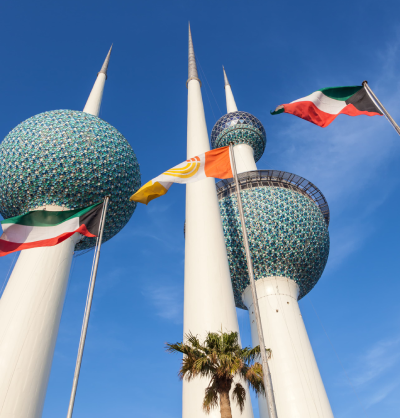

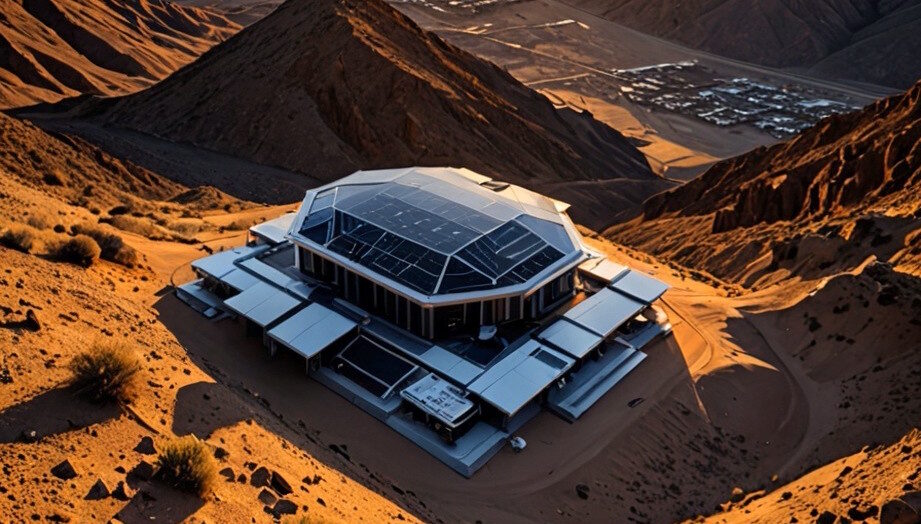


On 6 February, French President Emmanuel Macron welcomed the President of the United Arab Emirates (UAE) Mohamed bin Zayed bin Sultan Al Nahyan to the Élysée Palace for the signing ceremony of an ambitious agreement. Among other provisions, the agreement pledged the development of an artificial intelligence data centre with a capacity of 1 gigawatt, through a substantial investment estimated at between $30 and $50 billion (USD)1. The Franco-Emirati agreement, signed just a few days before the Paris Artificial Intelligence Action Summit, will lead to AI investments in both countries, ranging from the acquisition of cutting-edge chips to the development of data centres, talent development, and the creation of sovereign AI and cloud computing infrastructure.
This significant commitment with France is only the latest development in Abu Dhabi’s ambitious strategy to consolidate and expand its position, which places the UAE among the leading powers in AI on both a regional and global scale. Taking a leadership role in the sector is in line with the wider UAE agenda to diversify investments beyond fossil fuels and focus on transforming the country into a highly attractive and competitive technology and research and development hub.
According to a study conducted by Price, Waterhouse, Cooper (PWC), AI will contribute up to $15.7 trillion (USD) to global GDP by 2030, with the Middle East accounting for 2% of this amount, equivalent to approximately $320 billion (USD)2. These technologies are expected to boost the UAE’s economy by $96 billion (USD), with related projects expected to account for around 14% of its GDP by 2030. In such a scenario, the Gulf country is expected to record the fastest AI growth in the region, followed by Saudi Arabia, and the third fastest globally, right behind China and the US.
A cornerstone of the UAE’s National Strategy for Artificial Intelligence 2031 (2019)3, has innovative features, especially considering that the UAE’s first investments in the sector date back to the early 2010s. A comprehensive review of the main projects in question is certainly useful to understand the scope of one of the most remarkable plans in the sector at a global level, not only for the quality and quantity of the investments involved but also for the governance model adopted. Indeed, in 2017, the UAE became the first country in the world to establish a State Ministry for AI in 2017, headed by Minister Omar Sultan Al Olama.
2017 also saw the establishment of the Mubadala Investment Company, a sovereign fund that currently manages assets in excess of $302 billion (USD)4. The fund invests in both domestic and international companies. Among domestic companies, G42 — a leading AI technology developer and partner of OpenAI and Microsoft — stands out alongside MGX Fund Management Limited, an investment fund established in 2024 with a $100 billion (USD)5 endowment. In September, MGX launched the Global AI Infrastructure Investment Partnership with Oracle, Microsoft, BlackRock and Global Infrastructure Partners6. Then, in January, it joined Oracle, OpenAI and SoftBank in funding Project Stargate, a bold initiative set to invest $500 billion (USD)7 by 2029 to build a next-generation AI infrastructure in the US.
The main foreign companies funded by the UAE include the aforementioned OpenAI and Anthropic9, developer of the Claude AI model family. In turn, some of the major Western players in the sector are investing in UAE companies, such as Microsoft, which announced an investment of over $1.5 billion (USD) in G42 last April10.
Similarly, the National Strategy for Artificial Intelligence 2031 places a fundamental emphasis on research and development, with projects already making the GCC country one of the world’s major hubs in the sector. In fact, the UAE boasts the Mohamed bin Zayed University of Artificial Intelligence. Founded in 2019, it is the first academic institution of its kind in the world. Also worth mentioning is the Abu Dhabi Technology Innovation Institute, a research centre that, among other things, develops the Falcon open-source large language model. Last but not least, the Dubai Centre for Artificial Intelligence has a groundbreaking programme to establish specialised AI teams within each government entity, with the aim of systematically evaluating the use of AI in government structures to improve public services and increase the productivity of public employees by 20%11.
In contrast, the EU lags behind in AI, mainly due to low levels of investments, a continuous brain-drain to the US, GCC (and other destinations) and a complicated regulatory framework that hinders the development of new technologies. The Paris Agreement is a case study in mutually beneficial cooperation between GCC countries and EU members in a sector that will prove to be crucial for economic growth in the coming decades and may jumpstart further projects in the EU.
Sources
1https://www.reuters.com/technology/artificial-intelligence/france-uae-agree-develop-1-gigawatt-ai-data-centre-2025-02-06/
2https://www.pwc.com/m1/en/publications/potential-impact-artificial-intelligence-middle-east.html
3https://ai.gov.ae/wp-content/uploads/2021/07/UAE-National-Strategy-for-Artificial-Intelligence-2031.pdf
4https://www.mubadala.com/en/
5https://www.ai-cio.com/news/abu-dhabi-launches-artificial-intelligence-tech-investment-vehicle-mgx/
6https://news.microsoft.com/2024/09/17/blackrock-global-infrastructure-partners-microsoft-and-mgx-launch-new-ai-partnership-to-invest-in-data-centers-and-supporting-power-infrastructure/
7https://openai.com/index/announcing-the-stargate-project/
8https://www.businessinsider.com/openai-investors-latest-funding-round-2024-10
9https://www.cnbc.com/2024/03/25/ftx-estate-sells-majority-stake-in-startup-anthropic-for-884-million.html
10https://news.microsoft.com/2024/04/15/microsoft-invests-1-5-billion-in-abu-dhabis-g42-to-accelerate-ai-development-and-global-expansion/
11https://www.dubaifuture.ae/dubai-centre-for-artificial-intelligence