


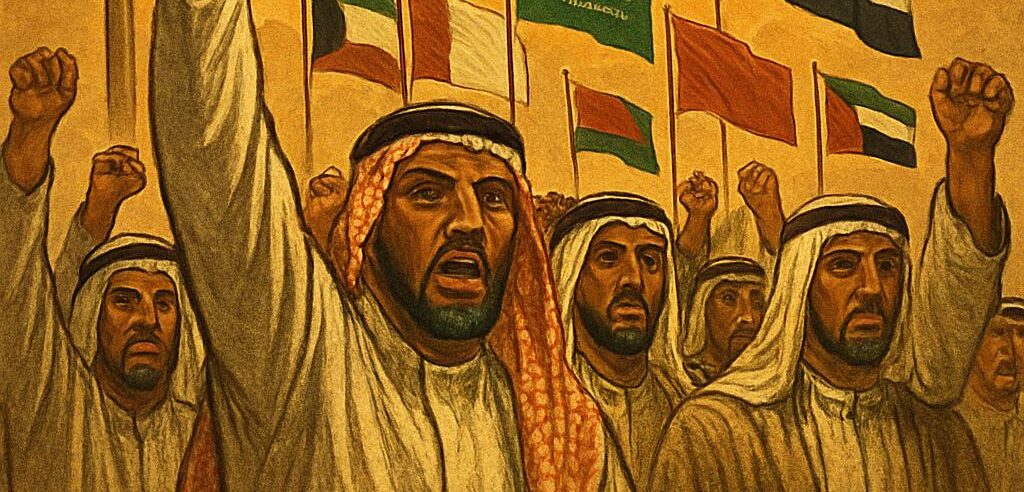


In March 1945, in the aftermath of World War II and the early stirrings of decolonisation, Arab leaders gathered in Cairo with a bold vision–founding the League of Arab States, better known as the Arab League. It was the first intergovernmental organisation in the Arab world. Their dream was straightforward yet ambitious: unity, solidarity, and collective strength. The League was meant to embody a shared destiny, to serve as a guardian of independence, a promoter of cooperation, and a mediator in conflicts.
Nearly eight decades later, that dream remains largely unfulfilled. The Arab League has become more of a stage for diplomatic speeches than a driver of regional action. Its inability to resolve crises, enforce its own decisions, or present a unified front has left many questioning whether it still has a role to play. Yet, the story of the Arab League is not simply one of failure. It is also one of untapped potential, and with the correct reforms, the institution could still become the force its founders envisioned.
At the heart of the League’s troubles is its structure. Decisions are made by a council in which each member state has one vote. For resolutions to pass, unanimity is required. In theory, this ensures that no state is coerced into decisions it does not support. In practice, however, it leads to paralysis. A single objection can block progress, reducing ambitious initiatives to watered-down compromises. The League’s committees and specialised councils suffer from overlapping responsibilities, inconsistent follow-up, and limited authority. Its General Secretariat, based in Cairo, is underfunded and politically constrained, unable to enforce the resolutions it is tasked with coordinating. Institutions that could provide legal oversight, like the Arab Court of Justice, were created on paper but never came to fruition. These weaknesses have been repeatedly exposed by crises in the region. In 2017, when Bahrain, Egypt, Saudi Arabia and the UAE imposed a boycott on Qatar, accusing it of supporting terrorism and interfering in neighbours’ affairs, the Arab League did not step in as a mediator. Instead, the divisions among its members were laid bare: some supported the boycott, others remained neutral, and the League as an institution stood paralysed. The same pattern has played out in Libya, Syria and Yemen, where member states have often supported opposing sides. While the League aspires to function as a unifying forum, it has at times instead come to embody the underlying diversity and fissures within its membership.
In 2011, the Arab League suspended Syria’s membership and imposed sanctions in response to Bashar al-Assad’s violent crackdown on protesters. But the regime, backed by Russia and Iran, simply ignored the measures and the League had no tools to ensure compliance. Without mechanisms to enforce decisions, even its most dramatic moves become symbolic gestures, leaving ordinary people disillusioned with an institution that appears powerless in the face of bloodshed.
Underlying all these issues is the question of sovereignty. Arab states have exercised prudence in maintaining their autonomy, especially concerning issues of security and defence. The idea of a joint Arab military force has been floated multiple times, most recently to respond to threats such as ISIS or instability in Libya. Nevertheless, this goal has remained unfulfilled, largely because member states have chosen to preserve full authority over their armed forces. In practice, national considerations often outweigh collective security concerns, leaving the organization committed to unity in principle but frequently acting on a more individual basis.
If this diagnosis seems bleak, the good news is that there is a way forward. Institutions can change and others have done so successfully. The European Union transformed itself by creating permanent executive bodies, binding laws and majority voting systems. The African
Union restructured its processes to avoid gridlock. The Arab League can also reform if its member states recognise that its survival depends on it.
One key reform would be the establishment of a Permanent Executive Council. Rather than relying on infrequent summits and rotating ministerial meetings, a smaller council made up of rotating members from different sub-regions could meet regularly and act quickly during crises. This would prevent paralysis and ensure follow-through on decisions. Another necessary step would be abandoning the unanimity rule. Replacing it with a qualified majority system, where two-thirds of members must agree for a resolution to pass, would strike a balance between inclusivity and efficiency. Such a system would have allowed the League to act more decisively in moments of division, like the Qatar boycott, where unanimity was impossible, but consensus was within reach. Equally important is the need to make the League’s resolutions legally binding. Voluntary compliance has proven ineffective, as member states pick and choose which commitments to honour. By amending its Charter, the League could give legal force to resolutions on issues of security, peace agreements, and sanctions. This would need to be coupled with a dispute resolution tribunal and automatic penalties for violators. Such measures would deter non-compliance and prevent unilateral actions that undermine collective agreements.
Finally, the Arab League must address its credibility problem in mediation. At times, the institution’s decisions have been guided by the priorities of its more influential members, leading some smaller states to approach it with understandable reservations. An Independent Mediation Council, made up of neutral countries such as Algeria, Kuwait and Oman, alongside respected legal experts, could provide impartial conflict resolution. By working with international organisations like the United Nations and the International Court of Justice, this body would ensure that disputes are resolved fairly and free from political manipulation.
A stronger Arab League could respond swiftly to crises, unite its members on global issues like terrorism and climate change, and create a framework for economic cooperation that would benefit all. It would enhance the region’s credibility on the international stage, making it a more effective partner for global institutions and reducing the influence of external powers that often exploit Arab divisions.
The Arab League stands at a pivotal juncture. It may continue along its current path—constrained by institutional limitations, influenced by global dynamics, and often unable to respond effectively to regional crises—or it can pursue meaningful reform to realise the vision that inspired its founders. The Arab world, home to more than 400 million people, rich in resources, history, and culture, deserves an organization capable of channelling its collective strength.
The principle that “unity is strength” is more than a motto; it is an enduring imperative. The 21st century presents challenges that no single Arab state can face alone. Whether it is regional conflicts, climate shocks, or the demands of a globalised economy, cooperation is not a luxury but a necessity. The Arab League still has the potential to embody that truth. To do so, it must summon the political will to reform, the resolve to promote genuine collective action, and the foresight to project a unified voice on behalf of the region.
The Arab League was born in a moment of great upheaval, and it faces another such moment today. If its leaders have the courage to reimagine the organisation as a force for unity and action rather than just a talking shop, it could once again become the beating heart of Arab cooperation, peace, and progress. The question is no longer whether reform is possible, the question is whether the Arab world can afford to do without it.
Sources
- Council on Foreign Relations. “Arab League.” Last modified March 19, 2019. https://www.cfr.org/backgrounder/arab-league.
- “Arab League.” Refworld. Accessed January 29, 2025. https://www.refworld.org/docid/3ae6b3ab18.html.
- Cairo Institute for Human Rights Studies. League of Arab States: A Manual. Cairo: Cairo Institute for Human Rights Studies, 2015. https://www.cihrs.org/wp-content/uploads/2015/12/league-arab-states-manual-en-20151125.pdf.
- Arab Center Washington DC. “The Arab League’s Many Failures.” Accessed January 29, 2025. https://arabcenterdc.org/resource/the-arab-leagues-many-failures/.
- Friedrich Ebert Stiftung. “The Arab League: Prospects for Reform.” Accessed January 29, 2025. https://library.fes.de/pdf-files/iez/09609.pdf.
- Italian Institute for International Political Studies (ISPI). “The World in 2024: The Great Fragmentation.” 2024. https://www.ispionline.it/en/the-world-in-2024-the-great-fragmentation.
- European Commission, “Military Factors in the MENA region: Challenging Trends,” accessed January 27, 2025 https://ec.europa.eu/research/participants/documents/downloadPublic?documentIds=080166e5b68ef46f&appId=PPGMS.
- European Union. “Council of the European Union.” Accessed January 29, 2025. https://european-union.europa.eu/institutions-law-budget/institutions-and-bodies/search-all-eu-institutions-and-bodies/council-european-union_en.
- African Union. “Rules of Procedure of the Assembly, Executive Council, PRC & Statutes of the Commission.” Accessed January 29, 2025. https://archives.au.int/bitstream/handle/123456789/6448/Rules%20of%20Procedure%20of%20the%20Assembly%2C%20Executive%20Council%2C%20PRC%20%26%20Statutes%20of%20the%20Commission%20_E.Pdf?sequence=1&isAllowed=y.
- International Federation for Human Rights (FIDH). The Arab League: A Guide to the Organization, Its Structure, and Its Work. Accessed January 29, 2025. https://www.fidh.org/IMG/pdf/rapport_lea_uk-lddouble.pdf.