




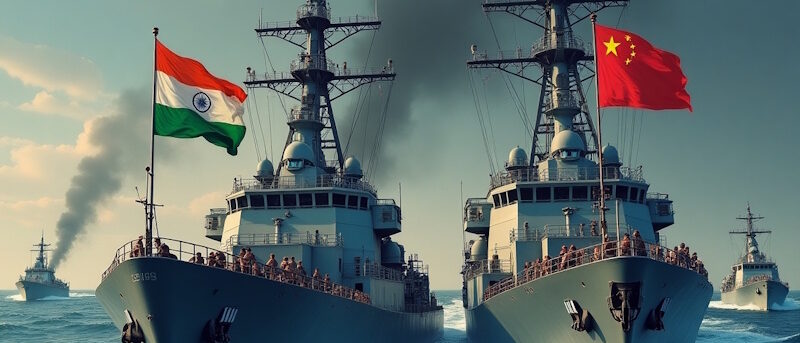


The maritime routes connecting the Arabian Gulf to global markets — notably through the Strait of Hormuz, the Bab El-Mandeb Strait, and the Arabian Sea — remain central to international energy transmission architecture. While the China-India rivalry primarily unfolds in the Himalayas and the broader Indo-Pacific, its maritime dimensions is exerting an increasingly indirect, yet strategic, pressure on Gulf states, which are recalibrating their strategic postures in response to systemic uncertainties, opting for multidimensional hedging, logistical, diplomatic, and economic, rather than conventional military realignment.
The Maritime Theatre
Since the 2017 Doklam Standoff and the 2020 Galwan Valley clashes, China-India tensions have expanded beyond land borders into the maritime domain. China’s “String of Pearls” initiative — a network of port facilities and naval footholds from Gwadar, Pakistan to Djibouti — contrasts with India’s SAGAR (Security and Growth for All in the Region) vision, anchored in strategic partnerships with the US, France and the Gulf state notably the United Arab Emirates, Saudi Arabia, and Oman — through a combination of port access agreements, joint maritime initiatives, and defence dialogues. This rivalry is particularly acute in the western Indian Ocean. China has formalised its military presence in Djibouti, while India has upgraded surveillance and strike capabilities on the Andaman and Nicobar Islands. The US military base on Diego Garcia reinforces the zone’s strategic complexity. Consequently, Gulf maritime security—historically underwritten by US naval power—must now contend with a shifting balance between Asia’s two rising giants.
The Strait of Hormuz, a transit point for 20% of global petroleum liquids, remains a critical chokepoint, as the Bab El-Mandeb Strait, which links the Gulf to the Red Sea and Suez Canal. While a direct naval confrontation between China and India remains unlikely, Gulf governments are increasingly alarmed by the spillover potential of Sino-Indian tensions. China’s maritime presence near Gwadar and Djibouti, India’s rising naval activity in the Arabian Sea, and trilateral naval exercises—such as India-France-UAE drills—have contributed to an increasingly unstable and unpredictable security environment, where intentions are opaque and alignments are fluid. The UAE’s investment in Khalifa Port (with Chinese stakeholders), and India’s deepening logistical partnership with Oman at Duqm, serve as strategic markers of this dual courtship.
Implications for the Gulf States
To mitigate mounting systemic risks, including the indirect fallout of Sino-Indian maritime competition, the proliferation of grey zone tactics such as underwater drone surveillance, GPS jamming, and ransomware attacks targeting logistics infrastructure. Gulf states have substantially increased their defence spending and cyber resilience strategies. This recalibration is evident in large-scale infrastructure upgrades: in 2024, the UAE’s Jebel Ali Port recorded a throughput of 15.5 million TEUs marking its highest volume since 2015. Concurrently, Saudi Arabia’s Jeddah Islamic Port expanded its South Container Terminal capacity from 1.8 million to 4 million TEUs, with plans to reach 5 million TEUs in subsequent phases.
These physical expansions are complemented by digital initiatives. The UAE’s National Cybersecurity Strategy (launched in 2019,) aims to secure digital infrastructure critical to economic and maritime continuity, while Saudi Arabia’s National Cybersecurity Authority (NCA) performs a comparable function, insulating key sectors from disruptive techno-political threats. Together, these initiatives reflect the Gulf states’ strategic pivot toward anticipatory defence measures designed to safeguard supply chains and critical infrastructures in an era of increasingly diffused and non-traditional security challenges.
Shifting to India?
Three structural factors underpin the Gulf’s gradual strategic tilt toward India:
- Geographical Proximity and Logistic Efficiency: Indian ports such as Mumbai or Kochi offer quicker transit times and more stable freight costs compared to Chinese ports. Their geographic proximity to the Middle East, Africa, and Europe, via the Suez Canal, adds further logistical advantage. .
- Balanced Trade Structure: In 2023–24, India-UAE trade reached $83.7 billion, (USD), with India exporting $35.6 billion (USD) and importing $48 billion (USD)—a modest trade deficit. Meanwhile, India’s trade with China yielded a record deficit of $99.2 billion (USD) on $118.4 billion (USD) of total trade. The discrepancy highlights the sustainability and mutual benefit embedded in India-Gulf commercial ties.
- Socioeconomic Linkages: With over 8 million Indian nationals residing in the Gulf, notably in the UAE, Saudi Arabia, and Qatar, India enjoys entrenched people-to-people and labor-market linkages. These expatriates form dense networks in healthcare, construction, and retail. China, in contrast, lacks comparable social and economic integration in the region. This preference is further institutionalised by the Comprehensive Economic Partnership Agreement (CEPA), signed in 2022, which aims to boost non-oil trade to $100 billion (USD) and services trade to $15 billion (USD) within five years.
Gulf security doctrines are increasingly evolving from conventional threat assessments to systemic threat frameworks. While a direct naval clash between China and India remains unlikely, it cannot be fully ruled out. Nevertheless, the Gulf’s more immediate concern lies in the collateral risks stemming from heightened maritime competition. These risks arising from their rivalry: insurance spikes, port sabotage, cyber intrusions, or the weaponisation of supply chains. This reflects the idea that Gulf states were urged to anticipate external techno-political disruptions. Similarly, the maritime domain may face a proliferation of “grey zone” tactics, such as underwater drone surveillance, GPS jamming, or ransomware attacks on port operating systems. These asymmetrical methods blur the boundaries between peace and conflict, challenging traditional security paradigms.
Strategic Flexibility
Though geographically removed from the core theatre of Sino-Indian tensions, the Arabian Gulf is increasingly shaped by the ramifications of their maritime brinkmanship. Rather than aligning strictly along traditional security lines, the Gulf states are crafting a layered strategy that privileges infrastructural diversification, cyber-resilience, and pragmatic hedging across multiple domains. This recalibration reflects a deeper structural shift: the recognition that great power competition is no longer fixed along geographic boundaries or conventional escalation ladders. Maritime security in the Gulf will not hinge solely on traditional alliances, but on the agility to navigate an oceanic space defined by systemic fluidity, multipolar entanglement, and the blurring of war-peace boundaries.
Sources
- https://www.bbc.com/news/world-asia-40478813
- https://www.reuters.com/world/asia-pacific/what-was-india-china-military-clash-2020-about-2024-10-25/
- https://indiasworld.in/sagar-a-decade-of-indias-maritime-vision-and-the-way-ahead/
- https://www.eia.gov/todayinenergy/detail.php?id=63446
- https://www.dpworld.com/news/releases/dp-world-records-highest-cargo-volumes-at-jebel-ali-port-since-2015/
- https://blogs.tradlinx.com/saudi-arabia-port-list-jeddah-islamic-dammam-yanbu-king-abdullah/
- https://www.adportsgroup.com/en/news-and-media/2023/03/18/ad-ports-group-signs-a-30-year-concession-agreement-to-develop-and-operate-safaga-port-in-egypt
- https://u.ae/en/about-the-uae/strategies-initiatives-and-awards/strategies-plans-and-visions/strategies-plans-and-visions-untill-2021/national-cybersecurity-strategy-2019#:~:text=The%20UAE’s%20National%20Cybersecurity%20strategy,and%20empowers%20businesses%20to%20thrive.
- https://www.orfonline.org/research/india-middle-east-europe-economic-corridor-towards-a-new-discourse-in-global-connectivity?utm_source=chatgpt.com
- https://www.indembassyuae.gov.in/bilateral-eco-com-relation.php
- https://www.reuters.com/markets/asia/india-trade-deficit-with-china-widens-record-992-bln-amid-dumping-concerns-2025-04-16/
- https://web.archive.org/web/20231008153753/https://www.mea.gov.in/population-of-overseas-indians.htm
- https://www.india-briefing.com/doing-business-guide/india/trade-relationships/india-uae-bilateral-trade-trends-and-outlook
- https://egic.info/analyse/silicon-tensions-and-what-the-us-taiwan-semiconductor-rift-means-for-the-gulf/