



Abstract: In January 2025, Italy and Saudi Arabia have been key players in several treaties with the aim of cooperating in the areas of energy transition, aligning with the Paris agreements and the goals of the 2030 Agenda. Given this scenario, could these new agreements, building on initiatives such as the South2 Corridor project and the Piano Mattei, mark a turning point in Italy’s path toward becoming Europe’s next energy transition hub?
Keywords: energy transition, green hydrogen, geopolitics of energy, energy cooperation, energy hub
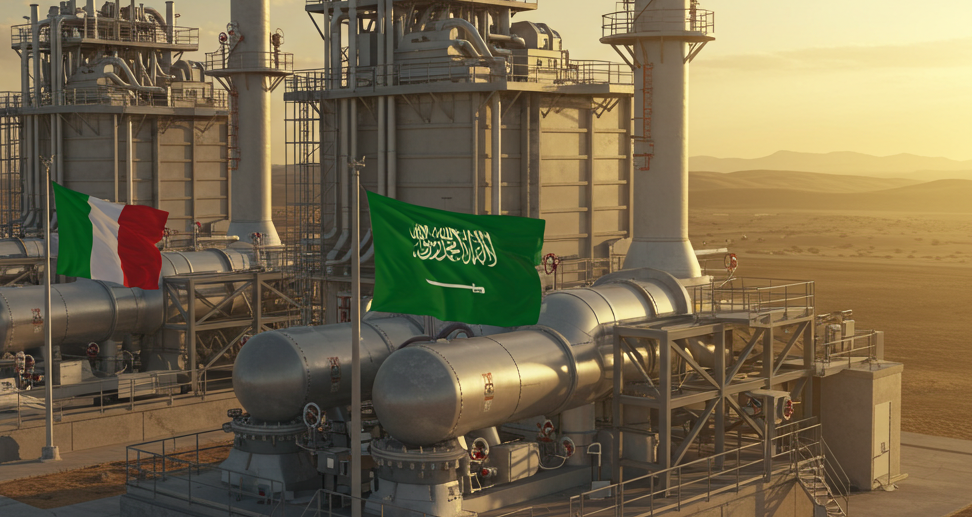
On 14 January 2025, the Italian Minister of Environment and Energy Security Gilberto Pichetto Fratin, and Saudi Arabia’s Minister of Energy, Prince Abdulaziz Bin Salman Al Saud, signed a five-year agreement in Riyadh to strengthen energy cooperation in the areas of green hydrogen, renewable energy, and CO2 capture. Key aspects of the agreement include the production and transportation of green hydrogen and derivatives of renewable and low-carbon nature, such as ammonia.
Building on this momentum, a Memorandum of Understanding (MoU) for a joint venture was signed on 26 January between Saudi listed Acwa Power, specialised in water desalination and green hydrogen, and Snam, an Italian company and European leader in natural gas transportation and storage. The MOU aims to promote cooperation and shared investment in the creation of a global distribution network to ensure a cost-effective and reliable supply of green hydrogen from Saudi Arabia to Europe, as well as the development of an ammonia import terminal in Italy to facilitate the distribution of green hydrogen via the SouthH2 Corridor, a 3,300-kilometre corridor linking Central Europe via Italy, Austria and Germany.
At the heart of these agreements is green hydrogen, a universal, lightweight and highly reactive fuel, generated through electrolysis, a chemical process that separates hydrogen from the oxygen in water, using exclusively renewable electricity. Unlike blue and grey hydrogen, which are produced from fossil fuels, with CO2 capture for the former, green hydrogen is totally emission-free. This aspect makes it a key solution for the decarbonisation of the so called “hard-to-abate” sector like chemicals and petrochemicals, iron and steel, heavy-duty truck, aviation and shipping which together account for nearly 60% of total industrial energy consumption and around 70% of industrial CO2 emissions.
Some ten billion dollars (USD) is now earmarked for the large package of trade agreements penned during the Al-Ula meeting between Italian Prime Minister, Giorgia Meloni, and Saudi Arabia’s Crown Prince Mohammed bin Salman, held on 27 January 2025. The emergent partnership between Rome and Riyadh is part of a broader framework of projects that aim to strengthen Italy in the field of energy transition. These include the SoutH2 Corridor to transport green hydrogen from North Africa to Europe via Italy and the Piano Mattei based on creating sustainable partnerships with African countries in the renewable energy sector. In addition, infrastructures, such as the Elmed, build electricity interconnection between Italy and Tunisia and foster energy integration between the two shores of the Mediterranean.
Beyond economic and trade issues, there are deep geopolitical matters underlying this energy partnership. In supplying the EU’s need for alternative sources to Russian oil and gas, Saudi Arabia plays a key role in promoting stability and security in the Middle East—of which the GCC countries are the lynchpin.
For the Italian Peninsula, this new collaboration not only enhances energy independence, but also attracts Saudi investments, further solidifying its strategic role in the Mediterranean. Thanks to its strategic position and investments, Italy can position itself as both a consumer and as an exporter of technologies and know-how in the energy transition for the rest of Europe. Europe, therefore, benefits from this Rome-Riyad pact, gaining a diversification of supplies, as well as new clean energy routes with the consequent decrease in dependence on Russia.
Italy offers a strategic gateway to the European market for hydrogen and its derivatives. This provides a more cost-effective and more advantageous alternative to other routes, such as the North Sea.
Italy offers a strategic gateway to the European market for hydrogen and its derivatives, thanks to its geographic proximity to the main hydrogen-producing regions and its well-developed and easily adaptable infrastructure for its transportation. Moreover, the Mediterranean offers more advantageous sea routes and the possibility of diversifying sources of supply, reducing the costs associated with production and transport. In contrast, new infrastructure and longer routes are required in the North Sea, with significantly higher costs.
As a result, Italy will not only reap the benefits of this cooperation but also position itself as a crucial bridge between the Global South and the European energy market, making room for itself among the EU giants of the energy transition (such as Sweden, Denmark, Finland), and establishing itself as one of the Continent’s new major players.
Sources
- https://www.repubblica.it/economia/2025/01/14/news/energia_intesa_italia-arabia_saudita_pichetto-423939049/
- https://www.ilsole24ore.com/art/dalla-difesa-all-energia-ecco-accordi-l-arabia-saudita-10-miliardi–AG4RtyYC
- https://www.wired.it/article/accordi-meloni-arabia-saudita-giorgia-meloni-bin-salman/
- https://elmedproject.com/
- https://www.radioradicale.it/scheda/750057/accordo-italia-arabia-saudita-intervista-ad-eleonora-ardemagni
- https://decode39.com/9843/italy-ksa-strategic-partnership/
- https://motaded.com.sa/Saudi-Arabia-and-Italy-Sign-Energy-Cooperation-Agreement
- https://www.linkiesta.it/2025/01/memorandum-energia-italia-arabia-saudita-combustibili-fossil i-rinnovabili/