





Despite his ‘America First’ election campaign and promises to end the so-called ‘endless wars’, President Trump is currently facing protracted conflicts abroad and domestic tensions. The current geopolitical situation therefore raises the question: Is the United States returning to isolationism, and what would this mean for the world?
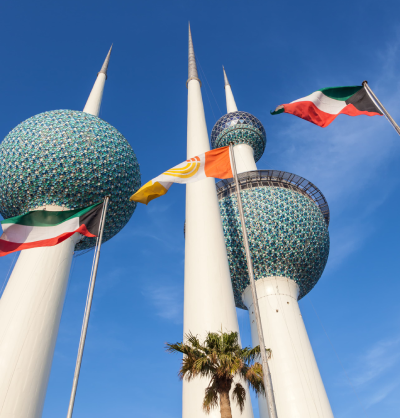
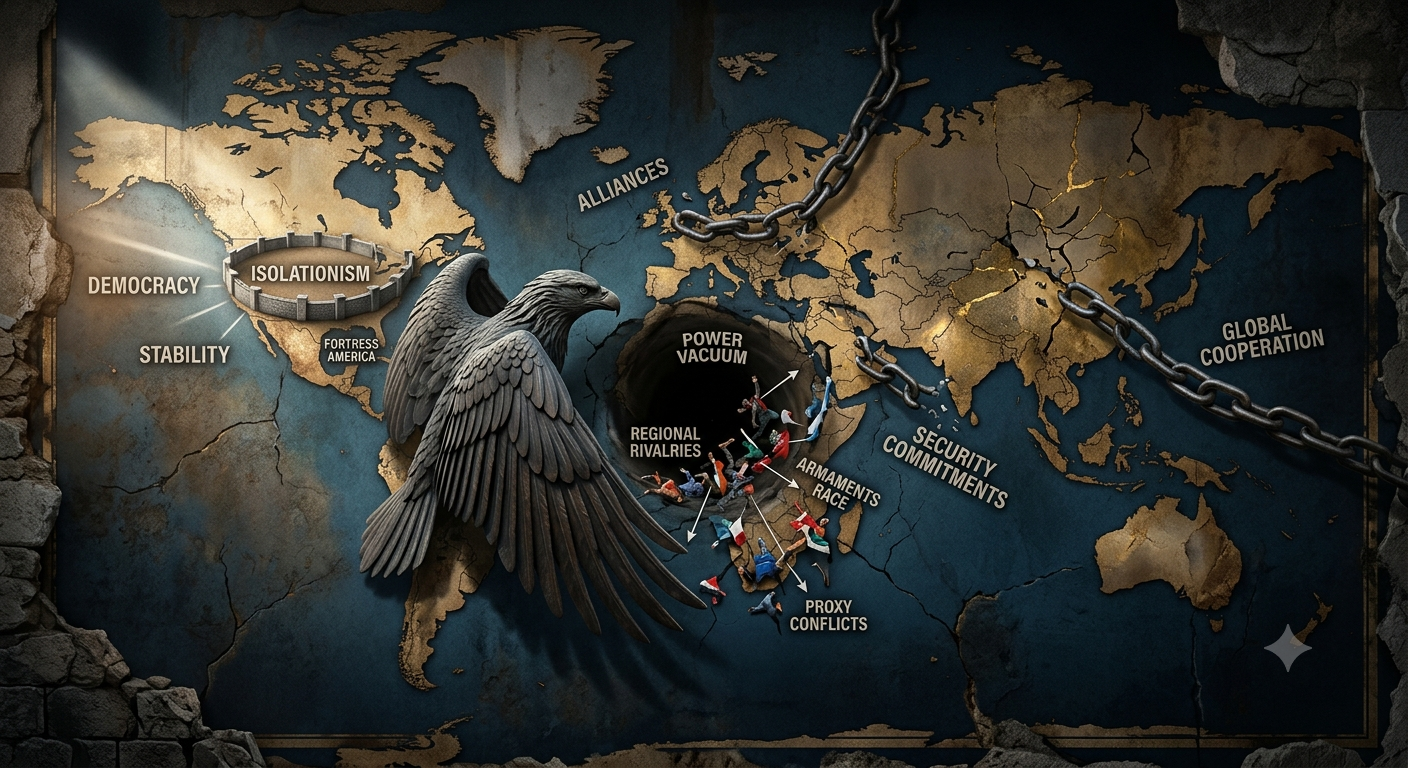
History offers us a warning. After the First World War, the United States withdrew from the international stage, rejecting cooperation and avoiding complex alliances. The consequences of this withdrawal were twofold: it undermined global stability and helped create the conditions that led to the outbreak of the Second World War. The question now is whether history might repeat itself in today’s equally fragile 21st-century landscape. The current war in Iran is a case in point, as is evidenced by the fact that it has already led to a significant escalation in tensions. What began as a US-Israeli attack in early 2026 has escalated into an ongoing and unstable conflict with no end in sight. The Iranian regime has proven to be more resilient than anticipated by the US, heavily targeting the GCC, a key American ally. Furthermore, the war has been prolonged and its costs have increased by recent attacks in Kuwait and Bahrain, as well as the closure of the Strait of Hormuz. This has brought to light a key concern: while Gulf states depend on the US for security, they are increasingly feeling the impact of US military choices. Analysts have observed that the war has destroyed the region’s long-standing strategy of avoiding direct involvement in the conflict between the United States and Iran, thereby drawing all GCC states into a cycle of escalation. Meanwhile, divisions are emerging within the United States itself. There is growing opposition to the war within Congress, which is seeking to limit military involvement, and public support is waning. This prompts a crucial question: what if the US, depleted by continuous strife, were to retreat? If American hegemony were to retreat, the immediate question would be who would fill the resulting power vacuum.
In Europe, the answer is uncertain. While the European Union has economic power, its military and strategic coherence remain limited. Although NATO still exists, it is heavily dependent on US leadership. Without US leadership, Europe would be under pressure to develop its own defence structures or rely on its fragmented national militaries. This could lead to either deeper integration or dangerous disunity. France or Germany could potentially take leadership roles, but neither has the capacity or political consensus to replace the United States globally. The result could be a Europe that is more fragmented and unable to respond effectively to crises on its borders and beyond.
The consequences could be even more immediate in the Middle East. The war in Iran has already demonstrated how swiftly regional instability can escalate. Gulf states, which were once protected by US security guarantees, are now direct targets. The Iranian strikes that have taken place across the region have severely damaged energy infrastructure, leading to a global oil crisis. This disruption has battered a major effect on supply chains, causing economic instability around the world. In the absence of a dominant external power, the region could shift towards a more multipolar balance, with countries such as Saudi Arabia, the UAE and Iran, as well as external actors such as China, competing for influence. While this environment might offer smaller states more flexibility, it also increases the risk.
Whether a post-American world would be more peaceful or more dangerous remains uncertain. On the one hand, reduced US intervention could decrease the frequency of large-scale foreign wars. On the other hand, the absence of a stabilising hegemon could intensify regional rivalries, accelerate arms races, and encourage proxy conflicts. However, recent developments in the Middle East, particularly the escalation of tensions involving Iran and the direct targeting of GCC states, suggest that such a post-American order has not yet emerged. Rather than retreating from its hegemonic role, the United States appears to be recalibrating its strategy. It continues to project power through its military presence, security commitments and strategic alliances while shifting greater responsibility onto regional partners. This indicates that US hegemony is not disappearing but evolving, adapting to new geopolitical realities instead of being fundamentally withdrawn.
What is sure is that the world is already changing. The war in Iran, attacks on GCC countries and mounting domestic fatigue in the US all suggest that we are witnessing a transition in the global system. American hegemony may not disappear overnight, but it is no longer unquestioned. If history has taught us anything, it is that when a dominant power steps back, the world does not stand still; it reshapes itself, often in unpredictable ways.
Sources
- AA, Yenişafak English. 2026. “Trump’s Iran War Accelerates US Decline, Ends American Hegemony, Analysis Argues.” Yenisafak.com. April 14, 2026. https://en.yenisafak.com/world/trumps-iran-war-accelerates-us-decline-ends-american-hegemony-analysis-argues-3717046
- “Blowback: How the Iran War May Change the World | Brookings.” 2026. Brookings. June 8, 2026.https://www.brookings.edu/collection/blowback-how-the-iran-war-may-change-the-world/
- Beane, Ryan, and Samantha Gross. 2026. “From Chokepoint to Crisis: The Strait of Hormuz and Global Oil Markets.” Brookings. June 8, 2026. https://www.brookings.edu/articles/from-chokepoint-to-crisis-the-strait-of-hormuz-and-global-oil-markets/
- “Iran, Kallas: ‘EU Will Play a Role in the Gulf Region after the Conflict.’” 2026. Eunews. May 12, 2026. https://www.eunews.it/en/2026/05/12/iran-kallas-eu-will-play-a-role-in-the-gulf-region-after-the-conflict/.
- Leber, Andrew. 2026. “The Gulf Monarchies Are Caught between Iran’s Desperation and the U.S.’S Recklessness.” Carnegie Endowment for International Peace. March 3, 2026. https://carnegieendowment.org/emissary/2026/03/gulf-states-iran-war-security
- Staff, Al Jazeera. 2026. “Iran Attacks Bahrain, Kuwait, Jordan in Retaliation for US Strikes.” Al Jazeera. June 10, 2026. https://www.aljazeera.com/news/2026/6/10/iran-strikes-bahrain-and-jordan-in-retaliation-for-us-attacks-in-hormuz
- Taylor, Paul. 2026. “Without US Military Support, We Need a European Defence Union. Here’s What That Looks Like.” The Guardian. The Guardian. February 18, 2026. https://www.theguardian.com/commentisfree/2026/feb/18/us-military-support-european-defence-union-ukraine.