


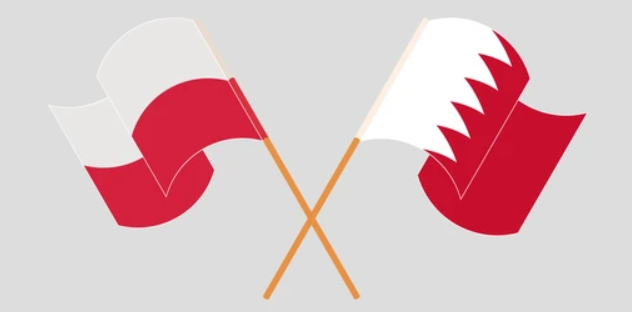


Bahrain — a constitutional monarchy with a population of around 1.5 million —stands out among the Gulf Cooperation Council (GCC) states for its early commitment to economic diversification. Despite being the least oil-rich GCC country, Bahrain maintains a high GDP per capita (USD 28,000–32,000) and serves as a regional financial and logistics hub. Poland’s economic engagement with Bahrain remains limited but growing, offering scope for expansion in sectors like machinery, food, pharmaceuticals, and digital services.
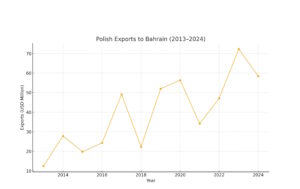
Polish–Bahraini trade remains modest in absolute terms but reflects consistent growth. Polish exports to Bahrain were USD 58.5 million in 2024, while Bahraini exports to Poland stood at USD 67.9 million in 2023. EU-Bahrain trade reached €3.53 billion in 2024 after peaking at €4.34 billion in 2023. Poland accounts for a small share of this trade but has shown increasing interest in developing Gulf market ties. The rise in Polish exports is likely supported by improvements in logistics connectivity, the opening of new distribution channels through Gulf intermediaries, and Bahrain’s stable and transparent regulatory environment. As Bahrain continues to reduce trade barriers and refining import procedures, Polish firms are better positioned to enter niche and high-value segments. This suggests that bilateral trade growth has been driven not only by demand factors but also by institutional and structural facilitators.
Source: UN COMTRADE Data Bank.
The analysis of Polish exports to Bahrain over the period 2013–2024 reveals a clear upward trajectory, with export values growing from approximately USD 12.5 million in 2013 to USD 58.5 million in 2024. This more than fourfold increase highlights the gradual strengthening of bilateral trade relations. Although the growth has not been entirely linear—periods of stagnation or decline occurred around 2015 and again between 2020 and 2022, likely influenced by regional instability and the global COVID-19 pandemic—the overall trend suggests resilient recovery and renewed demand for Polish goods. The steady expansion in Polish exports, particularly in industrial, consumer, and agri-food sectors, indicates growing market access and commercial interest that should be further supported by targeted trade promotion efforts.
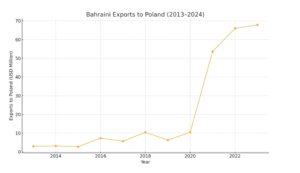
Source: UN COMTRADE Data Bank.
Between 2013 and 2023, Bahrain’s exports to Poland demonstrated a remarkable upward trajectory. Starting from just USD 3.01 million in 2013, exports fluctuated modestly until 2016, after which they began to rise more sharply. The lowest recorded value during this period occurred in 2015, at approximately USD 2.75 million. From 2017 onward, Bahraini exports to Poland gained momentum, culminating in a significant peak in 2023, reaching USD 67.9 million—the highest level in the observed series. This sharp increase suggests enhanced bilateral trade activity, potentially linked to stronger industrial or energy sector exchanges. The data indicate that 2023 marked a watershed moment in trade relations between Bahrain and Poland, pointing to intensified commercial engagement and opportunities for further expansion.
While goods trade dominates the bilateral exchange, services trade remains an under-explored area with promising potential. Poland has emerging strengths in IT services, engineering consulting, and higher education, which align with Bahrain’s demand for knowledge-based services and its drive to become a digital economy leader. Supporting mutual access in services—especially digital, financial, and professional services—could elevate the quality and depth of the economic partnership.
Compared to other major EU trading partners with Bahrain, such as Germany, France, or Italy, Poland’s share remains marginal. However, this also means there is significant room for expansion. While Germany is Bahrain’s top EU partner for high-end industrial goods, Poland could position itself as a cost-competitive supplier of machinery, processed food, and medical equipment.
Bahrain has emerged as a competitive destination for FDI, particularly in finance, ICT, and logistics. In 2023, Bahrain attracted USD 6.84 billion in FDI, reflecting a more than 250% year-on-year increase. Bahrain’s liberal investment framework—characterised by 100% foreign ownership, no restrictions on capital repatriation, and expanding free zones—has supported this surge.
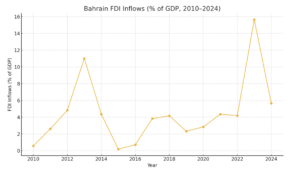
Source: World Bank, World Development Indicators.
Bahrain has emerged as a competitive destination for FDI, particularly in finance, ICT, and logistics. In 2023, Bahrain attracted USD 6.84 billion in FDI, reflecting a more than 250% year-on-year increase. Bahrain’s liberal investment framework—characterised by 100% foreign ownership, no restrictions on capital repatriation, and expanding free zones—has supported this surge. Bahrain’s FDI inflows as a percentage of GDP also reveal a structural shift. After a decade of modest levels (typically under 5% of GDP), inflows spiked to over 15% in 2023, before moderating to around 5.7% in 2024. This trend underscores investor confidence and the success of reforms aimed at diversifying the economy beyond oil. Financial services, logistics, and advanced manufacturing have been key beneficiaries.
Despite these favourable conditions, Polish FDI in Bahrain remains negligible—averaging only €1.7 million annually between 2013 and 2016 and rarely recorded in recent years. There is no evidence of Polish companies holding significant assets or subsidiaries in Bahrain. Any presence is likely confined to limited trade support activities or indirect representation. This reflects both missed opportunities and a lack of structured bilateral engagement.
Likewise, Bahraini investment in Poland has been minimal, rarely exceeding €1–2 million in any given year and showing no sustained pattern. There are no prominent Bahraini-owned entities operating in Poland’s strategic sectors. Capital flows have likely been limited to financial assets or experimental investments, and in some cases, even reflect disinvestment.
Poland’s current engagement with Bahrain is economically sound but under-leveraged. Trade is growing, but remains modest; investment flows are negligible. Bahrain’s economic dynamism, diversification strategy, and liberal business climate present a timely opportunity for Polish firms, especially as Poland looks to expand its commercial footprint outside the EU.
Barriers to deeper cooperation include limited market knowledge on both sides, the absence of a bilateral investment treaty, lack of direct air links, and the geographic and cultural distance between the two countries. Polish businesses may also be unfamiliar with the regulatory and legal frameworks in Bahrain, despite their simplicity and openness. Overcoming these challenges will require coordinated institutional support, better communication of commercial opportunities, and policy-driven engagement.
While Bahrain has a liberal and investor-friendly FDI environment, the lack of targeted bilateral initiatives likely contributes to underdeveloped capital engagement. Strengthening trade facilitation, business linkages, and investment incentives will be key to unlocking the full potential of the relationship.
Against this backdrop, please note some key strategic recommendations:
- Launch targeted trade promotion campaigns by establishing a structured export promotion strategy for Bahraini markets, focusing on sectors where Poland has a competitive advantage—particularly machinery, food processing, pharmaceuticals, and furniture. Cooperation with Bahrain’s Economic Development Board (EDB) and the Polish Investment and Trade Agency (PAIH) should lead to the organisation of business missions, B2B forums, and sector-specific exhibitions. To enhance outreach, promotional materials and market studies should be translated into Arabic to reduce informational and linguistic barriers.
- Expand bilateral investment facilitation by working toward the negotiation or activation of a Bilateral Investment Treaty (BIT), which would provide legal guarantees and strengthen investor confidence. In parallel, both countries should explore the establishment of a double taxation agreement and expand the use of financial risk guarantees through Poland’s export credit agency, KUKE. Polish companies, particularly those in export-oriented manufacturing and services, should be encouraged and supported to set up regional operations in Bahrain’s free zones, which allow 100% foreign ownership and easy capital repatriation.
- Develop institutional partnerships through the creation of a Polish–Bahraini Economic Cooperation Council, bringing together representatives from government ministries, business chambers, and sectoral organisations. This platform could promote bilateral dialogue, address regulatory challenges, and identify growth sectors. In addition, partnerships between Polish and Bahraini universities and innovation agencies—such as Bahrain Polytechnic and Poland’s National Centre for Research and Development—should be fostered, especially in emerging sectors like clean energy, digital technologies, and smart industry.
- Support SME internationalisation by designing a program—such as “SME Gateway to the GCC”—tailored specifically for small and medium-sized Polish enterprises interested in entering the Bahraini market. The program should offer practical support, including market advisory services, co-financing options, and soft-landing assistance. Bahraini sectors targeted under Vision 2030, such as ICT, logistics, and renewable energy, should be prioritised for Polish SME entry. E-commerce and digital distribution channels should also be promoted to help Polish producers connect with Bahraini partners and end-users.
- Strengthen financial and logistical ties by encouraging Polish financial institutions to establish correspondent banking relations or explore fintech collaboration with Bahraini counterparts. Opportunities in Bahrain’s well-developed financial sector, particularly in Islamic banking and digital finance, could serve as entry points for Polish expertise. Joint ventures in logistics, warehousing, or distribution should also be explored, taking advantage of Bahrain’s strategic location and its infrastructure as a regional logistics hub serving the wider Gulf region.
- Improve data and market intelligence by instituting regular monitoring of bilateral trade and investment flows and publishing concise, accessible reports. These should include sectoral opportunity mappings, trade trend updates, and investment case studies to inform business and policy stakeholders in both countries. Greater transparency and data-sharing will support informed decision-making and help identify gaps or untapped niches in the economic relationship.
Integrate Bahrain into Poland’s broader Gulf strategy by ensuring that Bahrain is not viewed in isolation but rather as a gateway to the GCC. Bahrain’s economic liberalism, coupled with its logistical connectivity to Saudi Arabia and the UAE, makes it a strategic location for Polish exporters and investors. Bahraini engagement should be systematically incorporated into Poland’s regional trade diplomacy, export promotion policies, and intergovernmental dialogues with other Gulf countries.