




Sixteenth century Portuguese chronicler and civil servant João de Barros, in his book Da Ásia, Década Segunda, describes the Island of Hormuz as a jewel in the midst of a region bustling with trade, cultural exchanges and a highly developed administrative set up noting that ‘a cidade é tam viçosa e abastada, que dizem os moradores della que o mundo é hum anel e Ormuz hua pedra preciosa engastada nelle …’
Though Barros never set foot in Hormuz, he worked in Lisbon’s Strategic Center of Maritime Enterprises in the 16th century, which was connected to the House of India (centro estratégico das empresas ultramarinas da Casa da India) and among other responsibilities was in charge of first hand letters, legal documents and interviews of numerous Portuguese explorers who returned from their exploration feats in Asia, bringing with them often very precise and lively accounts of the peoples and places they saw.
Another account, from the Livro das Cidades e Fortalezas, published by an unknown Portuguese civil servant around the 1580s and edited by Francisco Paulo Mendes da Luz in 1960, describes Hormuz as ‘a mais importante Fortaleza que os reis de Portugal tem nas partes das Índias.’
The presence of the Portuguese in the region was registered not only in historic documents like these, but also in poetic form. Portugal’s most famous one being Luís Vaz de Camões´ “The Lusiad” (1572) where the writer, who spent several years in Asia himself, wrote an epic poem about the journey of Portuguese explorer Vasco da Gama, the first to navigate across the Cape of Good Hope and arrive in India during the dawn of Portuguese maritime exploration. In Book X (102/156), Camões describes the entrance of the Gulf as:
‘Olha o Cabo Asaboro, que chamado
Agora é Moçandão, dos navegantes;
Por aqui entra o lago que é fechado
De Arábia e Pérsias terras abundantes.
Atenta a ilha Barém, que o fundo ornado
Tem das suas perlas ricas, e imitantes
À cor da Aurora; e vê na água salgada
Ter o Tígris e Eufrates ũa entrada.’
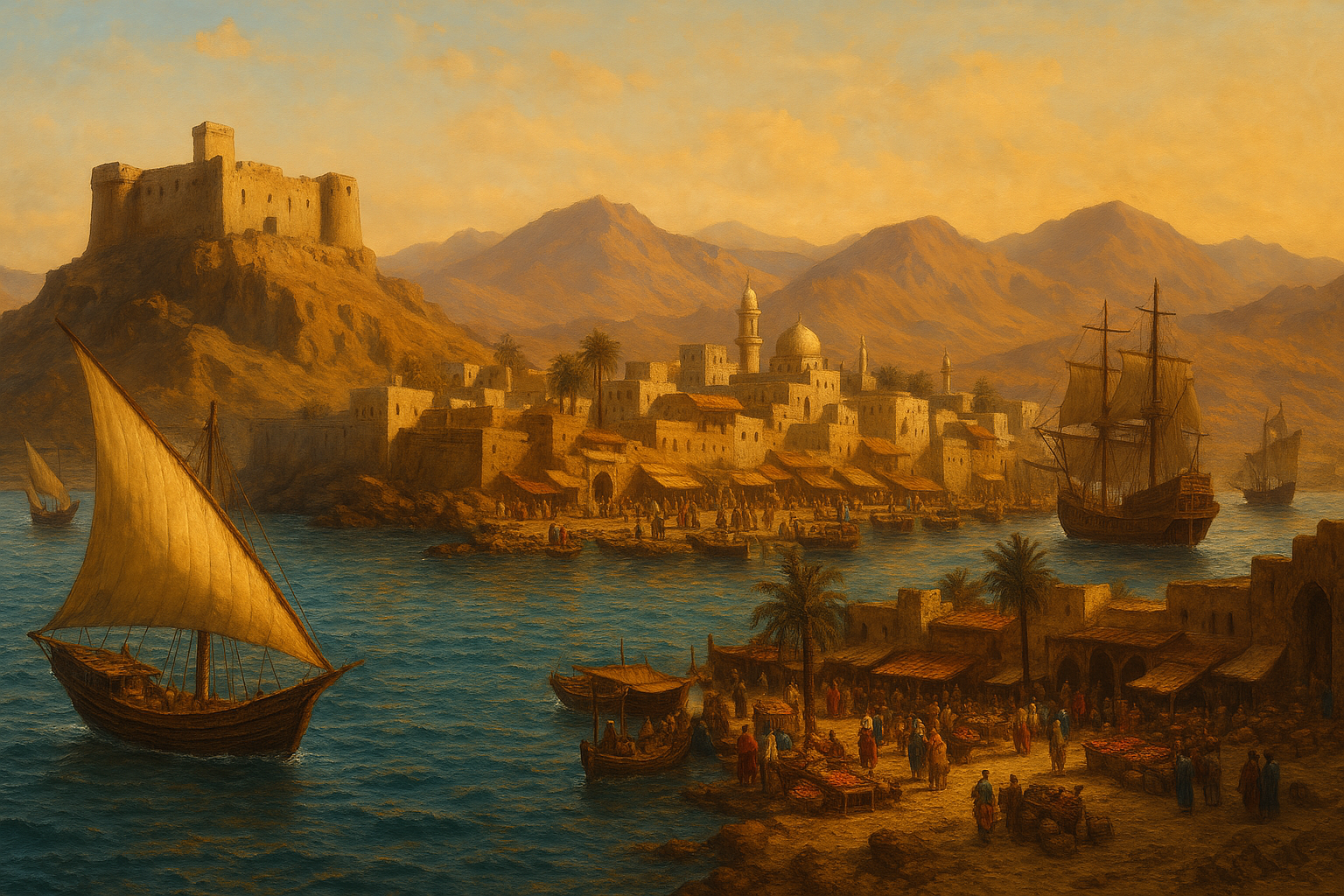
The first Portuguese explorer to conquer the Island of Hormuz, located in the Strait that carries the same name, was the notorious Afonso de Albuquerque, in 1507. Soon enough most coastal towns in Oman, which had been under some degree of administrative control of Hormuz, would fall under the rule of the Portuguese, Muscat being subdued in 1515. They would remain under Portuguese rule until they were permanently expelled in 1650 by the efforts of Nasir bin Murshid and Sultan bin Saif, members of the rising Yarubid dynasty.
Soon Hormuz lost strategic importance to Muscat as the Portuguese eventually were expelled from the island in 1622. Muscat became the administrative centre of the Portuguese in the Arabian Peninsula, thanks to its strategic importance at the entrance of the Gulf of Oman and the fact that it harbours a port of deep waters, where large ships could moor during the winter months. Ships were heavily dependent on the winds defined by the monsoon season and the winds were the lightest in the period that ran from December to March. The dependence on the monsoon also isolated the Portuguese in Oman from the capital of Portugal’s Estado da Índia, in Goa, during this time of the year, giving them a higher level of administrative freedom. Muscat held vibrant markets, negotiating in spices, dates, pearls, coffee, cattle, horses and other goods. It also was connected to major caravan routes. Lastly, the fact that it had access to abundant drinking water made it into one of the most important outposts for the Portuguese in the first half of the 17th century.
Even now, one can find news of recent discoveries of Portuguese shipwrecks in those surrounding waters, while architecturally the presence of Portuguese forts still tower over strategic spots along the coast of Oman. Yet, however fascinating these discoveries and visible reminders of the past may be to the modern mind, it is important to recall that the Portuguese occupation was recorded by the Omanis as being brutal. It consequently led to the internal mobilisation and unification of diverse tribes that were once at odds with each other, united towards the common goal of liberating Oman.
One name that has echoed in history in Oman’s struggle for liberation is that of imam Nasir bin Murshid (imam from 1624-1649). At the time, Oman’s leaders were elected imams, chosen by religious elites to rule as both political and spiritual leaders. In the midst of colonial chaos, Nasir bin Murshid rose to power, fighting the Portuguese for 25 years and passing away one year before liberation. Nasir’s cousin, Sultan bin Saif, carried out the final battle in Muscat in 1650. In the following years, Sultan gathered a powerful fleet and expanded Omani influence to East Africa, taking over Mombasa, the islands of Pemba and Zanzibar from the Portuguese as well. By the end of 17th century, Oman had become the uncontested naval power of the Indian Ocean and remained so until the first half of the 19th century.
Sources
- Couto, Dejanirah. “Muscat and the Portuguese: economic and political dynamics in the early 16th century (1507-1529)”. International Journal of Archaeology and Social Sciences in the Arabian Peninsula, n 15, 2022.
- “Livro das Cidades e Fortalezas”. F. P. da Luz (Ed.). Centro de Estudos Históricos Ultramarinos de Lisboa, 1960.
- Loureiro, Manuel. “Revisitando as Décadas da Ásia: algumas observações sobre o projeto historiográfico de João de Barros”. E-Spania Revue Interdisciplinaire d´Études Hispaniques Mediévales ed Modernes, no 30, 2018.
- Nicolini, Beatrice. “Oman´s Maritime Activities throughout the Indian Ocean: 1650-1856”. In A. Al Salimi & E. Staples (Eds), A Maritime History (pp. 141-159). Georg Olms Verlag, 2016.