







Introduction
The countries of the Gulf Cooperation Council (GCC; Bahrain, Kuwait, Oman, Qatar, Saudi Arabia and the United Arab Emirates) are enjoying a boom, fuelled by an increased demand for oil and gas, particularly LNG. This global demand has soared following Russia’s invasion of Ukraine and the resulting global uncertainty. Strong export receipts have enabled the GCC countries, notably the Emirates, Qatar, and Saudi Arabia, to invest in infrastructure development and new technologies, including energy renewables and initiatives aimed to solve issues associated with climate change. Furthermore, healthcare, tourism, education, information and communications technology (ICT), food products, and especially services, are also major winners in this resurgent economic boom across the Middle East. In contrast, the Swedish economy is currently struggling. A recent economic forecast, published by the European Commission, ranks Sweden at the bottom of the economic growth league. Indeed, the Commission’s economists reckon that Sweden will face negative growth of 0.8% this year, as Swedes address higher energy prices, spiralling interest rates, and plummeting property prices.[i] Sweden has long been associated with high personal and corporate taxes,[ii] however, these daunting rates of tax hamper economic growth and productivity. Talented Scandinavian millionaires tend to relocate to less penal fiscal jurisdictions. For this reason, Stockholm wanes, but Switzerland surges ahead.[iii] Sweden continues to be dependent on an influx of immigrants to meet the demand for labour. This, in turn, has led to worrying social problems in the last few years.[iv] These factors have damaged consumption and business confidence. Consequently, economic growth is not expected to recover until 2024. Some suffering will have to be endured before Swedes begin to enjoy happier prospects.
Sweden has a new centre-right coalition government since the autumn 2022 elections. The Swedish government must manage a challenging agenda, including the country’s response to the Ukrainian conflict and its knock-on impact on energy prices and supply. Russia’s aggression over the past year prompted Sweden to seek NATO membership, although final admission arrangements still require a resolution of objections raised by Turkey, which is already a member. It is also worth noting that Sweden is currently the President of the Council of the EU, so it has the opportunity to play an influential role in consolidating political, economic and cultural relations between the EU and the GCC countries.
Sweden’s Economic Prospects and Its Trade Opportunities with the Gulf
Although Sweden faces some short-term economic challenges, it is nevertheless accurate to suggest that, in terms of its fundamental strengths, it boasts one of the best performing economies in Europe. According to the latest 2023 Index of Economic Freedom, Sweden ranked as the seventh economically freest among 44 countries in the European region; while on a global basis, the Index ranks it as one of the best performing economies — indeed, it ranks 10th in its overall league table for economic freedom and open markets.[v] As the Index notes, ‘The Swedish economy performs well in regulatory efficiency, and open-market policies sustain flexibility, competitiveness, and large trade and investment flows.’[vi] Clearly, there is considerable potential to secure a greater trade exchange between Sweden and the GCC countries over the next few years. Currently, only some 4% of Swedish exports go to the Middle East and Africa. Yet these two regions offer great potential for their rapidly expanding populations and, in the case of Saudi Arabia, for a meteoric increase in GDP. Trade statistics reveal that Saudi Arabia is by far the largest trading partner for Sweden in the Middle East. Over the last five years, it is estimated that the total volume of trade between the two countries amounted to more than $6 billion (USD).[vii]
Sweden-Saudi Arabia Trade
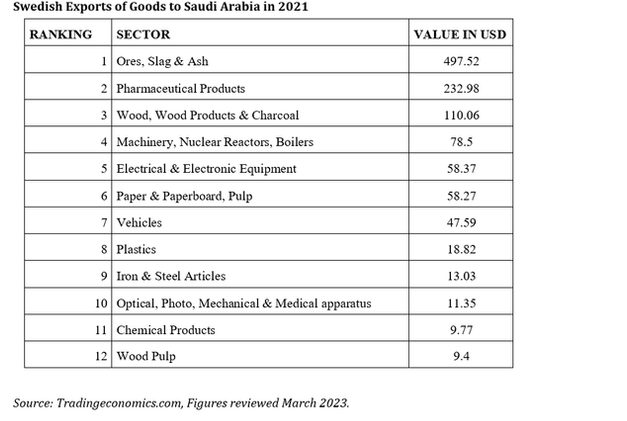
The following two tables detail trade statistics for goods — but not services — in 2021 between Sweden and Saudi Arabia. These figures, updated in March 2023, show that trade in goods is heavily slanted in favour of Swedish exports to Saudi Arabia (KSA). In 2021, the ten most popular categories of goods exported by Sweden to Saudi Arabia exceeded $1.1 billion (USD), and with oil prices booming, there is clearly scope for much larger trade. Iron ore, timber, and hydropower are the three main categories that constitute the resource base of Sweden’s export-orientated, manufacturing-based economy, and the first two are among the top three most popular exports to Saudi Arabia.
All the top ten Swedish export categories hovered around the millions, with minerals (notably iron ore) totalling almost half a billion dollars (USD). Pharmaceutical products, a strength for Sweden, ranked second with $233 million (USD), while timber and wood products came third with a total of just over $110 million (USD). Machinery for boilers and nuclear power stations ranked fourth with just under $80 million (USD). Electrical equipment is also important and ranked fifth in the league table with a total of $58.37 million (USD). Paper products ranked sixth with a similar total of just over $58 million (USD), while vehicles (re: Volvos) took seventh position in the rankings with export sales of $47.5 million (USD). Indeed, Volvo sold 698,693 vehicles in 2021, an increase of 5.6 % on the previous year. Fully electric or plug-in hybrids grew by a remarkable 64%, while recharge cars accounted for 27 % of the company’s overall sales in 2021.[viii]
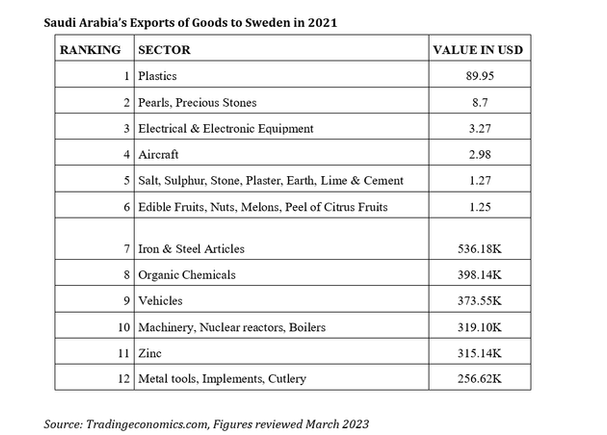
Regarding Swedish imports from Saudi Arabia, trade statistics for 2021 reveal that the twelve most popular product categories are dominated by one commodity: plastics. This has proved to be a highly successful export for Saudi Arabia, with sales of nearly $90 million (USD) recorded last year. The table shown above omits oil and gas because Sweden imports both these commodities from Norway and other OPEC member countries, notably Nigeria and Angola. In 2022, for instance, Sweden imported a total of $1.5 billion (USD) in oil and other hydrocarbon products from Nigeria.[iv] Far behind in this ranking are pearls and precious stones, with a total of almost $9 million (USD) in terms of revenues generated. In third position, we find electrical and electronic equipment, at just over $3 million (USD), and in fourth place aircraft, with a total of nearly $3 million (USD). There are also a number of product categories that generate some revenues, but not much. Fruits and nuts, for example, yield about $1.3 million (USD). While a range of building materials, such as plaster and cement, follow with a little less than $.3 million (USD).
The trade figures leave out trade in services, where Sweden boasts major strengths, such as in financial services. Sweden has built up a successful banking and finance sector with names such as Handelsbank, boasting a particularly strong profile. Sweden also has buoyant civil engineering and computer/IT sectors that have a lot to offer the GCC countries.
Significantly, Saudi Arabia’s vibrant services sector is often overlooked. The services sector represents 36% of Saudi Arabia’s wealth with the wholesale and retail trade sectors — together with restaurants and hotels — contributing some 8%, and finance, insurance and real estate a further 7.9 % [x].
Sweden-UAE Trade
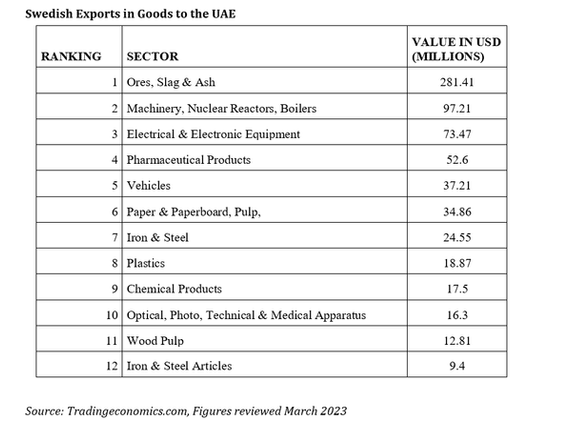
Similar to Saudi Arabia, Sweden’s exports to the UAE are dominated by the sale of iron ore, which totals over $280 million (USD). In second place is machinery of various types, which generated just under $100 million (USD) in revenues for Sweden. Electronic equipment follows in third place with sales of over $70 million (USD). Fourth ranking goes to pharmaceutical products, which generated over $50 million (USD). Motor vehicles — essentially Volvos — contributed a further $37 million (USD). These top twelve exports together totalled $667 million (USD) in 2021.
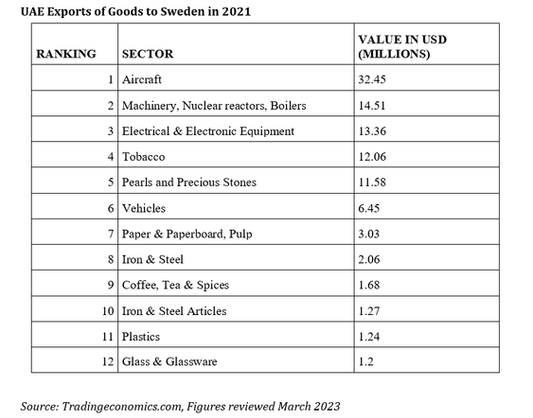
Turning to UAE exports of goods to Sweden, the total amounted to just over $100 million (USD). Almost a third of this sum was accounted for by aircraft—presumably the sale of planes from Emirates airline, the world’s largest carrier, which operates 269 aircraft and is the world’s largest operator of Airbus A380 and Boeing 777 aircraft.
Machinery ranks second with $14.5 million (USD) of equipment sold, while electronic equipment contributed another $13 million (USD). Interestingly, Swedes bought $12 million (USD) in tobacco from the UAE (the UAE is home to a number of major cigarette factories, such as the facility operated by Phillip Morris[xi]), while pearls and precious stones generated a further $11.6 million (USD). Again, these tables omit services. Yet Sweden earns more from banking, management consultancy and other services than it does from the export of goods. For its part the UAE has built up niche strengths, not least in a very popular tourist industry— Scandinavians tend to travel to warmer climes during the winter months, and it also boasts a highly successful national flag carrier: Emirates.
Sweden-Rest of GCC Trade
Regarding trade with other GCC countries, Sweden exported $351 million (USD) in goods to Qatar in 2021. Most of these revenues were attributable to iron ore. For its part, Qatar exported a mere $10.22 million (USD) in 2021, mostly plastics. Kuwait exported even less;: $2.7 million (USD) in 2021, with $ 2.24 million (USD) in iron and steel products. Meanwhile, Sweden exported $67.8 million (USD) in 2021 to Kuwait, mostly comprising manufactured goods, machinery, electrical goods, motor vehicles and pharmaceutical products. Sweden exported $155.47 (USD) million in goods to Oman in 2021 and almost half of this sum, $75.53 million (USD), was in the form of dairy products, eggs and edible foods. Oman bought just over $20 million (USD) of Volvos and other vehicles, $20 million (USD) in machinery and $18 million in electrical equipment (USD). In terms of exports from Oman to Sweden, these totaled only $2.32 million (USD) in 2021, mostly clothing of various forms along with aluminium and furniture, but none of these categories generated a million dollars through the year.
Sweden’s Trade with Bahrain
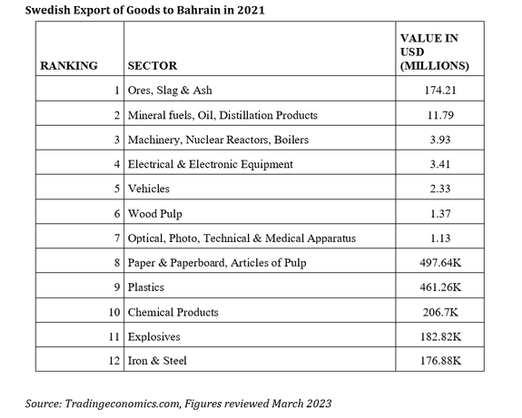
Turning to Bahrain, Sweden’s trade in goods with Bahrain is even more limited, but it managed to export almost US $175 million (USD) in iron and ore and related materials in 2021.
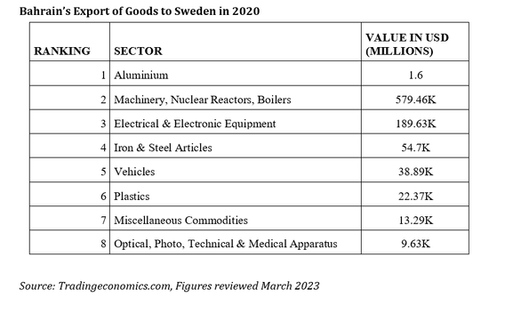
Bahrain’s exports are very limited. Aluminium is the main earner with $1.6 million (USD) generated in 2020; machinery sales earned $579,000 (USD); while electrical equipment brought in another $190,000 (USD). Otherwise, the sale of goods brought in relatively modest sums.
Future Prospects in Swedish-GCC Trade
This article has demonstrated that Saudi Arabia and the UAE are the leading export countries for Sweden in the GCC. The UAE is proving to be an attractive focus and it scores high in the latest 2023 Index of Economic Freedom. It is ranked the 24th freest economy in the Index and first out of 14 countries in the Middle East and North Africa region. Moreover, its overall score is higher than the world and regional averages. These are impressive scores. As The Index points out, ‘Economic restructuring has been underpinned by efforts to strengthen the business climate, boost investment, and foster the emergence of a more vibrant private sector’.[xii] With its strong presence in banking and financial services, the UAE represents an attractive hub for Swedish companies interested in exporting goods and services across the GCC.
It is also striking to note that in a recent article (11 February) the Economist reported that ‘the past few years have been a time of rapid change in the GCC. Saudi Arabia is shaking off many of its social restrictions and opening up to the world.’ The article goes on to say that Saudi Arabia and the UAE are moving fast in terms of social change. Together, they account for more than 75% of the GCC’s population and 70% of its $2 trillion in GDP. The Economist concluded by suggesting that ‘their experience will have an outsized impact on the region.’[xiii] Both the UAE and Saudi Arabia, along with Qatar and Kuwait, have sizeable sovereign wealth funds, which are having a huge transformative impact, not just on the region, but also on capital flows worldwide.
Saudi Arabia’s Public Investment Fund (PIF) is one of the most active and influential sovereign wealth funds in the world. The Fund has stated that it aims to manage assets amounting to a staggering $1.07 (TN-USD) by 2025.[xiv] Nearly a quarter (24%) of these assets will be held outside Saudi Arabia. In this context, Saudi Arabia is a hugely significant investor and trading partner for Sweden. The PIF is investing $40 billion (USD) a year in internal Saudi projects with the new city complex at NEOM generating considerable investor interest. The Gulf is home to several other SWFs. For instance, the Abu Dhabi Investment Fund (ADIA), is one of the world’s largest investment funds with assets estimated at $790 billion (USD) in March 2022.[xv] Meanwhile, the Kuwait Investment Authority follows closely behind with assets under management of $750 billion (USD).[xvi] The ADIA has consolidated its funds over the last years after two of its vehicles, Aabar and Ipic, were drawn into Malaysia’s 1MDB fraud case.
For its part, the Qatar Investment Authority (QIA) has an estimated $450 billion (USD) of assets under management. Qatar has invested heavily in the UK and now owns all (or most) of Harrods, Sainsbury’s, and a string of high profile luxury hotels, including Grosvenor House and the Connaught. Last year, QIA pumped €2.4 billion into the German power company, RWE and $1.5 billion (USD) into Bodhi, James Murdoch’s media venture in India. It was also an anchor investor in Porsche’s initial public offering. Clearly, sovereign wealth funds across the GCC are looking for attractive assets worldwide and Sweden may be a prime geographical location of interest.
*****
Before concluding, it is worth shining the spotlight on a promising economic sector for generating revenues across the Gulf: high-end tourism, which appears to be enjoying strong growth in the wake of the global Covid-19 pandemic. In Saudi Arabia, for example, tourism is a significant source of employment, particularly now that there are not so many new public sector jobs. Many Saudis have moved into the service sector in recent years, particularly hospitality. As The Economist observed, over the past seven years, more citizens are trying ‘a stint working in a hotel or mall (since) is also a good way to meet people.’[xvii] Bahrain, with a mature tourism sector, has the opportunity to promote the country’s rich history and culture to a wider audience. Walking around the old town in the capital is a memorable experience and one that many travellers from around the world would greatly value.
The Prize: Greater Saudi-Swedish Economic Cooperation
In conclusion, it is worth focusing on the opportunities for greater economic ties between Sweden and Saudi Arabia. Significantly, Saudi Arabia launched a new programme last year to encourage foreign direct investments. In this context, it has reviewed regulatory rules restricting foreign investors holding a controlling stake in local companies, including financial services companies. Saudi Arabia has taken concerted action to attract foreign investors to the country. The recent Davos in the Desert conference, held in October 2022, demonstrated this commitment.
A further initiative is also underway to encourage women to enter the workforce. An under-appreciated fact about Saudi Arabia is that for several years now, more than half of its citizens who graduated from university are women.[xviii] With higher oil and gas revenues due to sustained demand, Saudi Arabia has more money to spend on large scale investment projects such as infrastructure and housing for its rapidly growing population. This trend works in favour of Sweden, which has built up some of the world’s most experienced and skillful civil engineering companies. ABB, for example, a Swedish-Swiss conglomerate, backed by the Wallenberg family, is recognised as one of the leading manufacturers of electrical equipment, robotics and automation technology. Saudi Arabia is Sweden’s largest export market in the Gulf region, and it is important to appreciate that Swedish companies have been present in the area for more than 70 years.
Crucially, foreign capital and know-how are important pillars of Saudi Arabia’s economic strategy to diversify its economy away from hydrocarbons. Opportunity centres on attracting citizens into an expanding private sector, where they might find well paid jobs. In this context, Swedish know-how and experience could offer considerable benefits as Saudi Arabia seeks to transform its economy over the next decade. Recently, a Saudi-Swedish Business Council was established in Stockholm to exchange expertise and knowledge. In January 2022, a two day event was held at Expo 2020 Dubai, focusing on future investment opportunities for Saudi and Swedish companies. The Commissioner, General Hussain Hanbazazah, responsible for the Saudi Pavilion, observed that the newly created Saudi-Swedish Business Council was intended to set ‘plans and programmes to seize investment opportunities and turn them into tangible partnerships.’[xiv] The Dubai event paid special attention to digital transformation and sustainability, including building Saudi Arabia’s circular economy and related investment opportunities.
It is also encouraging to note the very positive meeting held in Spring 2022 in Riyadh when Nayef Al Hajraf, the Secretary General of the GCC, received the (then) Foreign Affairs Minister Anne Christine Linde and Ambassador Peter Semneby, Sweden’s Special Envoy to Yemen. At this meeting Dr Al Hajraf stressed the importance of boosting GCC-Swedish relations across a range of political and economic fields to serve common interests.[xx] It is now on the new coalition government, formed by Ulf Kristersson, to capitalise on these opportunities.
Looking ahead, considering the growing demand for technological innovation across the Gulf, Sweden is well positioned to offer a range of expertise and experience in ICT, transport logistics, health and infrastructure planning. This skill-set is specifically relevant to Saudi Arabia, which is developing its national infrastructure and, in particular, the digital city complex at NEOM. This is predicted to become one of the regions’s principal urban hubs. Building on the preparatory work undertaken in the last few years, the GCC and Sweden are now in a position to capitalise on the considerable commercial potential presented by the fast-changing economic forces reconfiguring their citizens’ daily lives.
Resources
- Economic forecast for Sweden, https://economy-finance.ec.europa.eu/economic-surveillance-eu-economies/sweden/economic-forecast-sweden_en
- In Sweden the top individual and corporate tax rates are, respectively, 57 percent and 20.6 percent. The tax burden equals 42.6 percent of GDP.
- However, recent academic research conducted at the London School of Economics suggests this media perception may be exaggerated, see ‘Do the Rich Flee Wealth Taxes? Evidence from Scandinavia’, by Katrine Jakobsen, Henrik Kleven, Jonas Kolsrud & Camille Landais ,Bonn/UCL – Macro Seminar ,October 19, 2021, https://econ.lse.ac.uk/staff/clandais/cgi-bin/Articles/WealthMigration_slides2021.pdf
- These tensions are explored by Paulina Neuding in a recent issue of The Spectator (and also on the weekly Spectator TV podcast, 10 March 2023 available on youtube), see Scandi Noir, The Spectator, 11 March 2023.
- See: 2023 Index of Economic Freedom, Heritage Foundation, Washington DC, https://www.heritage.org/index/country/sweden
- Source: 2023 Index of Economic Freedom, Heritage Foundation, Washington DC, : https://www.heritage.org/index/country/sweden
- Source: ‘Saudi Arabia, Sweden explore investment opportunities, 21 January 2022, Trade Arabia Business News, www.tradearabia.com
- Source: https://www.media.volvocars.com/global/en-gb/media/pressreleases/294767/volvo-cars-reports-all-time-high-revenue-and-profitability-for-the-full-year-2021
- Source: https://tradingeconomics.com/sweden/imports/nigeria
- Source: https://tradingeconomics.com/saudi-arabia/gdp-growth-annual
- The leading companies in the UAE cigarettes market are Philip Morris International Inc., Imperial Brands Plc, British American Tobacco Plc, Japan Tobacco Inc, and Korea Tobacco & Ginseng Corporation. Philip Morris International Inc was the leading company in the cigarettes category in UAE in 2021. For further details see https://www.globaldata.com/store/report/uae-cigarette-market-analysis/
- See: 2023 Index of Economic Freedom, Heritage Foundation, Washington DC, https://www.heritage.org/index/country/unitedarabemirates
- Source: ‘Reinventing the Gulf: a new dawn, a new day’, The Economist, 11th February 2023
- Source: ‘Saudi wealth fund targets $24bn investment in Arab states,’ Financial Times, 26/2/2022, https://www.ft.com/content/fefe4857-10b8-497b-9904-da86daf5c7bb
- Source: SWF Institute, 100 Largest Sovereign Wealth Fund Rankings by Total Assets
- Source: SWF Institute, 100 Largest Sovereign Wealth Fund Rankings by Total Assets
- Source: ‘Reinventing the Gulf: a new dawn, a new day’, The Economist, 11th February 2023
- Source: https://english.alarabiya.net/perspective/features/2015/05/28/More-women-than-men-in-Saudi-universities-says-ministry.
- Source: ‘Saudi Arabia, Sweden explore investment opportunities, 21 January 2022, Trade Arabia Business News, www.tradearabia.com
- Source: GCC Secretary General reviews GCC-Swedish relations, March 28, 2022, https://saudigazette.com.sa/article/618695