

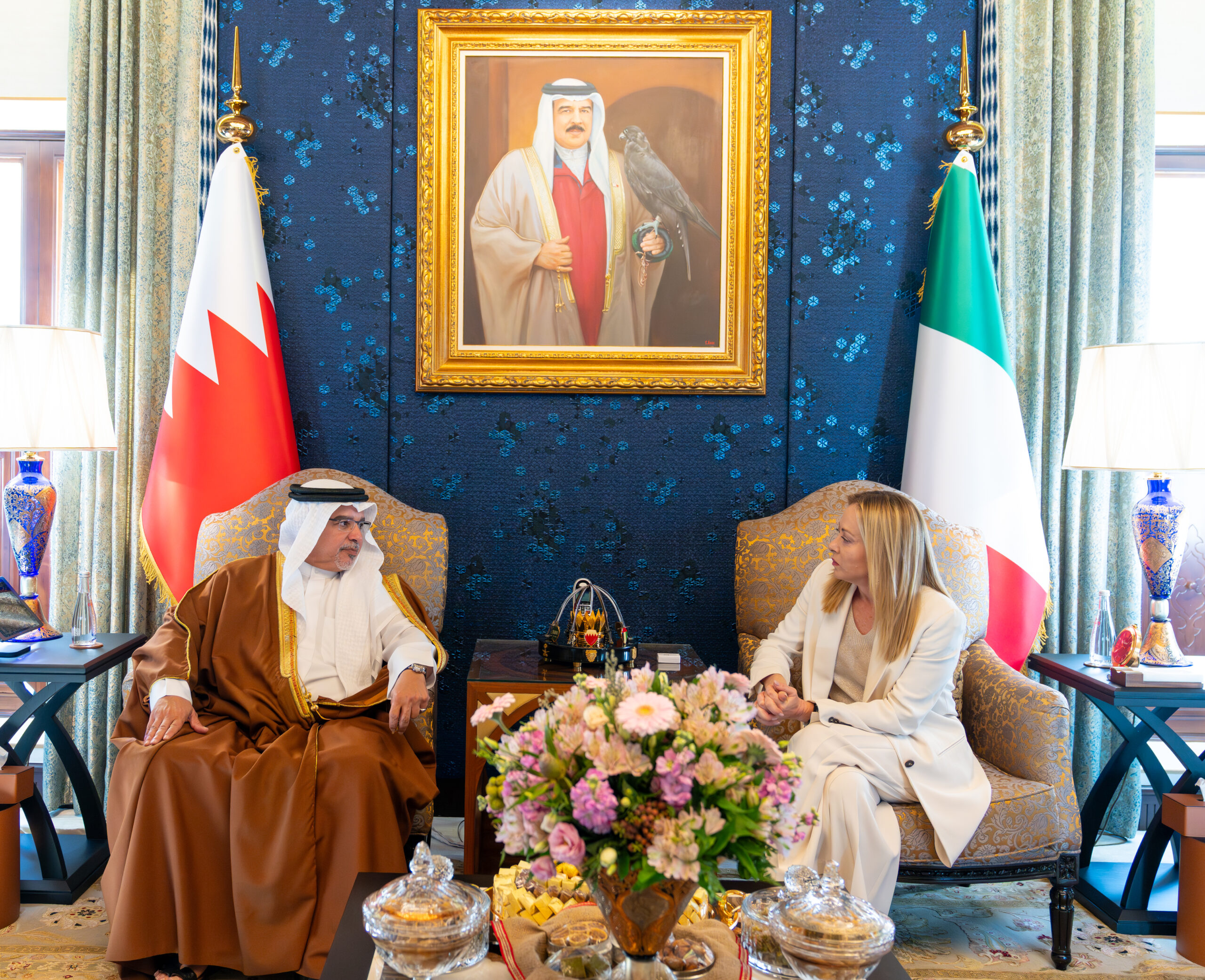


Italian Prime Minister, Giorgia Meloni’s, 2-3 December visit to Bahrain to participate as a Guest of Honour — on the invitation of Bahrain’s King Hamad Bin Isa Al Khalifa — in the 46th Gulf Cooperation Council (GCC) Summit brought Italy to the heart of Gulf decision-making. Meloni’s engagement with GCC leaders signals an important shift in Italy’s foreign relations—Rome is becoming more aware of its global position and around the world. In this case, it is clear that there is a strong personal bond between the Italian PM and Bahrain’s King and Rome and Manama are now moving fast from cordial cooperation to a more structured partnership.
Economic and industrial diplomacy were at the centre of the visit. In Manama, Meloni and Bahrain’s Crown Prince Salman Bin Hamad Al Khalifa oversaw agreements linking the ASRY shipyard with Italian champions Fincantieri in naval engineering and Roboze in additive manufacturing, pointing to future collaboration in shipbuilding, repair and high-tech production. These steps build on the MOU signed in Rome at the end of September, which committed both sides to trade and investment projects worth more than a billion euros in energy, defence and infrastructure.
For Italy, the invitation to attend the GCC Summit was as important as the bilateral deliverables. Analysts have long described Rome’s Gulf policy as strong but fragmented, relying on separate links with the UAE, Saudi Arabia and Qatar without an overarching regional frame. The Manama Summit partly fills this gap: by allowing Meloni to sit in on GCC deliberations, Gulf leaders tested whether Italy can act as a regional interlocutor rather than a purely sectoral partner. The visit also dovetails with the government’s Mediterranean agenda, from the Mattei Plan for Africa to new energy and connectivity corridors between Europe and the Middle East.
Meloni used her speech in Manama to articulate this ambition. She proposed a Gulf–Mediterranean Summit, offering Italy as host, and argued that the two regions need a more structured dialogue to exploit their shared ‘geopolitical centrality.’ She reiterated support for a two-state solution to the Israeli–Palestinian conflict, warned that the Gaza truce remains fragile, called for a credible nuclear arrangement with Iran and invited Gulf energy producers to work with Europe on a renewed energy diplomacy, with Italy as an entry point to the EU market.
For Bahrain, the visit fits into a long-term diversification strategy under its Economic Vision 2030, which aims to reduce reliance on hydrocarbons by developing finance, logistics, tourism and advanced manufacturing. Italian naval engineering, maritime services and industrial technologies match these priorities, while closer ties with an EU member state help Manama complement its Anglo-American security partnerships with deeper links to continental Europe.
The broader EU–GCC framework gives the trip an additional layer of meaning. Trade between the two blocs reached around 200 billion dollars in 2024, yet political coordination has often lagged behind economic interdependence. The first EU–GCC Summit in Brussels in 2024 and the 2022 Joint Communication on a “Strategic Partnership with the Gulf” signalled an effort to close this gap, including commitments to deepen energy cooperation and revive work towards a free-trade agreement. In this context, the Italian prime minister’s high profile in Manama can be read as both a bilateral success and a test of whether a medium-sized EU power can give practical substance to the emerging Europe–GCC architecture.
Much will depend on implementation. If the industrial agreements concluded in Bahrain translate into concrete projects and if the proposed Gulf–Med summit moves from idea to calendar, Italy and Bahrain could become a small but significant laboratory of how European and Gulf actors manage security crises, energy transition and economic diversification in an integrated way. For now, the visit has given Italy a new platform in the GCC and offered Bahrain a visible European partner at a time when the Gulf’s strategic relevance to the West continues to grow.
Ultimately, Meloni’s trip to Manama matters less for the photo-ops and more for the strategic template it suggests: a mid-sized European power leveraging dense sectoral ties (energy, defence, maritime, finance) to anchor itself inside GCC decision-making circuits and, in doing so, to pull the EU closer to a region that is now indispensable for global security and economic rebalancing. If Rome and Manama manage to turn memoranda into hardware, joint ventures and regular political consultation, they can demonstrate that Europe–Gulf engagement is most effective when it combines principled diplomacy on regional crises with pragmatic co-investment in diversification and connectivity. The challenge for both sides is therefore to institutionalise what is now still largely leader-driven: embed Italy–Bahrain cooperation in EU–GCC formats, align it with long-term strategies such as Bahrain’s Vision 2030 and the EU’s Green Deal and connectivity agenda, and use it to stress-test whether Europe can act as a strategic, not just transactional, partner for the Gulf.
Resources
- https://www.ansa.it/english/news/world/2025/12/03/gulf-med-summit-needed-italy-ready-to-host-it-says-meloni_5fd1dd6f-b96f-4178-add3-143ed2f6d99d.html
- https://www.newsofbahrain.com/bahrain/122838.html
- https://decode39.com/12645/inside-melonis-gcc-invitation-from-bilateral-actor-to-regional-player/
- https://gulfmagazine.co/bahrain-foreign-direct-investment/
- https://www.europarl.europa.eu/legislative-train/theme-a-stronger-europe-in-the-world/file-partnership-with-the-gulf