



Keywords:
Regional security, Geopolitical tensions, Qatar, Cultural diplomacy, Gulf instability, Fashion Event postponed, Middle East concerns, Internal instability, Regime legitimacy, Islamic Revolutionary Guard Corps (IRGC), Proxy networks, Regional volatility, Strategic transition, Revolution, AI, Pax Silica, Silicium, Technology, Industry, Semiconductors, Supply Chains.
Fashion Meets Fear
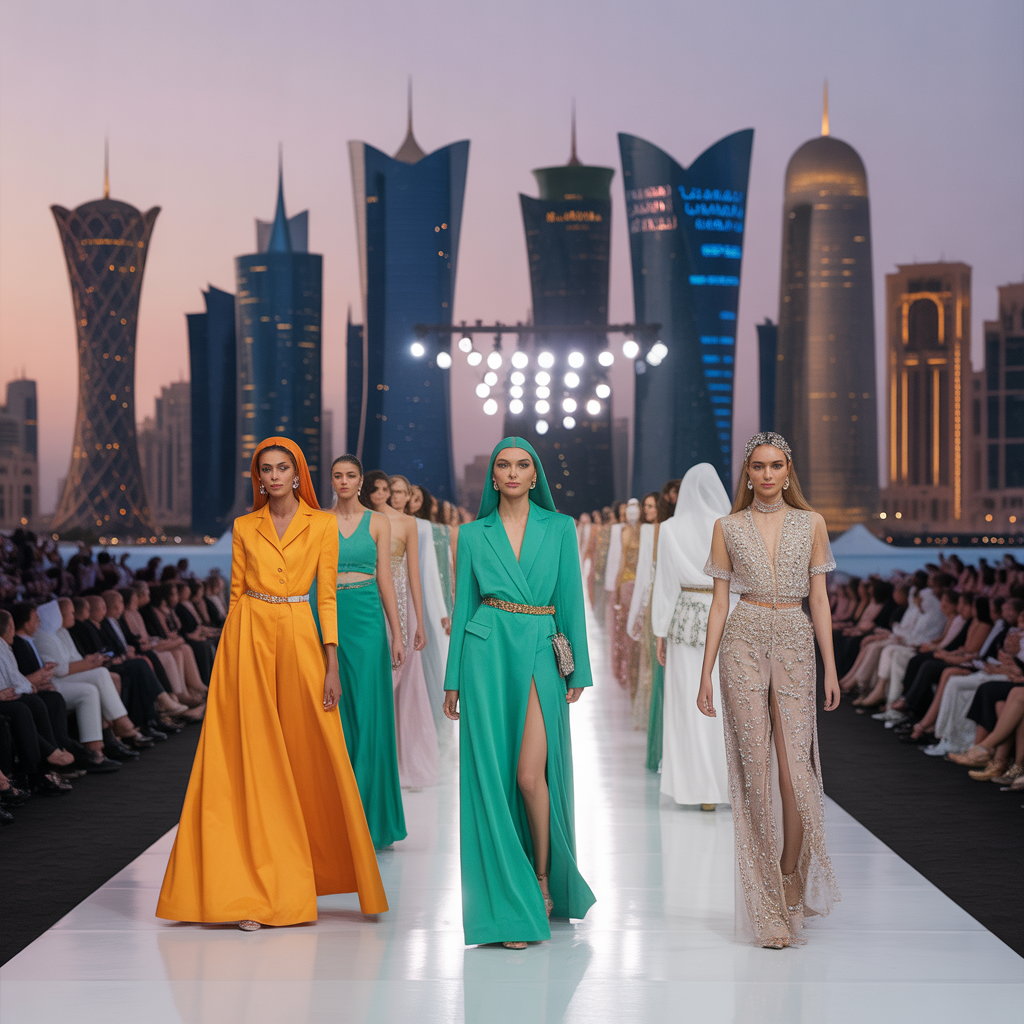
The 2026 Doha Fashion Show was postponed due to growing regional security concerns as a precautionary measure to emphasize the importance of ensuring the safety of all participants, including designers, staff, media representatives, and international guests. The event, which was originally scheduled for the end of January, has been rescheduled from 16-18 March. While the change affects the fashion calendar, it also reflects broader anxieties linked to the current security environment in the region.
The event is part of Qatar’s long-term effort to invest in fashion and creative industries as a way to diversify its economy beyond energy exports. Since its launch in 2022, the Doha Fashion Show has developed into a significant platform for both regional and international designers, fostering cultural exchange and highlighting Middle Eastern design, while supporting Qatar’s ambition to establish itself alongside established global fashion centers. For a country that has carefully curated its international image as a hub of culture and diplomacy, the postponement has a symbolic weight. Fashion weeks and cultural festivals are more than celebrations of style; they are tools for soft power, tourism and foreign investment. Delays of this magnitude, particularly when linked to security, send signals that go far beyond runway lights and press invitations. Also, the decision to delay the event carries both economic and reputational costs. For designers, event planners, and sponsors, especially smaller regional labels banking on exposure to global buyers, postponements mean disrupted timelines, delayed launches, and added uncertainty in an already competitive industry. Despite this, the organisers remain adamant that the event will proceed in March, with all international and regional participants still expected to attend. But the postponement has already made its mark, serving as a stark reminder that cultural events are not insulated from politics — especially in a region where global rivalries and regional grievances can swiftly reshape the atmosphere.
Indeed, Qatar’s decision is more closely tied to broader geopolitical dynamics in the Gulf than to the fashion sector itself. Over the past year, relations between regional and global powers have become increasingly tense, characterised by diplomatic rivalries, military posturing and violent incidents. A key source of this instability has been the confrontation between Israel and Iran, which has occasionally escalated into direct and indirect clashes. In June 2025, for example, Iran launched missiles at the US-operated Al Udeid Air Base in Qatar in response to US strikes on Iranian nuclear facilities. This incident led to the temporary closure of Qatari airspace and significant disruption to commercial flights. Although the airspace has since reopened and travel has largely resumed, these events have highlighted how quickly regional escalations can affect civilian activity and economic operations, contributing to the perception that Gulf airspace is becoming increasingly unpredictable. Alongside periodic military tensions, Qatar has also taken on a sensitive role in relation to ongoing regional crises, including the prolonged humanitarian situation in Gaza. The country has positioned itself as a supporter of ceasefires and humanitarian assistance, engaging with a wide range of international actors while carefully managing its relations with the United States, neighbouring Gulf countries and other global powers. Both citizens and expatriates in Qatar have experienced subtle but persistent reminders of this delicate balance, ranging from temporary travel disruptions to increased public discussion about regional security. These conditions create a backdrop of uncertainty that tends to affect high-profile international events more than routine public life and it reinforces the perception that international conflicts can have direct local consequences.
As the Middle East continues to face a challenging geopolitical situation, events such as the Doha Fashion Show will likely serve as indicators of security and confidence, as well as serving as a reminder that even glamour must submit to geopolitics in this era.
Iran at a Crossroads
Iran is experiencing an extended period of internal instability, characterised by ongoing social unrest, economic decline, and the gradual erosion of the legitimacy of the Islamic Republic. While these dynamics do not yet constitute a revolution, they suggest a ‘revolution in the making’ that is already shaping Iran’s regional position. This evolving internal crisis has direct strategic implications for the Gulf Cooperation Council (GCC), for whom Iran remains a key security concern and an integral regional player.
Despite growing pressure, the Iranian political system has proven resilient. Control is maintained through a dense security system, most notably the Islamic Revolutionary Guard Corps (IRGC), combined with selective and targeted repression. However, this resilience masks growing structural fragilities. Chronic inflation, high youth unemployment and prolonged international isolation continue to undermine economic stability and social cohesion. Protest movements that combine young women and men, ethnic minorities and, increadsingly, the bazaris are increasingly calling for a redefinition of the state–society relationship, rather than reform. Signs of a shift in attitude are also emerging among groups that have traditionally supported the regime, including parts of the urban middle class and lower-ranking religious leaders. This suggests a growing legitimacy gap rather than imminent collapse.
For GCC states, Iran’s internal situation gives rise to three main strategic scenarios. The first scenario is increased regional turbulence, whereby a weakened Iranian government could lose control of its proxies, further destabilising Yemen, Iraq and Lebanon, and endangering maritime security, energy infrastructure and trade routes such as the Red Sea and the Strait of Hormuz. The second scenario is more positive and involves a managed transition in Iran towards policies focused on economic recovery and diplomatic normalisation. This could lead to a reduction in regional tensions and enable the GCC to implement confidence-building measures. Third is the risk of spread whereby popular mobilisation in Iran could spillover to the GCC and prompting governments to reinforce internal stability.
Collectively, these situations highlight that Iran’s domestic transformation is already a fundamental element in Gulf security estimations. For the GCC, the challenge is about containing possible impacts from Iran. Whether Iran moves towards controlled adaptation or deeper instability, its trajectory will fundamentally shape the Gulf’s strategic environment. In a Middle East characterised by instability, the future of Iran will remain one of the most reliable indicators of whether the region moves towards greater stability or fresh disorder.
Pax Silica and the Gulf: Technology, Power and a Quiet Strategic Shift
Alongside rising security tensions and persistent political instability, a quieter but structurally consequential transformation is reshaping the Gulf’s strategic environment: the emergence of what analysts increasingly describe as Pax Silica. The term does not refer to a formal alliance or codified doctrine, but rather to an evolving technology-centred order in which semiconductors, artificial intelligence infrastructure, data governance and advanced manufacturing have become core instruments of geopolitical power.
Originally driven by the intensifying US–China technological rivalry, Pax Silica reflects a broader transition from efficiency-based globalisation to security-driven industrial policy, marked by export controls, targeted subsidies and the progressive reorganisation of critical supply chains among trusted partners. In January 2026, this framework took on direct relevance for the Gulf when Qatar and the United Arab Emirates formally joined the US-led initiative launched only weeks earlier. Their accession signalled a qualitative shift: Gulf states are no longer acting merely as external financiers of global technology, but are positioning themselves as institutional participants in a reconfigured techno-geopolitical architecture.
Pax Silica operates as a coalition of capabilities rather than a political bloc, linking countries with complementary strengths across the technology stack—from advanced chip design, manufacturing and equipment in the United States, East Asia and parts of Europe, to energy availability, capital mobilisation and large-scale infrastructure in the Gulf. For Gulf governments, this alignment fits squarely within long-term diversification strategies and reflects the growing importance of data centres, AI platforms and high-performance computing as pillars of future economic growth. Energy remains central, but in a transformed role: no longer primarily an export commodity, it increasingly underpins compute-intensive infrastructure essential to digital and industrial competitiveness. At the geopolitical level, Pax Silica also functions as a form of technology diplomacy, embedding Gulf states more deeply within Western-aligned industrial ecosystems while allowing them to hedge against excessive dependence on any single power centre. At the same time, it highlights the accelerating fragmentation of global technology governance, where access to advanced chips, AI tools and investment flows is shaped less by market openness than by political alignment and strategic trust.
In this sense, Pax Silica complements the region’s broader strategic transition: beyond hydrocarbons and traditional mediation roles, the Gulf is consolidating its position as a critical node in the global contest over technology, resilience and long-term economic power.
Sources
- https://english.alarabiya.net/News/gulf/2026/01/16/qatar-fashion-show-canceled-over-regional-security-concerns-say-organizers-
- https://www.thenationalnews.com/magazine/2026/01/11/doha-fashion-show-announces-dates-for-new-season/
- https://dohanews.co/qatar-condemns-use-of-food-as-a-weapon-in-gaza-at-launch-of-global-security-forum-2025/
- https://menafn.com/1110608868/Qatar-Fashion-Show-Postponed-To-Prioritise-Safety-Of-Designers-Talents-Organisers-Say
- https://alhurra.com/en/10753
- https://www.middleeastmonitor.com/20260114-saudi-arabia-leads-gulf-efforts-to-dissuade-washington-from-striking-iran/
- https://opinione.it/esteri/2026/01/15/abdulla-al-junaid-caduta-regime-iran-incertezza-medio-oriente/
- https://www.state.gov/pax-silica
- https://www.reuters.com/world/middle-east/qatar-uae-join-us-led-effort-bolster-technology-supply-chain-2026-01-11/