




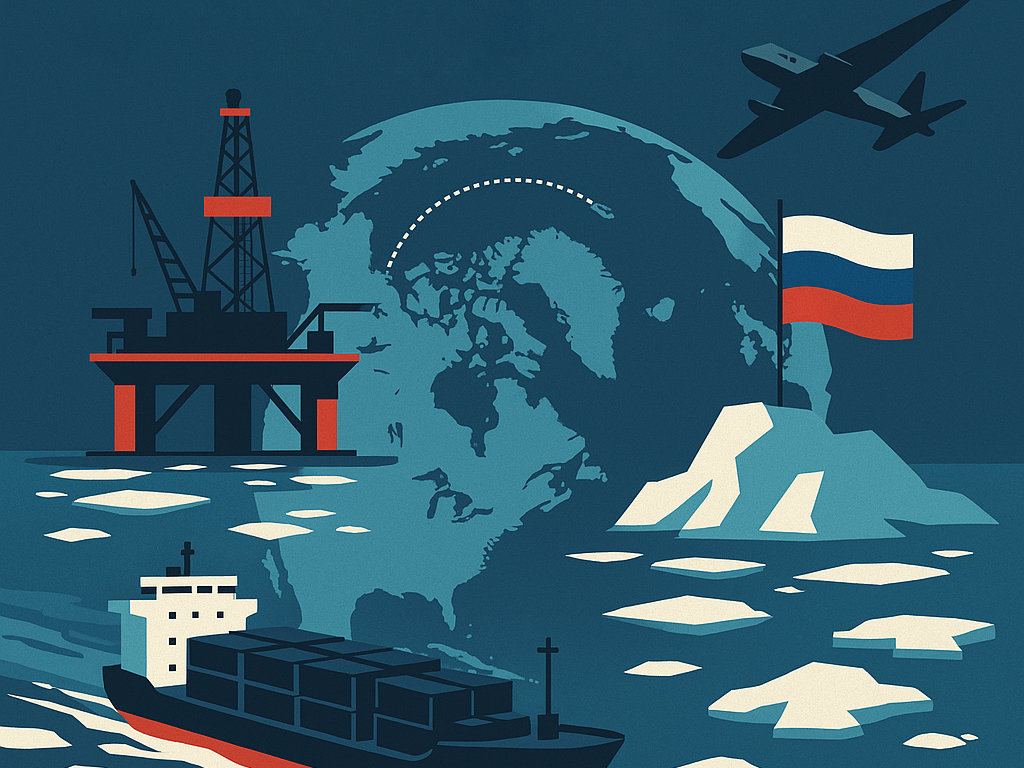


The quickening melting of Arctic ice is generating a new geopolitical frontier. The Arctic, traditionally perceived as peripheral and relatively stable, is now increasingly central to global power projection strategies. Determining its growing relevance are overlapping and mutually reinforcing climatic, economic and military dynamics.
According to estimates, up to 25% of the world’s untapped conventional hydrocarbon resources lie beneath the Arctic seabed. And, the melting of the polar ice cap is making new maritime routes navigable, in particular the Northeast Passage, which significantly reduces transport time between Asia and Europe compared to the traditional Suez Canal. But the significance of the Arctic goes far beyond the economic dimension: the polar route is also the shortest trajectory for the launch of intercontinental ballistic missiles between Russia and the US, with direct implications for global security.
Russia clearly identified the Arctic as a linchpin of its national security strategy. Since 2021, it has built more than 590 new military facilities in the region, reactivating Soviet bases and enhancing their presence of the Northern Fleet, the naval arm of its nuclear deterrence doctrine. The ‘Ocean-2024’ exercises involved some 400 ships and 120 aircraft, deploying nuclear-capable bombers. Russia’s icebreaker fleet of 41 vessels (of which 7 are nuclear-powered) gives Moscow operational control over the North Sea Route and the ability to support military and civil activities even under extreme conditions.
Simultaneously, incidents of Russian interference in communication and navigation infrastructure in the Arctic region have been documented, including cuts to submarine cables and disturbances to GPS systems in NATO areas. According to the Center for Strategic and International Studies (CSIS), despite the difficulties on the Ukrainian front, Russian capabilities in the Arctic remain high and represent a major security concern for the US and its allies.
In recent months, US interest in Greenland has been particularly assertive. President Donald Trump has repeatedly described control of the island, rich in mineral resources and home to the Pituffik military base, a crucial node for surveillance and anti-missile defence in the northern hemisphere, as strategic. Vice-President JD Vance’s visit to the base, without prior coordination with the Greenlandic and Danish governments, has raised diplomatic concerns, accompanied by statements questioning Denmark’s ability to guarantee Greenland’s security.
The Denmark responded by highlighting the existence of a bilateral security agreement with Washington, in force since 1951, which allows — if agreed — the expansion of the American presence. Foreign Minister Lars Løkke Rasmussen recalled that at the end of World War II, the US had 17 bases in Greenland, compared to the only one active today. He also noted that Atlantic cooperation can and must remain the mainstay of the management of new Arctic challenges, rejecting any unilateral or neo-annexationist interpretation.
Meanwhile, Greenland has formed a new government of national unity that excludes the more radical pro-American party. The new Prime Minister, Jens-Frederik Nielsen, has declared his intention to pursue a gradual path to independence from Copenhagen, while strengthening ties with the European regulatory and economic framework.
The Svalbard archipelago, under Norwegian sovereignty and governed by the 1920 Treaty, is also the subject of increasing tension. The treaty prohibits militarisation of the area, while allowing the presence of citizens and economic operators from other signatory states. Russia recently accused Norway of violating these commitments, claiming that the infrastructure present would have a dual civil and military function. The Norwegian authorities categorically deny this, pointing out that there are no NATO bases or military operations on the archipelago.
However, in recent years, symbolic and provocative activities on the Russian side have increased, including the arrival of sanctioned officials, unauthorised parades and the planting of Soviet flags in old mining settlements. International analysts speculate that Moscow may use Svalbard as a possible pretext for future pressure actions, similar to what has happened in other peripheral and semi-continental contexts.
China has also increased its involvement in the Arctic, despite not being an Arctic state. Beijing calls itself ‘quasi-Arctic’ and has invested in scientific missions, port infrastructure, submarine research and energy collaborations, particularly with Russia. China is now the main buyer of Russian energy resources from the Arctic and has expressed interest in greater involvement in the development of new trans-Arctic trade routes.
The US Department of Defence has highlighted the risks associated with a possible Sino-Russian axis in the Arctic, which could alter power relations and threaten free access to international resources and routes. At the same time, China maintains a cautious diplomatic profile, avoiding explicit military postures in the region.
The Arctic Council — an intergovernmental body founded in 1996 — has seen its operational capacity progressively reduced following the Russian invasion of Ukraine in 2022. Activities are now suspended or limited, and the multilateral dialogue between the eight Arctic states (Canada, Denmark, Finland, Iceland, Norway, Russia, Sweden and the US) has been severely curtailed.
In this context, there is a growing need to develop new instruments of regional cooperation, capable of including permanent observers (including Italy, France, Germany, the United Kingdom, India, Japan and China), while keeping the shared governance of routes and resources, respect for international law and the prevention of military crises at the centre.
The growing competition between powers in the Arctic takes place against a backdrop of unprecedented climate emergency. Environmental change accelerates the unravelling of economic opportunities and geopolitical risks. The main risk is that, in the absence of effective coordination, the Arctic region will turn from an area of cooperation into a theatre of increasingly acute rivalries.