


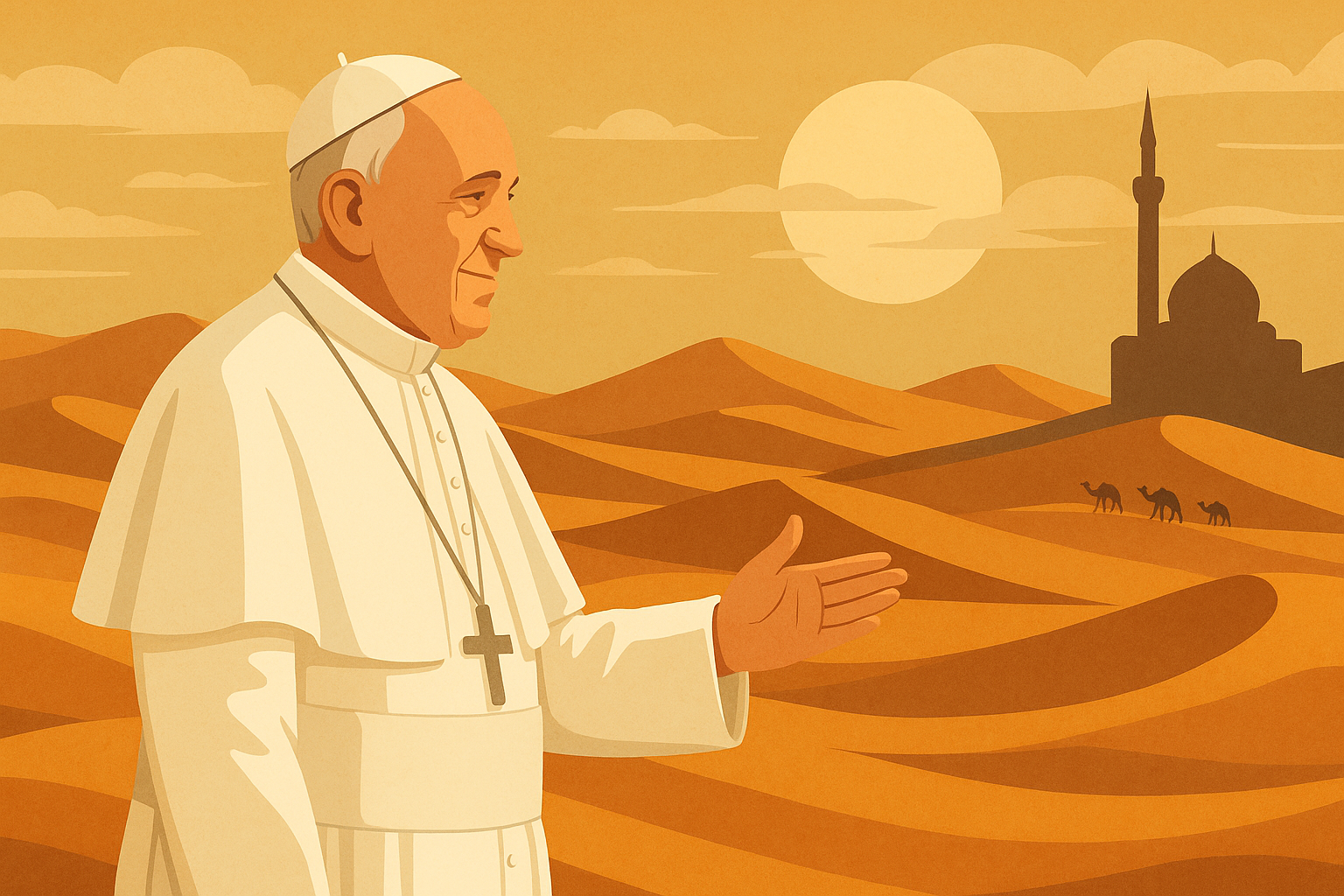


When Pope Francis set foot on the sands of the Arabian Peninsula in 2019, he shattered centuries of silence, mistrust, and geopolitical distance between the heart of Christianity and the cradle of Islam. No Pope had ever crossed that threshold — the symbolic and spiritual gateway of the Muslim world. With a simple gesture, rooted in humility and courage, Pope Francis inaugurated a new chapter in the relationship between Christianity and Islam, between the Catholic Church and the Arab world.
His visits to the United Arab Emirates and Bahrain were not only diplomatic outings or interreligious courtesy calls. They were, and remain, moments of profound theological and geopolitical significance. Francis arrived not as a statesman or a missionary, but as a pilgrim of peace, bearing a message of fraternity, coexistence, and shared human dignity.
More than simple political symbolism, his presence marked a reorientation of the Catholic Church’s relationship with Islam — from distant observation to direct engagement, from theological suspicion to spiritual kinship. The Arabian Peninsula, once imagined as unreachable terrain for papal diplomacy, became the soil where one of the boldest gestures of religious reconciliation in modern history was planted.
The First Step: 2019, the United Arab Emirates
On 03 February 2019, Pope Francis arrived in Abu Dhabi, becoming the first pontiff in history to visit the Arabian Peninsula. The visit coincided with the 800th anniversary of the encounter between Saint Francis of Assisi and Sultan al-Malik al-Kamil — a meeting Pope Francis described as a symbol of dialogue and mutual respect.
One of the most significant moments was the inter-religious meeting at the Founder’s Memorial, where Pope Francis and the Grand Imam of Al-Azhar, Ahmad Al-Tayyib, signed the Document on Human Fraternity for World Peace and Living Together — a milestone in Christian-Muslim dialogue. The document calls for peace, mutual respect, condemnation of violence in the name of religion, gender equality, and the protection of places of worship.
Francis also celebrated Mass at Zayed Sports City, with over 180,000 attendees — an unprecedented event in a Muslim-majority country. He visited Sheikh Zayed Grand Mosque and met with Crown Prince Mohammed bin Zayed, reinforcing diplomatic and cultural ties. Mons. Khaled Akasheh, head of the Islamic section of the Pontifical Council for Interreligious Dialogue, called the trip ‘a new page in Christian-Muslim relations.’
A tangible result of this visit was the announcement of the Abrahamic Family House in Abu Dhabi — a complex hosting a church, a mosque, and a synagogue, physically embodying the concept of religious coexistence.
The Bahrain Visit, 2022: Consolidating Friendship
In November 2022, Pope Francis visited the Kingdom of Bahrain — a small island state with a significant Catholic community. This 39th apostolic journey of his pontificate took place under the motto ‘Peace on Earth to People of Good Will’ and focused on interfaith dialogue in a world torn by conflict.
Francis took part in the Bahrain Forum for Dialogue: East and West for Human Coexistence, where he once again met the Grand Imam of Al-Azhar, reaffirming their alliance for peace. Cardinal Miguel Ángel Ayuso Guixot, head of the Dicastery for Interreligious Dialogue, summarised the trip in four words: dialogue, mutual respect, fraternity, and peace.
He also used the occasion to encourage religious freedom and interfaith harmony in a country ruled by a Sunni monarchy over a Shiite majority.
Interreligious Dialogue: A Path of Fraternity
Interfaith dialogue lay at the heart of Pope Francis’ magisterium. His journeys to Egypt (2017), Morocco (2019) and Iraq (2021) reflected a consistent effort to build bridges rather than barriers — promoting a ‘culture of encounter’ as an antidote to narratives of civilizational conflict.
A key dimension of this effort has been his relationship with Al-Azhar, one of the most influential Sunni Islamic institutions. The personal bond between the Argentinian-born Bishop of Rome and Grand Imam Ahmad El-Tayyeb has enabled a level of cooperation that transcends formal declarations, fostering a shared commitment to peace, education, and humanitarian solidarity.
Throughout his engagements in the Gulf, Jorge Mario Bergoglio has also respectfully encouraged host nations to continue their commendable efforts in promoting religious tolerance and peaceful coexistence. Without entering into sensitive theological or legal debates, the Pope has voiced appreciation for the hospitality extended to Christian communities and expressed the hope that believers of all faiths may be afforded the space to worship and contribute to the common good, in accordance with each country’s legal and cultural framework.
This diplomatic and pastoral approach reflects Pope Francis’s broader vision of dialogue as a gradual, respectful process — one that seeks mutual understanding, promotes shared values, and encourages practical cooperation without compromising the integrity of each tradition.
Islam and the Church
The Catholic Church’s engagement with Islam under the leadership of Bergoglio has been marked by openness and realism. In Evangelii Gaudium (2013), the Pope invited Christians to appreciate the spiritual richness of Muslims while condemning all forms of religious extremism. Yet critics have pointed out that Islamic ethics are not always universal and that Christian minorities still face severe limitations in many Muslim-majority nations. Dialogue with Islam cannot be abstract. This is why Pope Francis has always wisely focused on concrete communities and leaders, like those in the UAE and Bahrain, who are genuinely committed to pluralism
Bergoglio’s Gulf visits have left a lasting legacy. The Document on Human Fraternity inspired the United Nations to declare February 4th the International Day of Human Fraternity. It also laid the foundation for Fratelli Tutti (2020), the Pope’s encyclical on universal brotherhood.
In the Gulf, these journeys strengthened the presence of Christian communities and encouraged local reforms — including ministries of tolerance and the official recognition of churches.
With his life and example, Pope Francis has redefined the Church’s relationship with Islam and the Arab world. As a “pilgrim of peace,” he has broken new ground in religious diplomacy, offering a bold and prophetic witness of Christian commitment to fraternity and mutual respect.
His words in Abu Dhabi: To desire peace, to promote peace, to be instruments of peace: we are here for this,’ will echo for many years to come.
Sources
- https://www.acistampa.com/story/inizia-il-viaggio-storico-di-papa-francesco-destinazione-emirati-arabi-10604
- https://www.vatican.va/content/francesco/it/travels/2019/outside/documents/papa-francesco_20190204_documento-fratellanza-umana.html
- https://www.vaticannews.va/it/papa/news/2019-02/papa-francesco-abu-dhabi-commenti-dialogo-interreligioso.html
- https://www.cittanuova.it/multimedia/2022/11/4/papa-bahrain-religioni-dialogo/
- https://www.vaticannews.va/it/vaticano/news/2022-11/cardinale-ayuso-viaggio-papa-bahrein-dialogo.html
- https://www.rainews.it/articoli/2022/11/papa-francesco-in-bahrein-rilancia-il-dialogo-sulla-fraternit-umana-tra-oriente-e-occidente-b172741a-8ac2-4c88-a67d-1ecdd615ba51.html
- https://www.vaticannews.va/it/papa/news/2019-02/papa-francesco-udienza-generale-viaggio-emirati-pace-dialogo.html
- https://www.asianews.it/notizie-it/Papa-Francesco-e-l%27invito-al-dialogo-con-l%27Islam-29858.html
- https://www.firenzepost.it/2019/02/03/papa-francesco-negli-emirati-arabi-uniti-il-significato-di-questo-importante-viaggio-papale
- https://www.ilgiornale.it/news/cronache/labbraccio-papa-e-islam-non-fermer-guerra-santa-dei-1642928.html
- https://www.vaticannews.va/it/vaticano/news/2021-10/pontificio-consiglio-dialogo-interreligioso-cardinale-ayuso.html
- https://www.ilgiornale.it/news/mondo/papa-parla-ad-abu-dabhi-costruiamo-insieme-lavvenire-1639445.html