






For many observers, artificial intelligence (AI) appeared like a meteorite—hit the planet around 2022 and dramatically altering our lives. This perspective fuelled anxious reactions in the media and, consequently, attempts by some experts to reassure the public by explaining that this “new” invention has very limited applications. These extreme reactions could have been avoided by recognising that artificial thought is much older than we generally believe. It is a tool that humans first conceived of during the Middle Ages and have continually improved over time, much like the clock and the magnifying lens.
Just as an atomic clock seems like a divine marvel compared to the first mechanical clock of Pope Sylvester (9th century), and the Hubble Telescope appears miraculous compared to the lenses of Ibn al-Haytham (11th century), our AI models seem remarkable compared to their ancestors: the wheels that Raymond Llull constructed in 13th-century Spain to promote peace among religions.
The principle of their operation, however, remains the same: reducing human language to a series of minimal symbols that, when combined by the machine, can form coherent sentences.
Llull’s is fascinating for two reasons:
- He conceived artificial thought without fear of using it for a noble and spiritual purpose
- His ideas flourished thanks to the environment of medieval Spain, where the constant rivalry among major religions forced them not only to innovate but also, paradoxically, to engage in mutual contact and tolerance.
Al-Andalus, the Lighthouse of Europe
The Iberian Peninsula, known to the Arabs as Al-Andalus, was occupied starting in 711 and quickly became the world’s leading scientific and technical hub, as well as the beacon of Muslim juridical and theological civilisation.
This choice was driven by the fact that its Emirs were the last descendants of the Umayyads, who needed to survive the overwhelming power of the new Abbasid caliphs. Additionally, the neighbouring Christians Kingdoms remained dangerous, especially on the battlefield. Furthermore, as Henri Pirenne demonstrated a century ago debunking a common misconception, the Germanic Kingdom of Spain had a thriving economy even before the arrival of the Arabs. Thus, the rulers of Al-Andalus sought to appear open-minded to the large local Jewish community to secure their loyalty, and waged wars against the Christians with mutual respect, limiting unjustified massacres and violent mass conversions. At the end of the day, today’s victor could always become tomorrow’s defeated.
The list of milestones achieved under their rule is expansive: from water mills to court poetry, from the sterilisation of surgical instruments to sugar-based desserts, from citrus cultivation to the use of Arabic numerals which gradually replaced Roman numerals as the main basis for advanced mathematics. And, books in which the three faiths engaged were written with remarkable realism and documentation, even by today’s standards.
Ars Magna, or “the Great Skill”
Llull was born in the Balearic Islands in 1232, when the Crusaders had already won the decisive battle of Las Navas de Tolosa, and the Muslims, under the Berber Almohad dynasty, had become increasingly intolerant. The saddest sign of this deterioration had been the persecution of Averroes, Islam’s most brilliant philosopher, whose works survive today mainly in Latin translations.
Llull felt the religious calling and joined the Order of Preachers founded by the Spanish saint Dominic de Guzman. The austere lifestyle and exceptional intellectual preparation of these friars were specifically aimed at peacefully converting the Muslims of the newly conquered regions and refuting internal heresies that weakened Christianity.
Like nearly all Catholic scholars in Spain, Llull was educated on Arab texts. He realised that traditional theology and philosophy were too imperfect to convince Muslims and heretics.
A great skill, an Ars Magna, was needed. A technique to pose potentially infinite questions while providing logically coherent answers from a limited set of initial terms. This research technique had to be capable of asking new questions (in Latin, inventiva) and providing rigorous answers (in Latin, demonstrativa), applicable to an undetermined number of cases (in Latin, compendiosa) in any field of knowledge (in Latin, generalis).
Llull first presented this technique abstractly in his books. For each field of knowledge (physics, theology, philosophy, medicine, law):
- He selected the founding concepts.
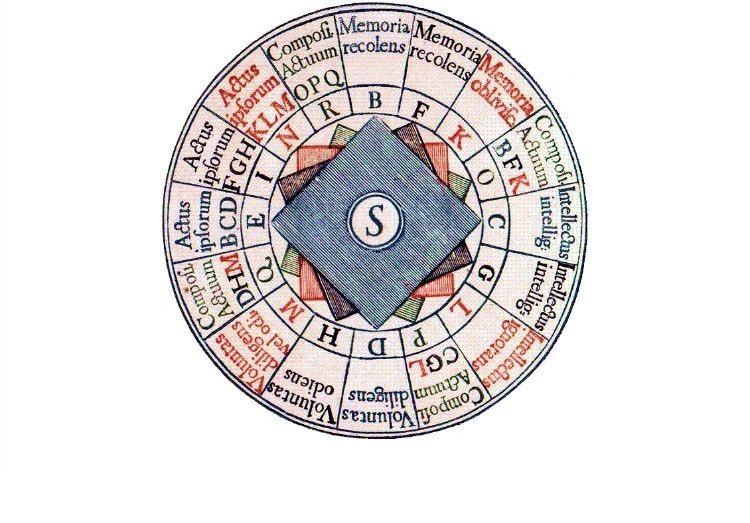
- He arranged them on two or more concentric wheels.
- He positioned geometric shapes (triangles, squares or stars) at the centre, which, when rotated, could place the founding concepts in various correlations.
- He compiled tables with all the combinations produced by rotating the shapes.
- He assigned a letter of the alphabet to each of the founding concepts or combinations.
Llull also designed a “universal” wheel with actions of the human mind ( = S), which could interact with those of various disciplines.
For example, A = “God,” B = “remember,” C = “understand,” D = “love,” E = BCD (“remember, understand, and love”), K = “forget,” L = “ignore,” M = “love or hate,” N = KLM (“forget, ignore, and therefore love or hate”), O = BK (“remember or forget”).
By connecting the concepts through the vertices of the shapes and describing these connections in alphabetic code, Llull could condense complex expressions into short, rigorous sequences. For instance, discussing the struggle between academic authority and personal reasoning, he could write: “In any dispute, one must refer to authorities in N and to reason in E I” (I = “remember, understand, and hate”).
Addressing the problem of free will and predestination, he could begin by stating: “Since A cannot fully enter S, E transforms into N and N into E through the black triangle.” Once this language was fully codified, Llull attempted to physically construct his wheels, which, by shifting the vertices of the shapes, were meant to “think” live in front of an audience. Among the modi the wheels could be used (today we would say: among the prompts with which they could be programmed), he envisioned discovery, verification, consultation, debate, prayer guidance, interpretation of sacred texts, and even mystical contemplation.
With his marvellous invention, he voyaged three times to the Muslim Kingdoms of North Africa, hoping to convert them without bloodshed. Each time, he was arrested and exiled, and during his last attempt, it is said that his machine was destroyed. Sadly for him, Llull’s books on the Ars Magna had found no success even at the Sorbonne in Paris among the most learned scholars of the Catholic world.
Thus, Llull died without achieving any of his dreams.
The Legacy of a Dreamer
However, during the Italian Renaissance, his studies were revived and commented upon by the alchemist and philosopher Giordano Bruno. Later, in the 18th century, Bruno’s commentaries were examined by the scientist G.W. Leibniz, who built a prototype of a thinking machine with symbols arranged on interlocking gears.
Obviously, Leibniz lacked the energy required to power such a device. Only in the mid-20th century did Alan Turing lay the foundations for building artificial minds powered by electricity, and only a few years ago chips reached an efficiency capable of powering our ChatGPT, Mistral, or DeepSeek.
But the fundamental idea—maximising the formalisation of language to automate its combinations—remains the same as that formulated by Llull for the first time in medieval Spain. And just as he did not hesitate to use these tools to spread religious faith without violence and to live it without fanaticism, we too should not hesitate to put them at the service of the values we hold most dear.