

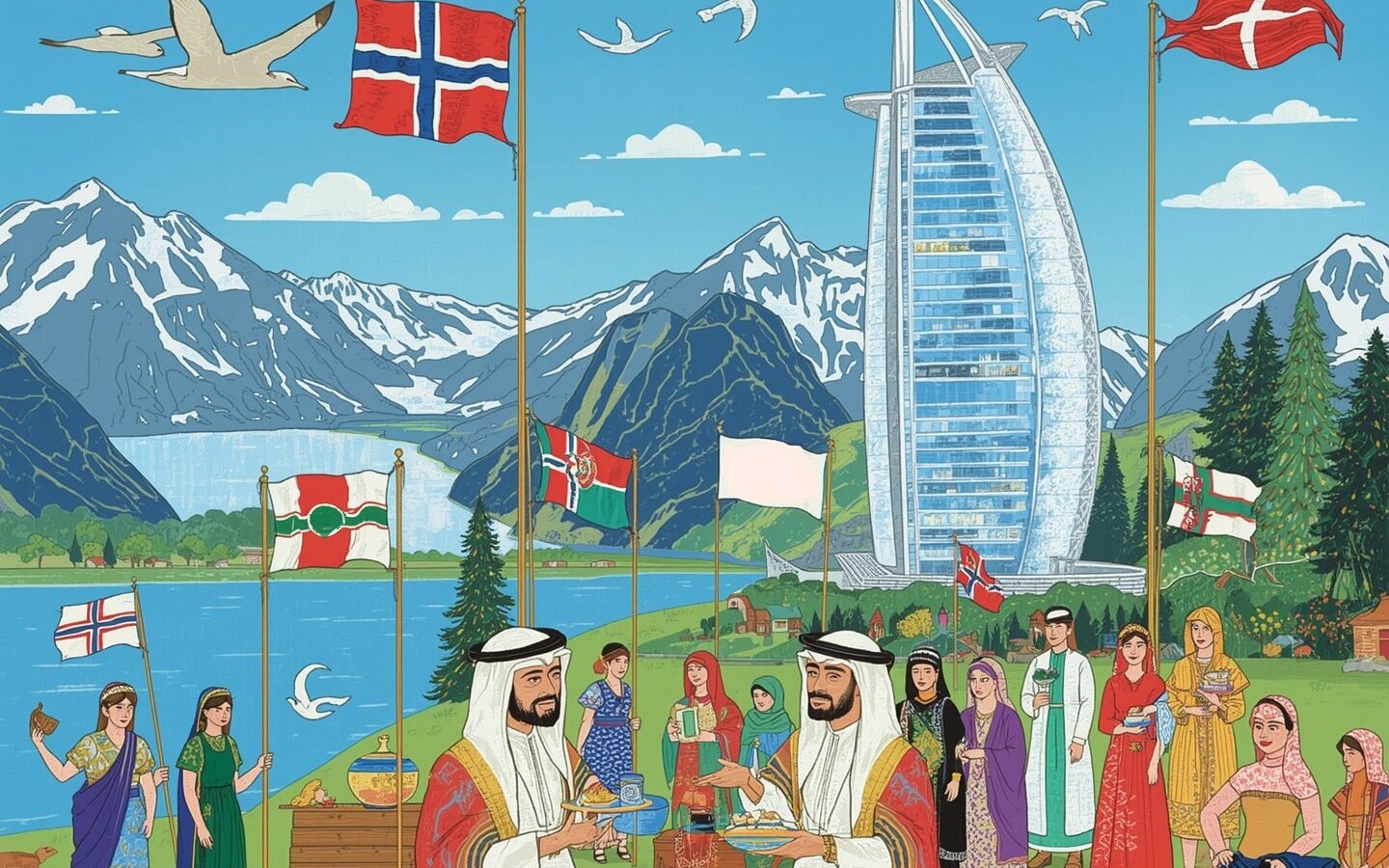


Sovereign wealth funds (SWFs) convert natural resource wealth into lasting economic gains. Norway’s Government Pension Fund Global (GPFG) and the Gulf’s major funds—Saudi Arabia’s Public Investment Fund (PIF), Qatar Investment Authority (QIA), and Abu Dhabi’s Mubadala Investment Company—follow distinct paths. Norway is saving for the future by adhering to strict ethical guidelines. In contrast, Gulf funds aim to drive rapid economic change and reduce oil dependence. These strategies influence national growth and spark opportunities for Europe-Gulf partnerships in areas such as sustainability, technology, and governance.
Norway’s GPFG, valued at $1.9 trillion USD in 2024, is the world’s largest sovereign wealth fund. Established in the 1990s to manage surplus revenues from North Sea oil, the fund operates under a straightforward principle:the government may spend only up to 3% of the fund’s value each year, based on anticipated returns. All investments are made overseas to avoid inflation at home, reflecting Norway’s cautious economic strategy. The fund invests its money across global markets, with 70% in stocks (small stakes in about 9,000 companies), 28% in bonds and the remainder in real estate. Transparency is paramount: detailed quarterly reports are published, and Parliament conducts oversight..
Ethical considerations guide the GPFG’s investment decisions. The fund avoids companies involved in the production of controversial weapons, environmental harm, human rights abuses, or corruption. As of June 2025, over 100 companies, including China Shenhua Energy for coal production and Philip Morris for tobacco, have been excluded, with decisions enforced by the independent Council on Ethics. This ethical focus establishes GPFG as a global standard-setter in responsible investment. Its commitment to steady, long-term gains is rooted in Scandinavia’s culture of political consensus and fairness across generations.
Gulf funds pursue more transformative goals. Saudi Arabia’s PIF, managing about $925 billion (USD), is the financial engine behind Vision 2030: a national plan designed to diversify Saudi’s economy and reduce its dependence on oil exports. Unlike Norway’s GPFG, PIF invests heavily in the domestic economy, funding projects such as NEOM, a planned $500 billion high-tech city in the desert, and The Line, anurban development built around sustainability and artificial intelligence (AI). It manages more than 220 companies across 13 strategic sectors,aiming to stimulate job creation and private-sector growth. PIF has also joined the One Planet Sovereign Wealth Fund (OPSWF) Framework, a global initiative encouraging long-term, climate-conscious investment decisions by SWFs. This signals a growing interest in sustainability, bringing Gulf funds closer to the ethical standards championed by Norway.
Abu Dhabi’s Mubadala, with assets nearing $327 billion (USD), invests both globally and locally. Indeed, theMasdar initiative is a leader-project in clean energy development across the Middle East and beyond. Meanwhile, Mubadala backs industries such as aerospace, semiconductors, and healthcare, helping the UAE transition toward a knowledge-based economy. It adopts a higher-risk strategythan the GPFG by focusing on infrastructure, private equity, and fast-growing sectors, aligning well with Europe’s green and digital priorities. Qatar’s QIA, which manages around $525 billion (USD), combines global prestige investments with domestic development. It holds significant stakes in companies like Volkswagen and Barclays, and owns London’s Canary Wharf district. At home, it supports tourism via Qatar Airways and education via Education City, a hub for universities and innovation. Its recent $1 billion (USD) push into tech-focused venture capital supports diversification aligned with Qatar’s own Vision 2030. These sovereign wealth strategies reflect different national imperatives. Norway’s GPFG is designed to preserve wealth and ensure long-term stability. Gulf funds are designed to catalyse fast economic transformation. Norway reduces risk through passive, diversified, global investments. Gulf funds pursue a proactive strategy, embracing higher risk to develop key industries, attract talent, and expand their global influence.
Yet both models face challenges. GPFG’s heavy equity exposure makes it vulnerable during global downturns, like the 23% drop it suffered in 2008. Domestically, debates continue about whether the fund should divest entirely from fossil fuels or take a more active role in fighting climate change.
Concerning Gulf funds, the challenges are more structural. Their ambitious domestic projects, such as NEOM or Qatar’s digital economy goals, involve considerable execution, financial, and reputational risks. Much decision-making remains highly centralised, particularly in Saudi Arabia, raising concerns about long-term institutional resilience. Regional tensions, fluctuating oil revenues, and still-developing regulatory frameworks complicate strategy and increase volatility. Transparency is improvingbut it still does not match the democratic oversight and public scrutiny seen in Norway. Gulf sovereign wealth funds are also reshaping European markets. QIA’s real estate
holdings in London and its stake in German automakers strengthen business ties. Mubadala’s biotech and energy partnerships help advance medical research and clean energy. PIF’s investment in companies like Activision Blizzard taps into Europe’s digital industries. These cross-continental investments align with Europe’s Green Deal and digital transition goals.
Sustainability is a growing area of convergence. Guided by the OPSWF Framework, Gulf funds are increasingly prioritising climate-aligned investment. This opens new doors for collaboration on projects such as green hydrogen, a clean fuel made from renewable energy, projected to be a $300 billion (USD) market by 2050, or carbon capture, a technology that traps and stores CO₂ emissions. European companies can also tap the Gulf
Capital for infrastructure projects, such as electric vehicle charging networks or smart cities. Governance remains a key dividing line. Norway’s GPFG operates with high levels of transparency, independent management, and public accountability. Most Gulf funds are state-directed and executive-controlled.Trust between European and Gulf stakeholders can deepen, laying the groundwork for broader alignment on ethics, risk, and sustainability.
Norway and the Gulf offer two powerful, yet fundamentally different sovereign wealth models. While the Scandinavian country provides stability through discipline, the Gulf countries enforce their transformation through bold investment. Both strategies bring strengths—and both have much to learn from each other. For Europe, engaging with both offers an opportunity to partner in building sustainable, forward-looking economies that respond to shared global challenges.
Sources
- Norges Bank Investment Management. Government Pension Fund Global – Quarterly Report Q2 2025. https://www.nbim.no/en/publications/reports/2025/quarterly-report-q2-2025
- Norges Bank Investment Management. Ethical Guidelines and Exclusion List (June 2025). https://www.nbim.no/en/the-fund/responsible-investment/exclusion- of-companies/
- Public Investment Fund. Vision 2030 Programs and Portfolio Updates. https://www.pif.gov.sa/en/Pages/default.aspx
- One Planet Sovereign Wealth Fund Initiative. Companion Document 2024. https://oneplanetswfs.org
- Mubadala Investment Company. Annual Review 2024. https://annualreview.mubadala.com/2024
- Masdar. Clean Energy Portfolio. https://masdar.ae/en/what-we-do/clean-energy
- Qatar Investment Authority. Public Investment Summary Q4 2024. https://www.qia.qa
- Bloomberg. Gulf Sovereign Funds Expand European Investments (March 2025). https://www.bloomberg.com/news/articles/2025-03-30/gulf-sovereign-wealth- funds-boost-investments-in-europe
- Financial Times. PIF, Mubadala and QIA Ramp Up Global Stakes (April 2025). https://www.ft.com/content/gulf-funds-expand-2025