


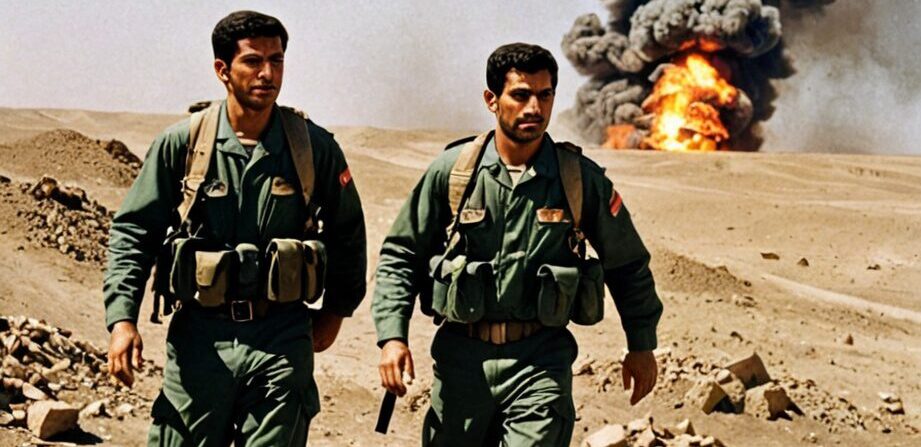


22 September will mark the 45th anniversary since the outbreak of the first Gulf War—the which pit Saddam Hussein’s Iraq against the newly formed Islamic Republic of Iran. Todays Middle East bears the stretch marks of that war and it is important to continue to analyse the war from various perspectives in order to understand our own times and the international relations that define them. This work offers a brief philosophical look at the war using Machiavelli. While this analysis does not suggest it is the interpretation, it does seek to make a contribution to the discourse and show that Machiavelli has something to offer modern war studies and reflections on the Middle East.
*****
Few people are neutral when it comes to Machiavelli. Some shrug his ideas off as archaic and no longer suitable for the modern work while other over-emphasise his ideas. But there is a distinction to be made in his works—the The Prince, intended for Lorenzo de Medici, introduces realpolitiks into decision making. It severs a decisions from an ideological, moral compass and seeks to highlight that leadership requires strength and decisiveness to best achieve stability and the common good. The cruelties that have been carried out in the name of national interests based on the separation of state and morality illustrates the controversial nature of Machiavelli’s thinking. However, Machiavelli’s The Art of War contains many ideas and strategies that are not as controversial, focusing more on the essential principles of military force, power and war. This briefing explores how Machiavellian principles about political and military power are depicted in the Iran-Iraq War (1980-1988), ultimately demonstrating Machiavelli’s enduring influence on modern international relations.
Ancient Tactics, Modern Battlefield
In The Art of War, Machiavelli illustrates his ideas through a Socratic dialogue between Fabrizio Colonna (a Military General), Cosimo Ruccelai (the Duke) and some of Cosimo’s loyal friends. Colonna first explains the necessities of a good King, clarifying what makes a good general rather than what makes them a good politician. Good generals only need to be valiant, not be good men. Generals like Caesar and Pompey were valiant, leading them to success on the battlefield, but failing them as politicians. For these politicians to succeed in a well-ordered state, they should have sole authority over the army to ensure quick decisions. Without ultimate authority, quick decisions cannot be made and oftentimes will lead to issues within the army. Iraq’s (then) President, Saddam Hussein, had taken over the helm of the Ba’athist Party and reduced national decision-making to just him. This allowed for him to make swift decisions in 1979, at a time in which border fighting was escalating and Iran had identified secular Iraq as one of their most pronounced adversaries. In the span of a mere 8 days, Hussein had pulled Iraq out of the 1975 Algiers Agreement on land borders, abrogated the agreement, and promptly invaded Iran. This swift decision making facilitated Iraq’s seizure of the southern region of Khuzestan and the Shatt al-Arab with almost no Iranian resistance. Despite exposing Iran’s disorganisation and relative weakness, it also exposed many of Iraq’s military struggles.
Discipline
Machiavelli describes the nature of creating an army; starting with the selection of personnel, arming them, organising them, training them in smaller groups and escalate to a larger group, and exposing them to the enemy from a distance. This process takes time and commitment. Machiavelli writes about the best soldiers to select, how to draft them (Deletto), and then a three-part training programme.
In the Iran-Iraq war, this focus on individual soldier training is lacking. A study led by Major General John R. Landry in 2011, interviewed some of Hussein’s closest and most important generals in the war. In these interviews, the Generals recall the (lack of) preparation before the war. Senior Corps and Division Commanders met in July 1980 to discuss a potential war with Iran, which Hussein did not attend, in which the government representatives made clear that a war with Iran may occur in the immediate future. The generals assumed this meant in the next two years but, unfortunately, it actually meant in the next two months. Given that Iran’s 1979 revolution was still, in many ways, ongoing, Iraq was able to exploit Iran’s internal chaos and the lack of adequate defence to take the Shatt al-Arab. This is despite Iraq’s pertaining a disorganised army themselves with no clear or consistent strategic goals. After a few important territorial gains, Hussein proceeded to commit what Machiavelli considers one of the worst mistakes in war: he stopped.
Commitment
After taking the Shatt al-Arab, Iraq proposed a ceasefire with Iran government and he prevented his army from capitalising on their early gains and continuing on to a vulnerable Tehran, hoping that the quick, successful, invasion of the waterway would compel Iran to sign a ceasefire. This failed terribly. Machiavelli warns his readers about committing this mistake, utilising Hannibal’s victory against the Roman army in the battle of Cannae as an example. The battle of Cannae is one of the worst defeats in the history of the Roman Empire, in which they lost to a significantly smaller Carthaginian army. However, despite this tremendous victory for the Carthaginians, Machiavelli states that Hannibal’s refusal to march on Rome ultimately cost him the third Punic War and his life. Iraq paid the same price for their reluctance, Iran would go on the offensive for the next five years of the Iran-Iraq war, costing both sides hundreds of thousands of lives. Iranian offensives, despite their numerical advantage over Iraq, were not as effective as the Ayatollah had hoped for. Why? The Iranian government had two armies at their disposal, the Iranian army (Artesh) and the Islamic Revolutionary Guard Corps (the Pasdaran), leading to internal chaos in the command and control of Iranian military assets.
Internal Disorganisation
An important reason the Iranian government was able to, ultimately, organise a defence but not strategic offences against Iraq was because their two armies: the Iranian military and the Pasdaran, reported to different leaderships. Once Iran attempted to go onto the offensive, there were clear issues between the two armies with both refusing to co-operate with one another. Machiavelli would describe this army as undisciplined. He defined a disciplined army as being one in which their soldiers knew their position, how to obey their commands from their leader, and to join company with one another. Of course, in Machiavelli’s times this was very different, armies were made up of infantries, artilleries etc. But the concept remains the same. Iran’s military disorganisation prevented them from putting together consistently effective offensives, leading to another Machiavellian principle; consistency. A disorganised army can have successful attacks and victories, however Machiavelli argues that all their ‘progress’ evaporates after a loss: ‘For, as one engagement that you win cancels out every other bad action of yours, so likewise, when you lose one, all the things you have done well before become useless.’
This theme is seen all across the war. Both armies were extremely disorganised, explaining why the war carried on for almost a full decade. The war had no clear winner, with both suffering tremendous losses and neither gaining any significant portions of land. Both sides used all the resources they had available to end the war. For Iraq, this meant the use of chemical weapons against Iranian civilians.
The Cost of Victory
To achieve victory, a General must use all available resources and wits. Machiavelli sets aside ethics and honour in war, and instead proposes strategies that are seen as morally wrong yet may lead to success on the battlefield. He dedicates Part 7 of War to the usage of treachery and different strategies that Generals have used in the past to surprise their enemy. One of the most controversial strategies he discusses is the pollution of rivers and water sources, something we would characterise as a biological and/or chemical weapons attack—an international crime. Unfortunately, similar strategies were used in the Iran-Iraq war, and they went unpunished. In 1986, Hussein’s Generals confronted him and demanded minimal interference from the President. This nearly amounted to an open mutiny, because they felt his caution in the war was leading to defeat. Hussein’s priority was his political survival, so he stayed on the defensive much of the war to gain the support of the Western world. However, once the generals were given total control, the Iraqi army went on the offensive. The Iraqi Generals viewed and then deployed chemical weapons (re: mustard gas, cyanide and tabun nerve agent) as the solution to the deadlock in the war. The Iraqi chemical attacks peaked in 1988 on the Kurdish town of Halabja, killing 5,000 civilians and injuring another 10,000. Western powers turned a blind eye on these attacks, knowing that Iran’s inability to defend against them would eventually lead to the end of the war (and it did). This event again demonstrates Machiavelli’s influence, yet it also shows a flaw in his form of thinking. As previously mentioned, Machiavelli fears that in making the military a profession, men will make decisions to elongate wars and conflict. The exact opposite happens in this case. Hussein’s Generals felt the war was going on for too long and took matters into their own hands. In demanding non-interference from the government in military decisions, they show a limit to Machiavelli’s theory about military counsels yet follow Machiavelli’s mentality as well by doing whatever it took to end the war.
Modern Implications
Machiavelli’s Art of War contains concepts that are clear and present in the 1980-1988 Iran-Iraq war and will continue to be present in modern conflicts. As technology advances, so do the weapons and strategies used for war, leading us down a path of increasingly destructive conflicts. Advancements in technology not only escalate the dangers of war, but also complicate the ethical question of whether the ends truly justify the means for global leaders.