



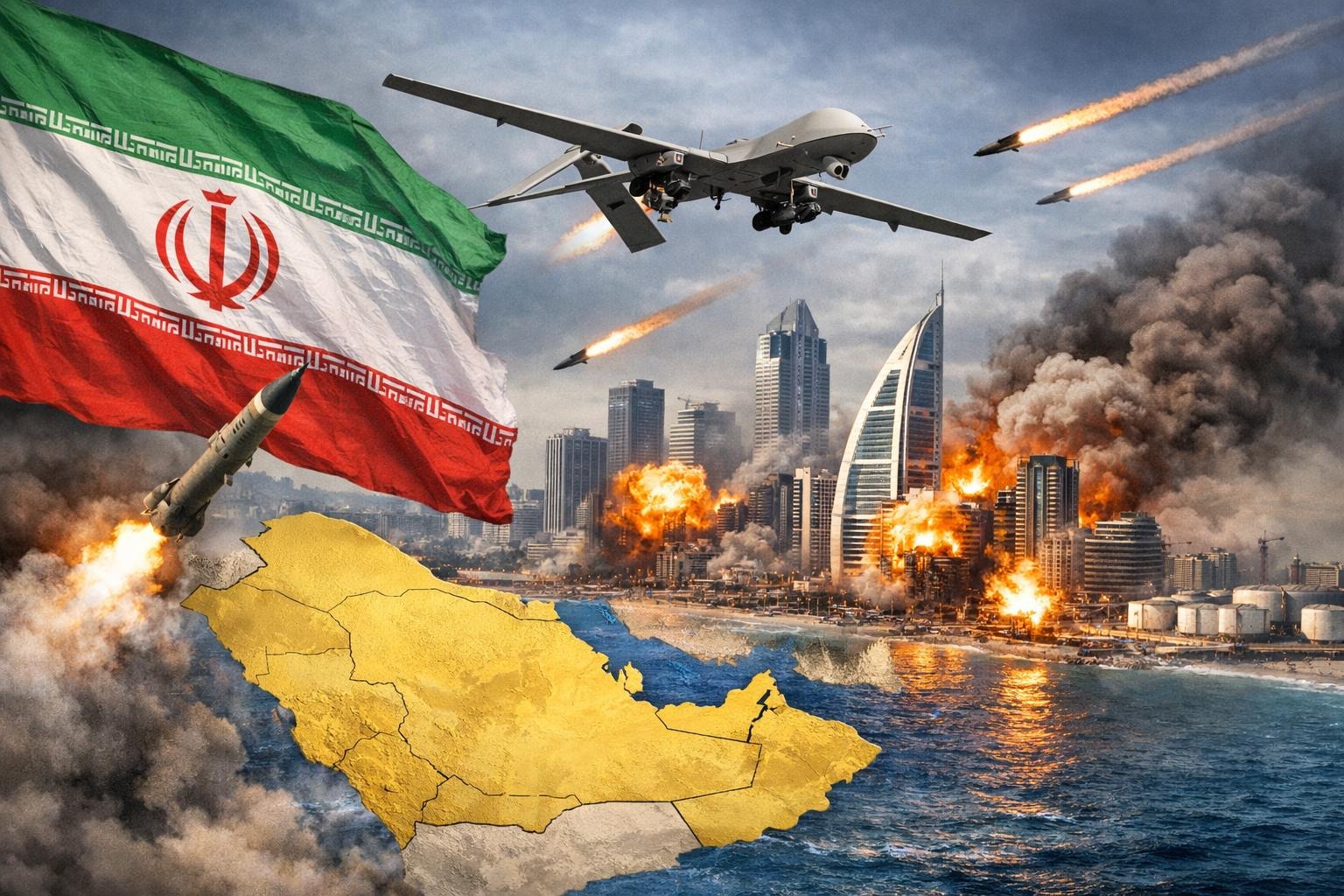


The unprecedented attacks launched by the Islamic Republic of Iran on the six Gulf Cooperation Council (GCC) countries on 28 February 2026 are the latest chapter in a long-standing regional conflict. They are the culmination of nearly five decades of managed hostility between the Arab Gulf monarchies and the Islamic Republic, marked by regional power struggles, ideological confrontations, proxy warfare and recurring escalations. Understanding the historical context of these attacks reveals the persistent dynamics of the Iran-GCC conflict and suggests its future course.
Managed Hostility Since 1979
Since the establishment of the Islamic Republic in 1979, relations between Iran and the Arab Gulf states have alternated between periods of heightened tension, deescalation and limited rapprochement, such as the latest one since 2023. The history of their coexistence can be characterised as ‘managed hostility,’ a complex balance of cooperation and conflict as none of the countries can wish away the geography. They have maintained a level of cooperation while operating in an environment of deep distrust and regional instability. The underlying reasons for conflict were never fully eliminated but rather managed, with each escalation carrying the potential to become a tipping point.
Some reasons for conflict date back decades or centuries, but the emergence of the revolutionary theocratic regime in Iran in 1979 brought new challenges to the Arab Gulf countries. Iran’s constitution enshrined the export of the Islamic Revolution in its preamble, which provides the basis for ‘the continuation of the Revolution at home and abroad,’ striving with other Islamic and popular movements to form a unified Islamic community and liberate oppressed people around the world. Increased religious extremism among parts of the Shia communities dotted around the GCC, together with Tehran’s revolutionary rhetoric have heightened concerns among the GCC countries and reshaped Gulf security dynamics. The GCC itself was established in 1981 in response to the dual shocks of the Islamic Revolution and the subsequent Iran-Iraq War (1980-1988).
In the 1980s and 1990s, the GCC faced several attempts to undermine regional security from Iran and its aligned groups. In Saudi Arabia’s Eastern Province, unrest in 1979-1980 was inspired by revolutionary Iran and linked to groups such as the Organisation for the Islamic Revolution in the Arabian Peninsula (OIRAP). In Bahrain, a 1981 coup attempt led by the Islamic Front for the Liberation of Bahrain, supported by Iran, sought to establish an Islamic republic, reflecting Tehran’s narrative that Bahrain was its 14th province. Kuwait dealt with a series of bombings in 1983, followed by an assassination attempt against its Emir and aircraft hijackings demanding the release of the imprisoned bombing perpetrators, which included Dawa members such as Abu Mahdi al-Muhandis, later deputy head of Iraq’s Popular Mobilisation Units and a close associate of Islamic Revolutionary Guard Corps (IRGC) Quds Force Commander Qassem Soleimani. During the Iran-Iraq War, the Gulf countries supported Baghdad against revolutionary Tehran, which led to Iranian attacks on Kuwaiti oil tankers in the so-called Tanker War. Further escalation in Saudi Arabia was marked by the creation of the Iran-backed Hezbollah Al-Hejaz in the 1980s, implicated in the 1996 Khobar Towers bombing, which killed US personnel, as well as assassinations of Saudi diplomats in Nigeria, Pakistan and Turkey. Saudi Arabia and Iran broke off diplomatic relations twice — once after violent clashes during the 1987 Hajj pilgrimage and the second time in 2016 after the burning of Saudi Embassy in Tehran in reaction to the execution of Shia cleric Nimr Al Nimr, former member of the OIRAP.
The Geopolitical Chessboard: The Iran-GCC Strategic Competition
Ideological rivalry has underpinned geopolitical competition. Tehran has sought to position itself as leader of the Islamic world, challenging Saudi Arabia’s role as Custodian of the Two Holy Mosques — Islam’s holiest sites — and de-facto leader of the Islamic world. Ayatollah Khomeini aligned with Islamist movements such as the Muslim Brotherhood in arguing that hereditary monarchies are illegitimate and has sought to champion the Palestinian cause. While Saudi Arabia has been its primary rival, Iran has also escalated longstanding territorial and maritime disputes with other GCC countries. The Islamic Republic revived territorial claims over Bahrain, claiming it as its 14th province. It has maintained claims over Gulf waters and asserted influence over key maritime chokepoints. Tehran has also continues to occupy the Emirates’ Abu Musa, the Greater and Lesser Tunb islands near the Strait of Hormuz. The dispute over whether the Gulf is ‘Persian’ or ‘Arabian’ illustrates a broader contest over legitimacy and regional leadership. Coupled with the support for various groups across the region, Iran’s development of an advanced nuclear and ballistic missile programmes with the help of China, North Korea and Russia has further heightened GCC concerns.
Iran’s Dual Strategy
For over 40 years, the Islamic Republic has crafted a dual strategy against the GCC countries, combining external encirclement with internal subversion, adapted to regional and global shifts.
Externally, Iran has sought to project influence across the region, including in Lebanon, Syria, Iraq, Yemen, Gaza, and the Horn of Africa, supporting various armed groups and proxy militias and creating the so-called ‘Axis of Resistance,’ aiming to encircle its GCC rivals. This interlinked network has allowed Iran to pressure the GCC via multiple fronts. Throughout the years the IRGC and its Quds Force have supported Iran’s revolutionary goals across the region. In 2015, the late Quds Force Commander Soleimani, boasted that: ‘We are witnessing the export of the Islamic Revolution throughout the region. From Bahrain and Iraq to Syria, Yemen and North Africa.’ At that time, Iran intensified its support for the Houthis as the Saudi-led Coalition intervened against them in Yemen, marking also an escalation on sea in Bab El Mandeb.
Internally, Iran has sought to exploit local grievances, foment sectarianism over national identity, recruit and radicalise youth, develop sleeper cells and support militant groups staging attacks, from arson to bombings, aiming to destabilise Gulf states from within and increase internal pressure on the leadership. Militants from GCC states have reportedly received training in Lebanon, Iran and Iraq with the IRGC overseeing increased coordination among the groups in the region. Isa Qassim (Bahrain), Hussein Al-Ma’tuq (Kuwait) and Hezbollah’s late Secretary General Hassan Nasrallah have been members of the Supreme Council of the Ahl al-Bayt World Assembly (ABWA), the Iranian Supreme Leader Ali Khamenei’s international umbrella for Shia clerics created in 1990, promoting the Islamic Republic’s agenda and ideology abroad. In the post-2011 period, Bahraini authorities imprisoned figures accused of exploiting the domestic unrest and coordinating with Iran and Hezbollah aiming to establish an Islamic republic. Kuwait expelled Iranian diplomats in 2017, accusing Tehran of interference and espionage in relation to the discovery of the Abdali cell with a large arms cache two years earlier. Several Bahraini militant groups and leaders have been operating from Iran, including the Al-Wafa Islamic Party linked with the Al-Ashtar Brigades, which are proscribed as a terrorist organisation in the Canada, the UK and the US and are part of a group of pro-Iranian militias in Bahrain receiving support and training from Iran and its regional proxy network. The 2019 strikes on Saudi Arabia’s oil installations in Abqaiq and Khurais, which disrupted approximately 5% of global oil supply, coupled with intensified attacks on oil tankers in the Gulf and the Red Sea, and the 2022 Houthi attacks on UAE’s Jebel Ali, one of the world’s busiest ports, have demonstrated Iran’s capacity to inflict economic damage on the GCC and global economy.
Ironically, Iran’s efforts to expel foreign forces from the region have helped justify their continued presence and contributed to closer security cooperation between the GCC countries and the United States, as well as other foreign partners, particularly since the 1990s.
Pattern of Iran’s Pressure Tactics on the GCC
Over the past nearly five decades, Iran’s tactics against the GCC countries have represented a multi-dimensional strategy to expand influence, deter adversaries and impose costs while avoiding a full-scale war with its neighbours. This has included:
- Fomenting sectarianism, developing sleeper cells, especially through recruitment and radicalisation of youth, in the GCC countries that can be activated to stoke unrest and exert additional internal pressure on the leadership;
- Supporting militant groups in the GCC, such as the Al-Ashtar Brigades in Bahrain and Hezbollah Al-Hejaz in Saudi Arabia;
- Training and harbouring militants from GCC countries, often linked with proxy networks across the region;
- Endangering maritime security and global trade — threats to close and mine the Strait of Hormuz, Houthi threat to Bab El Mandeb and Red Sea shipping, attacks and seizures of foreign oil tankers in the Gulf (intensified since 2019);
- Inflicting economic costs with missile and drone strikes on critical infrastructure, such as oil installations and ports.
- Cyber-attacks on GCC state institutions and critical infrastructure, including energy sector.
Where Do We Go From Here?
What we are witnessing today is what the Islamic Republic has been preparing for decades and no GCC country — even those viewed as closer to Tehran and acting as mediators like Oman and Qatar — has been spared. This is despite the fact that the GCC countries refused to allow their territory to be used for attacks on Iran and have been in a period of rapprochement with Iran since 2023. Facing an existential threat, missile and drone attacks on civilian and energy infrastructure in the GCC and public unrest in some GCC countries are a natural evolution of Iranian offensive based on decades of experience rather than a departure from its strategy. The scale of attacks against the GCC countries makes it difficult to see reparation of Iranian-GCC relations in the near future and carries the risk of becoming a decisive turning point in regional balance despite limited calls for restraint and diplomacy. We are already seeing the GCC countries putting their differences aside and uniting in the face of Iranian attacks, another unintended consequence of Tehran’s own actions.
References
- ‘Iran (Islamic Republic of) 1979 (rev. 1989),’ Constitute Project, https://www.constituteproject.org/constitution/Iran_1989.
- Oubai Shahbandar, ‘The Persian “Domino Effect,”’ Arab News, 21 December 2016, https://www.arabnews.com/node/1027466/.
- ‘Kuwait Downgrades Ties with Iran,’ Kuwait Times, 20 July 2017, https://kuwaittimes.com/kuwait-downgrades-ties-iran/.
- ‘Strikes on Saudi Oil Disrupt Global Supply,’ Reuters, 16 September 2019, https://www.reuters.com/graphics/SAUDI-ARAMCO/0100B29Q1C7/.
- ‘UAE Reaffirms Commitment to Not Allowing Its Airspace, Territory or Waters to Be Used in Any Military Actions Against Iran,’ Ministry of Foreign Affairs of the United Arab Emirates, 26 January 2026, https://www.mofa.gov.ae/en/mediahub/news/2026/1/26/uae-iran;
‘Saudi won’t allow airspace to be used for military action against Iran, crown prince says,’ Reuters, 27 January 2026, https://www.reuters.com/world/middle-east/iran-welcomes-any-process-prevent-war-president-tells-saudi-crown-prince-phone-2026-01-27/.