




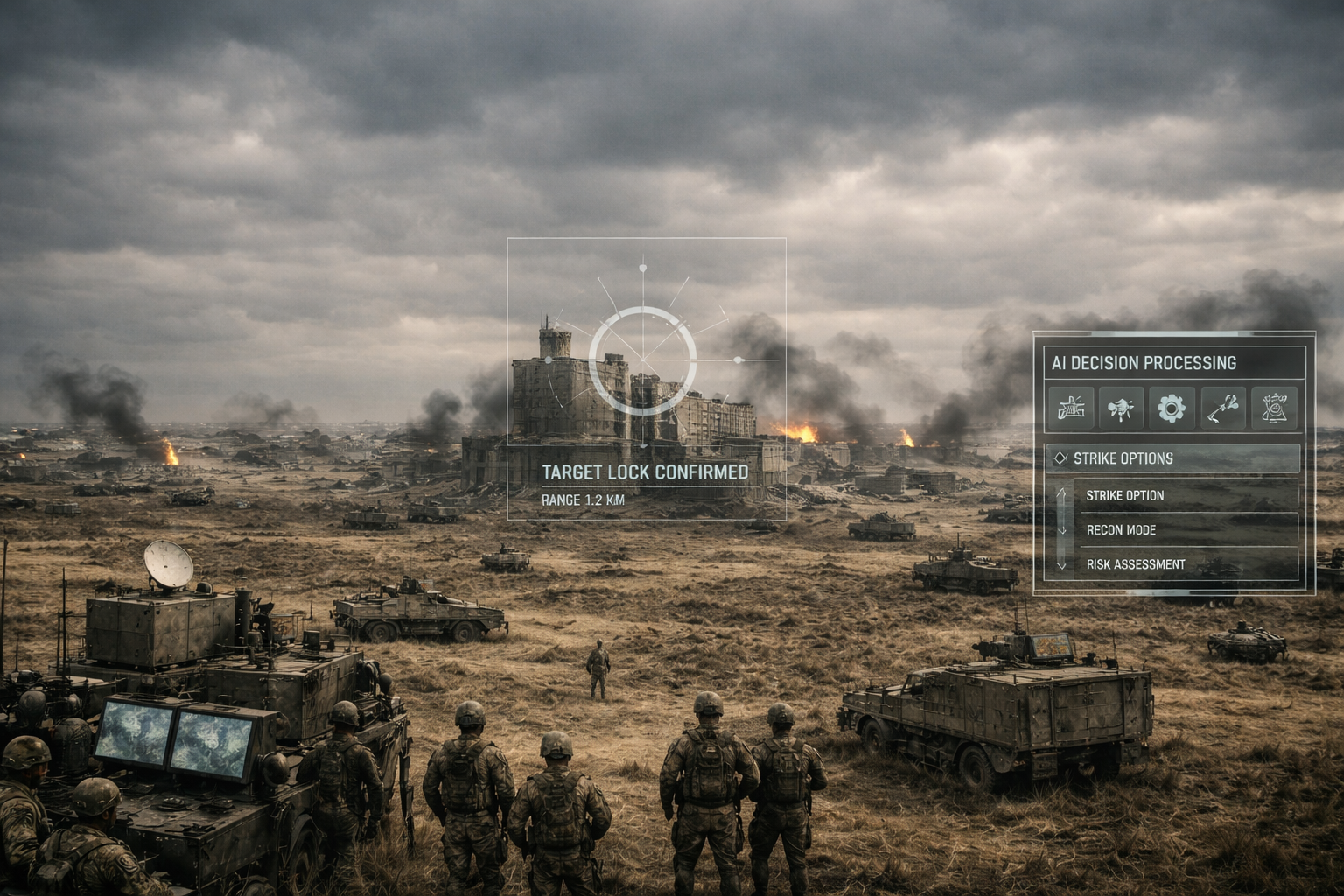


From cryptography to the full automation of war management, the scaling of AI deployment in the military has been driven by optimisation logic rather than rationalised functionality, while the “why” remained largely unaddressed. The current use of AI in the US-Israel war on Iran stresses the need for a legal, ethical, and conceptual assessment of the ongoing remodelling of the battlefield.
From Cryptographic Tools to Agentic War Management
Historically, AI has long been embedded in military tasks, from early cryptographic tools in World War II [1] to logistics planning systems such as the Dynamic Analysis and Replanning Tool (DART) during the Gulf War [2]. The shift in the 2010s toward data-driven deep learning enabled modern computer vision to identify targets through satellite imagery without explicit programming [3]. Today, these capabilities are further enhanced by large language models (LLMs), which support operational planning, intelligence synthesis, and even elements of decision-making.
Delegating the kill switch to a machine we can not explain or hold accountable undermines existing humanitarian law. Although the decision is alleged to be made by military officers, military-trained staff lack the interdisciplinary skills needed to comprehensively evaluate the system’s datasets and outputs. Additionally, non-rule-based AI systems cannot be explained by even their developers. They can not, and should not, be fully trusted, especially after the recurring deceptive behaviour of LLM chatbots.
The Efforts and Limitations of International Law
Since 2014, international efforts to regulate lethal autonomous weapon systems have been underway as part of the United Nations Convention on Certain Conventional Weapons, reflecting growing concern over delegating life-and-death decisions to machines. There is an emerging consensus around a “two-tiered” approach combining prohibitions and regulations. However, disagreements persist over many elements, including what constitutes a “meaningful human control” [4]. At the same time, rapid advances in AI and decreasing costs are accelerating proliferation risks.
Many countries have already been investing in such use, given the survival needs of some and the hegemonic goals of others. Therefore, what can be done retrospectively at this stage is to learn from the mistakes that are being compounded, including the Minab tragedy, and to steer the development of AI towards robust national protection, aligned use with humanitarian law, and a risk management approach. A brief overview of deployments in the figure below [5] shows that some uses, such as training, are more justified than others that directly influence the kill switch, such as autonomous targeting.
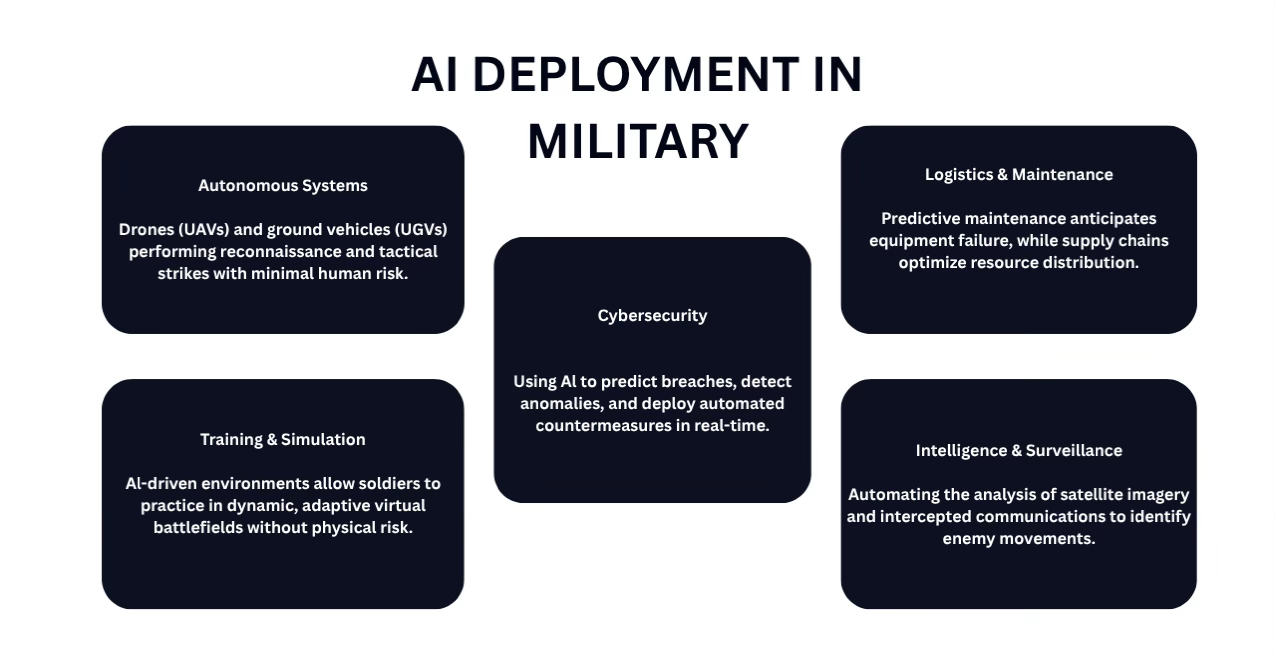
Figure 1: Overview of AI use in the Military (created based on information from the following [5])
The Three-Layer Fronts of War and How AI Scales Them
Beyond the physical battlefield, generative AI tools have been used to produce deepfakes and disinformation campaigns aimed at political destabilisation, while cyberattacks increasingly target digital infrastructure such as data centres. These developments illustrate a multilayered conflict environment in which military, technological, and informational systems are deeply intertwined and increasingly AI-driven.
At the operational level, AI is implemented in the entire F2T2EA “kill chain”: Find, Fix, Track, Target, Engage, and Assess. Computer vision systems identify potential targets, autonomous platforms refine their coordinates, persistent surveillance ensures continuous tracking, and LLM-driven systems generate and prioritise target lists. Precision-guided munitions execute strikes, while automated tools estimate collateral damage [8]. This chain is incorporated in Palentir’s Maven Smart System, which was used by U.S. forces to process surveillance data and identify over 1,000 Iranian-linked targets within the first 24 hours of military operations [6].
The first challenge with such a cycle is the chosen terminology of “workflow” and “chain”, which implies an optimisation-driven “management” of war, losing the intent of functionality and defence goals. Furthermore, this agentic approach to war automation makes AI-driven tasks more tightly linked and harder to debunk, which only complicates accountability and error resolution.
The ethical stakes of this transformation are starkly illustrated by the strike on the Shajareh Tayyebeh girls’ school in Minab, which reportedly killed over 150 civilians. Investigations suggest that outdated intelligence data, coupled with insufficiently maintained “no-strike lists,” contributed to the targeting error [7]. Testimonies from former U.S. defence officials indicate that institutional priorities favoured operational speed and lethality over civilian protection, highlighting a broader cultural shift within military structures [8].
As a global regulatory framework is unlikely to be finalised at this time, efforts should prioritise using AI for risk mitigation and defence rather than target identification and strike execution. This means prioritising tools like verification systems and anomaly detection to support human oversight and judgment. Ideally, AI should be excluded from lethal decision-making and instead applied to safer areas such as training, cyber defence, and risk management. Without this shift, AI-driven optimisation of warfare risks creating scalable conflicts that undermine accountability, ethics, and human control.
[1] Kirthi Jayakumar. (2025). The Military Origins of AI. Civitatem Resolutions. Accessed on March 23, 2026.
https://www.civitatemresolutions.com/feminism-and-tech/the-military-origins-of-ai
[2] Sara Reese Hedber. (2022). DART: Revolutionizing Logistics Planning. Histories & Futures.
https://www.ogu.cz/sagitta/materials/dart.pdf
[3] Artificial Intelligence Timeline. (2019). Military embedded systems. Accessed on March 23, 2026.
https://militaryembedded.com/ai/machine-learning/artificial-intelligence-timeline
[4] United Nations News. (2025). ‘Politically unacceptable, morally repugnant’: UN chief calls for global ban on ‘killer robots.’ Law and Crime Prevention.
https://news.un.org/en/story/2025/05/1163256
[5] Artificial Intelligence In Military Market (2025 – 2030). Grand view research.
https://www.grandviewresearch.com/industry-analysis/artificial-intelligence-military-market-report/request/rs1
[6] Diya GUPTA. (2026). Streamlining the kill chain: how AI is changing modern warfare. France 24.
https://www.france24.com/en/middle-east/20260321-streamlining-the-kill-chain-how-ai-is-changing-modern-warfare-iran
[7] Kevin T Baker. (2026). AI got the blame for the Iran school bombing. The truth is far more worrying.
https://www.theguardian.com/news/2026/mar/26/ai-got-the-blame-for-the-iran-school-bombing-the-truth-is-far-more-worrying
[8] How is AI running the Kill Chain in Iran? | The Security Brief. BBC News.
https://youtu.be/w_11LXTr4UA?si=Fu1ZF0PQFX7CU3yF