


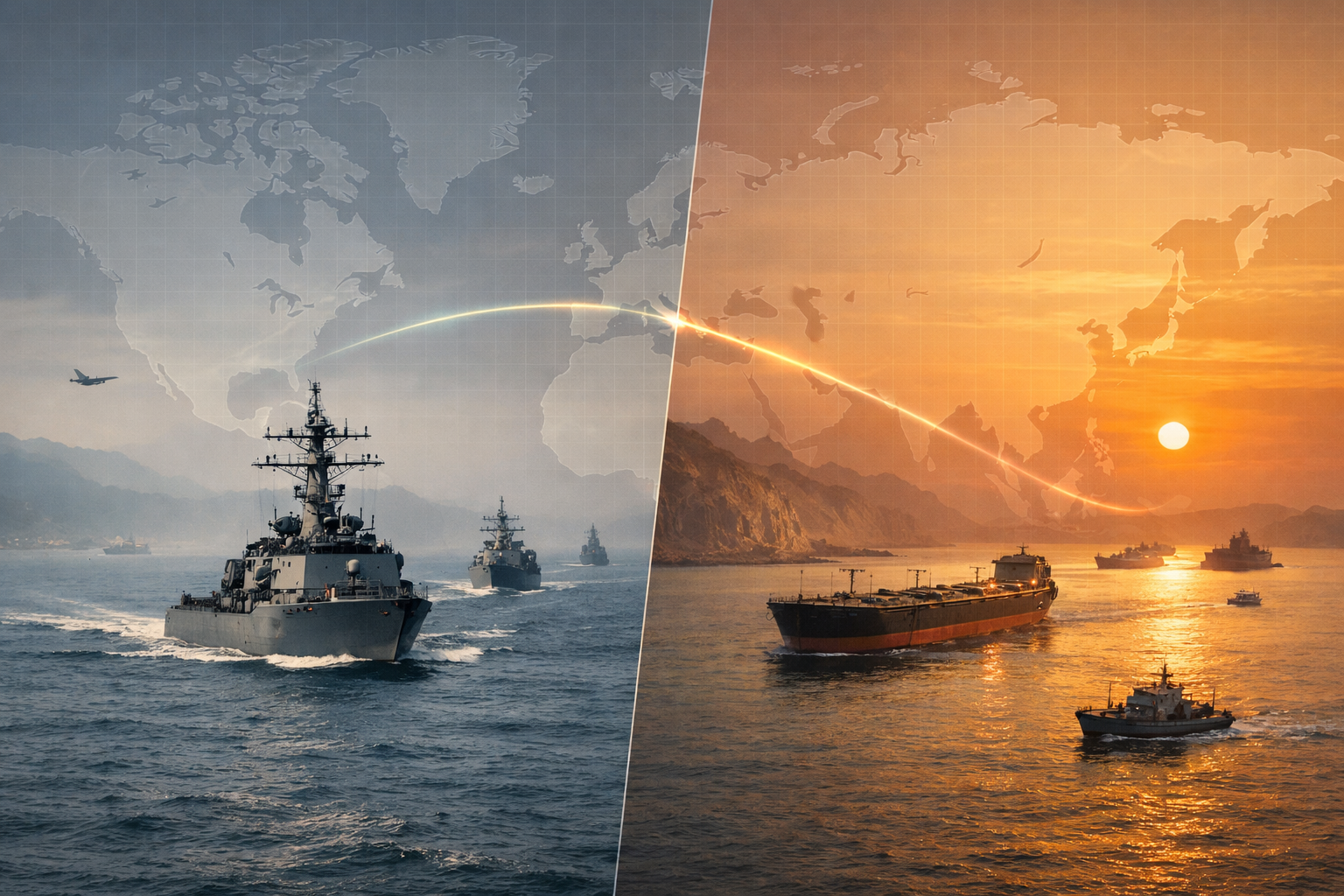


Oil prices have jumped some 40% since the 28 February 2026 commencement of the US/Israel strikes against Iran. As tankers queue up on either side of the Strait of Hormuz, insurers balk at the risk, and US President Donald Trump scrambles to build a coalition to help open it. In addition to Europe, Asia’s main economic powers — China, Japan, South Korea, Taiwan — are feeling the pinch and their factories are slowing down as fuel costs bite. The chaos in the Gulf should not be viewed as a stand alone event but rather as a dress rehearsal of what a flare-up in the Taiwan Strait could unleash. Some 20% of the world’s oil trade passes through the Strait of Hormuz and Iran’s closure of the waterway, and its attacks against its Arab neighbours, has paralysed shipping.
Against this backdrop, Japan’s Prime Minister, Sanae Takaichi, met US President Donald Trump, and faced calls to deploy forces to help secure the strait—95% of Tokyo’s oil sails through there. It’s a demonstration of how one narrow waterway can drive-up costs globally, from Tokyo factories to European pumps. Global shipping — that vast web of owners, banks, and reinsurers — acts like its own sovereign network and decisions hinge on risk, not flags or pleas.
If crisis were to hit the the Taiwan Strait, the stakes multiply as it funnels a significant share of global maritime trade as well, ranging from: chips, electronics and raw materials. Imagine factories in Shenzhen, Seoul, Taipei halting as parts dry up. Taiwan’s chip foundries — half the world’s advanced semis — go dark, costing trillions in lost output. Rhodium pegs direct hits at $1.6 trillion yearly, with knock-on impacts dwarfing the shocks that Hormuz can inflict.
Yet these two Straits mirror each other—they are narrow gateways to economic life for medium and great powers alike. Disruption ripples around the world because these are vital trade routes and the world is an interconnected labyrinth. In 2022, when Russia invaded Ukraine, food prices across Africa and the Middle East were impacted because Ukraine was a vital producer. Now, in 2026, it is Hormuz’ turn and it is the international energy market — and the down stream products (re: petrochemicals such as Qatari helium) — is in flux with prices spiking and growth stalling. Conflict in Taiwan has the potential to undermine global trade further.
In an age defined by the twin peaks of adventurism and resilience, it is important to reinvigorate the institutions that uphold the international order lest we slip back into the geopolitical contests of the 19th and 20th centuries—with all the destruction that generated.