

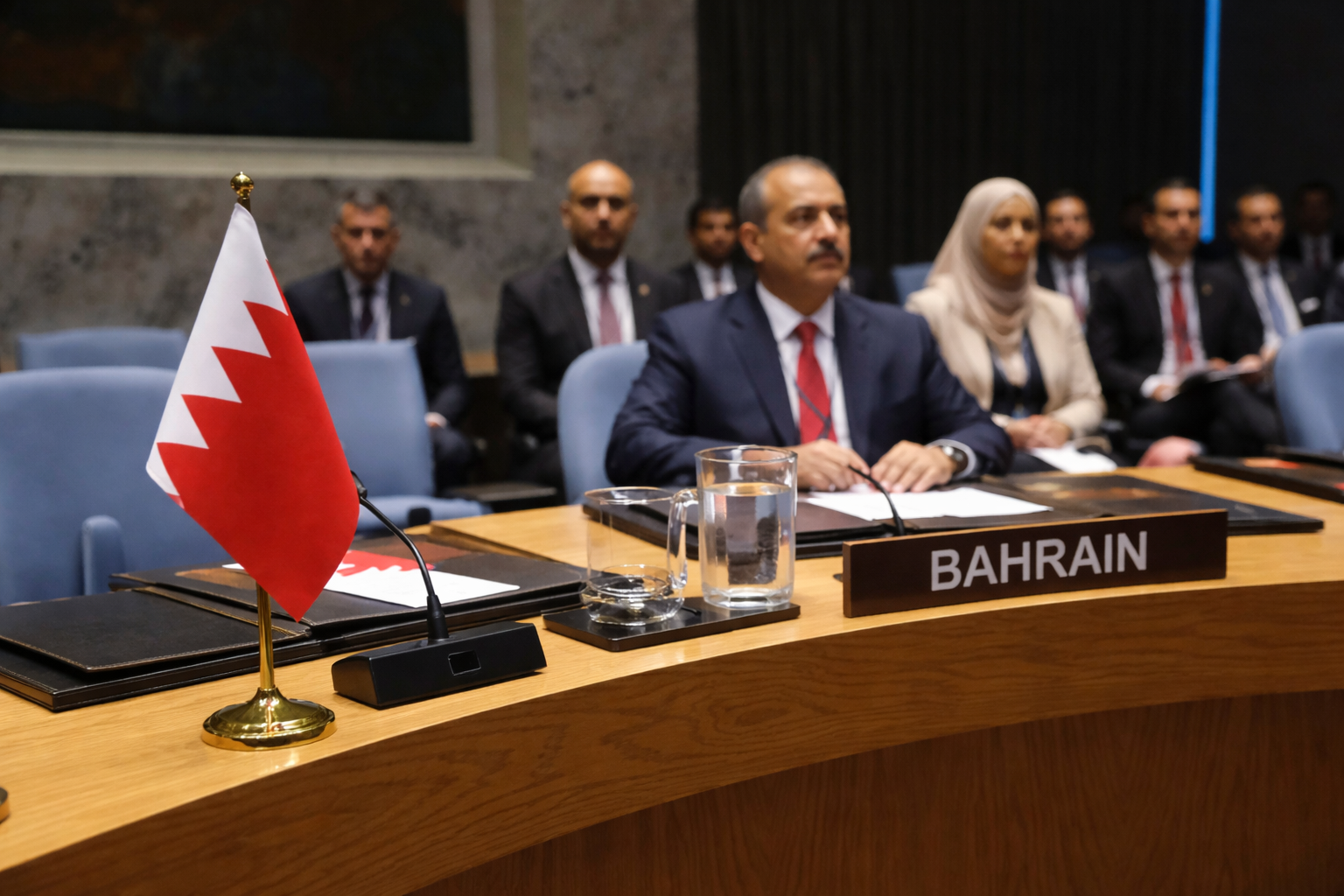


There is a tendency to treat the UN Security Council (the ‘Council’) as a theatre for the great powers, an arena where the permanent five posture, veto, and trade talking points. Yet in the messy reality of diplomacy, it is often the elected, non-permanent members who determine whether the Council functions at all. That is the context Bahrain steps into in 2026-2027, a period when the UN system is expected to manage overlapping crises, while political trust in multilateralism is plainly under strain.
Bahrain’s term should be read as an opportunity, both for the Council and for the wider Middle East. Not because a small state can suddenly ‘fix’ structural problems, but because small states can be unusually effective at the mechanics of progress, narrowing disagreements, drafting workable text, and insisting on outcomes rather than performance. The Council needs more of that kind of diplomacy, quiet, practical, and results-driven.
Bahrain brings a particular kind of strategic realism to this role. As a small Arab Gulf country, it has learned to operate in a neighbourhood where security dilemmas are not academic. Deterrence and dialogue coexist, alliances matter, escalation risks are ever-present, and miscalculation is never far away. Those instincts are valuable inside the Council, where debates can sometimes drift into abstractions, lofty principles that are detached from what actually changes conditions on the ground.
A Bahraini contribution that consistently ‘lands’ in the Council will be one that keeps returning to first principles, including protecting civilians, lowering the temperature in moments of acute danger, maintaining humanitarian space, and safeguarding the flows that underpin economic stability, particularly trade and energy. These are not glamorous themes, but they are the difference between a Council that is useful and one that is merely noisy.
There is, of course, a regional dimension that Bahrain can speak to with credibility. The Middle East remains one of the Council’s most persistent tests, and too often the Council’s engagement has swung between paralysis and overreach. Bahrain can help press for something less dramatic but more effective, steady, incremental diplomacy, rooted in a clear-eyed view of regional dynamics. That means recognising how long-running conflicts mutate, how fragile states become conduits for extremist recruitment, and how humanitarian collapse and security collapse are rarely separable in practice.
Where Bahrain may be at its most influential is on files where it already has practical standing and where the Council can still find common ground. Maritime security is a prime example. For both Europe and the Gulf, freedom of navigation is not a slogan, it is economic security in its most literal form. That makes this an area where Bahrain can help drive sensible Council work, supporting coordination, reinforcing norms, and encouraging the kind of language that deters attacks on commercial shipping without inflaming wider confrontations. It is also an area where Bahrain’s instincts, disciplined, security-minded, and alliance-aware, can translate into proposals that are concrete rather than aspirational.
The same applies to countering violent extremism and the broader prevention agenda. The Council often looks strongest when it acts early, when it backs stabilisation, protects institutions, and supports political processes before conflicts congeal into permanent stalemates. Bahrain can
credibly push that ‘prevention first’ logic, including through support for more inclusive peace processes and the meaningful participation of women and youth in mediation and reconciliation. These are issues that allow bridge-building across regional and political groupings, especially with European members, because they are rooted in long-term security logic rather than short-term point-scoring.
This is where Bahrain’s engagement with Europe becomes particularly important. A productive term will depend, in part, on Bahrain’s ability to work with pragmatically with the Council’s European members, both permanent and elected, on the overlap between regional stability and rules-based order. Cooperation with the EU on humanitarian coordination, sanctions design that reduces unintended civilian harm, climate-related security risks, and maritime resilience should be not only achievable but mutually beneficial. Bahrain’s longstanding relationship with the UK also offers an additional channel for constructive coordination, particularly when Council diplomacy risks sliding into pure messaging.
None of this is about lowering ambition, it is about raising the odds of delivery. In practice, Bahrain’s most valuable contribution may be procedural as much as political, encouraging careful drafting, resisting needlessly escalatory language, and building cross-regional coalitions that give Council outcomes a longer shelf-life. Small states often excel at this because they are less invested in zero-sum theatrics, and more invested in stability that holds.
For Bahrain, the strategic upside is equally clear. A Council term is a global platform, but it can also serve as a vehicle for Gulf security in the broadest sense, by reducing escalation risks, reinforcing norms against targeting commercial shipping, supporting deconfliction mechanisms, and keeping non-proliferation on the agenda in a way that is sober and realistic. Bahrain is also well placed to keep the Council’s attention on the hard truth that humanitarian and security outcomes are intertwined, particularly in the Middle East, where conflict fatigue has become its own form of risk.
Bahrain’s 2026-2027 term should be judged by a simple standard, did it make the Council more useful? If Bahrain leans into coalition-building, especially with European partners, while staying anchored in regional realities, it can demonstrate what strategic influence looks like for a small state. Not dominating the agenda, but improving the quality of the Council’s work. And in today’s polarised geopolitical environment, that is not a minor achievement.
Sources
UN Information Centre Manama – ‘Bahrain Begins Term as Non-Permanent Member of the UN Security Council’, 8 January, 2026
https://www.un.org/en/information-center-manama/bahrain-begins-term-non-permanent-member un-security-council
Bahrain News Agency – ‘Foreign Minister: Bahrain’s UN Security Council membership for 2026– 2027 conveys a message of peace and cooperation’, 1 January, 2026
https://www.bna.bh/En/ForeignMinisterBahrainsUNSecurityCouncilmembershipfor20262027conveysamessageofpeaceandco operation.aspx?cms=q8FmFJgiscL2fwIzON1+DtqFrF3Y9zaNrpuqG/d06s0=
Derasat (Bahrain Center for Strategic, International and Energy Studies) – ‘Bahrain on the Brink of Renewed Membership in the UNSC (2026-2027)’, 28 October, 2025
https://www.derasat.org.bh/en/bahrain-on-the-brink-of-renewed-membership-in-the-un-security council-2026-2027/
Mohammed bin Mubarak Al Khalifa Academy for Diplomatic Studies (Bahrain) – ‘Mohammed bin Mubarak Al Khalifa Academy holds dialogue with EU Special Representative for GCC’, 4 November 2025
https://www.bna.bh/en/news?cms=q8FmFJgiscL2fwIzON1+DhbSagIf4ghBJOZTA24eCGA=