

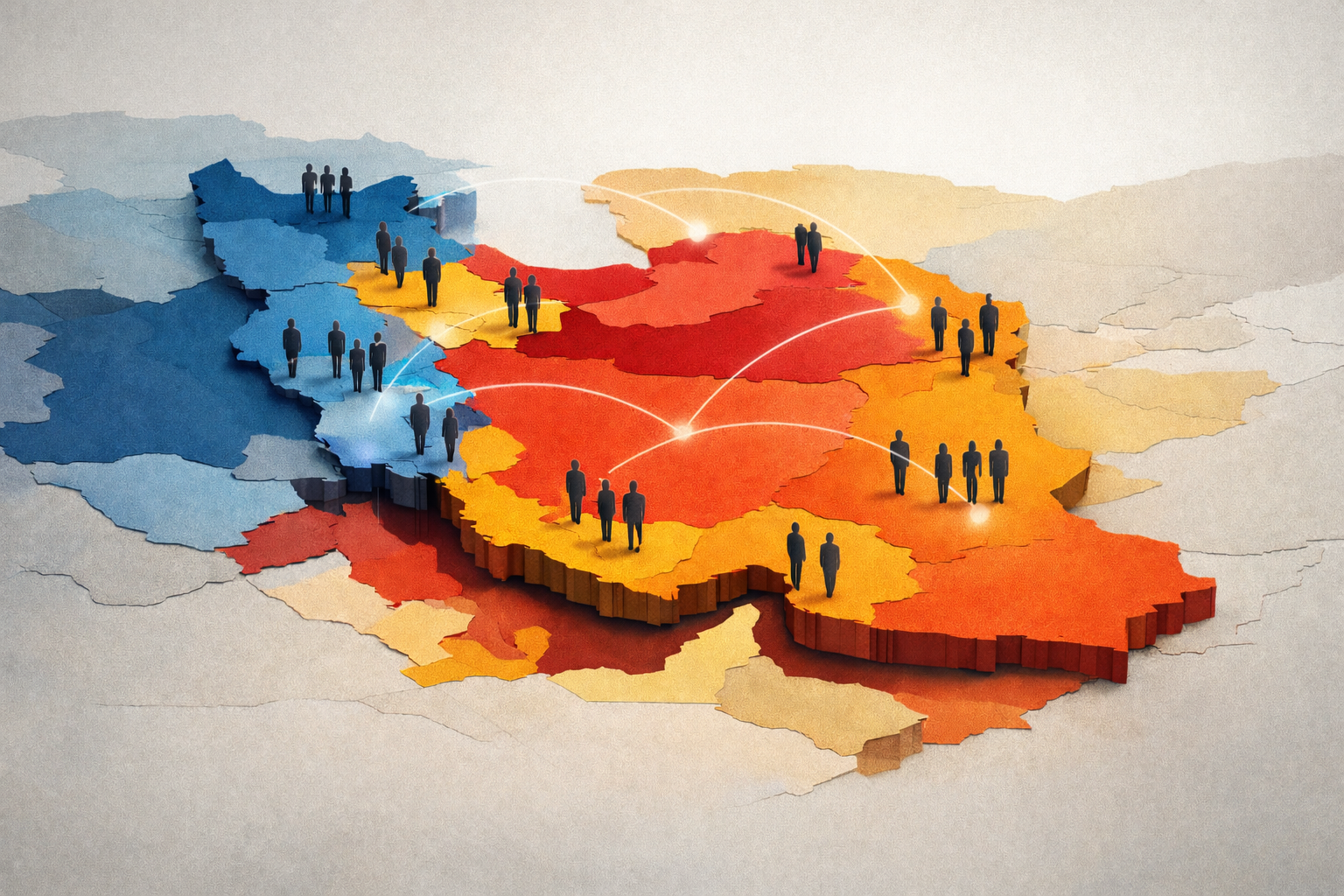


In popular discourses, the term Iranian opposition, tends to evoke the imagine a united political bloc that stands as an alternative to the current regime of the Islamic Republic. In reality, Iran’s opposition resembles more of an ecosystem: a constellation of actors, networks and symbols that move on different planes, without consistent coordination mechanisms and often with varying ultimate objectives. While there is a bottomline goal of dissecting the office of the Ayatollah, the Islamic Revolutionary Guard Corp (IRGC), Guardianship Council and the other institutions of revolutionary Iran, the ‘what-comes-next’ is not shared across the entire ecosystem. For this reason, it is appropriate to speak of a conceptual geography of groups to answer: 1. what are the main spaces of dissent, 2. how do dissenting groups communicate to each other and, 3. what issues retard the deepening of their collaboration and therefore reduce their ability to form a functioning alternative of the existing governing system?
The institutional context matters. The Islamic Republic is a hybrid system in which elected institutions and ordinary administration coexists with unelected centres of power and — in moments of crisis — an imbalanced role for the security apparatus. In other words, it is not a monocratic dictatorship. In the most intense cycles of upheaval, ordinary political competition among various actors of the Islamic Republic is, in fact, compressed and the conflict is treated as an existential threat.
First Space: Opposition as Society Within the Country
Inside Iran, opposition is a social fact before it is a party-specific issue. Organised channels are constantly exposed to repression, infiltration or delegitimisation and there is a recurring pattern. Mobilisation spreads through informal networks — professional communities, universities, markets, neighbourhoods and even families — and when recognisable figures emerge, they tend to be neutralised quickly or forced into silence. To survive, the internal opposition often adopts decentralised and “leaderless” forms, not by choice but by necessity.
The popular protests that began on 28 December 2025 provide an example of this dynamic: an economic trigger (currency collapse, cost of living, generalised discontent) transforms into an openly political protest which then morphs into direct confrontation with the system, with a response that combines repression and an information strangulation. In such an environment, protest can be broad and persistent without producing a stable apex, because that apex is the first thing the regime is able to strike.
In the first space, when one speaks of leaders, it is more accurate to think of figures who function as moral, symbolic or thematic reference points, rather than operational. For example, long-term political prisoners, such as Mostafa Tajzadeh, digital freedom activists such as Hossein Ronaghi, or cultural figures who have given voice to dissent, such as the rapper Toomaj Salehi are not leaders in a chain-of-command, but points of narrative and reputation aggregation that the system fears precisely because they help give continuity to the memory of protest.
It remains true that the perception of an anti–status quo consensus is widespread. There are widely cited studies indicating a large majority oppose the continuation of the current system, but with strong divergences over what should replace it. In the GAMAAN report on political preferences (2024 survey) about 70% of respondents state that they oppose the continuation of the Islamic Republic, and the most frequent disposition is the one that considers regime change a precondition for any change (about 40%), followed by orientations that imagine a structural transformation and a more gradual transition. In the 2022 GAMAAN survey on preferred system forms, when asked which regime type would be desirable, the choice was distributed among a secular republic (34%), an Islamic republic (22%), a constitutional monarchy (19%) and an absolute monarchy (3%), while more than over 21% declared they did not feel sufficiently informed to answer. Such data is valuable for capturing an underlying orientation, but they must be read as indicators with methodological limits, not as a referendum. The substance, however, is politically decisive: many reject the status quo, far fewer agree on the “after.”
Second Space: Opposition as Political, Identity and Rights Fracture
The cycle that started in 2022 with Women, Life, Freedom has provided dissent with a common language, capable of holding together individual rights, rejection of social control and a demand for dignity; in subsequent waves — even when the sparks were economic or geopolitical — that frame has remained the most recognisable symbolic reference. For this reason, Women, Life, Freedom, also functioned as a bridge: from the women’s question and freedom over the body it broadened the discourse to citizenship, discrimination, repression, pluralism and the quality of the State, offering a shared lexicon to very different social and identity segments.
The second space is not a map of provinces, but of fractures: rights, inequalities, linguistic or confessional identities, relationship with the State, historical memory. Here opposition does not always present itself as an alternative national programme, but as a request for protection, an end to discrimination, administrative autonomy, fair access to resources and services. This level broadens the base of dissent because it brings politics into everyday life; at the same time it makes it more difficult to unify the opposition, because what for some is pluralism and recognition, for others is perceived as a risk of fragmentation or as a lever the regime can use to divide.
In this area of the conceptual map, particular weight is carried by those figures who, while not belonging to the urban secular-progressive tradition, have assumed a bridging role between civil claims and social legitimacy. The most cited case is Molavi Abdolhamid, a Sunni leader in Zahedan, who denounces violence against protesters and has insisted on the right to protest—he is not a leader of an organised opposition, but his voice matters because he speaks to segments that regime propaganda denounces as Westernized elites.
The international dimension of human rights enters here as a pressure factor, but also as an accelerator of the regime’s hardening. The fact that multilateral venues and international organisations have intensified investigative attention on repression signals that the rights dossier has become part of political and reputational contention: a potential cost in the long term and, in the short term, an incentive for the regime to further close civic space.
Third Space: Opposition as Diaspora, Visibility and Competition
The third space is the diaspora: the area in which the opposition can do what inside Iran is almost impossible: organise and attend conferences, build coalitions, raise funds, exert political pressure and speak steadily with the international information, political, economic and security ecosystems. The diaspora is also, inevitably, a competitive space: more freedom means more pluralism, but also more leadership conflicts and more struggles for the monopoly of representation. In this space Women, Life, Freedom has also acted as a political-cultural brand of the movement: a recognisable and translatable label, capable of mobilising communities and international public opinion and of giving a common identity to the diaspora’s squares, without requiring a single leadership or a centralised structure.
In this space Reza Pahlavi, the Crown Prince and son of the last Shah of Iran, has returned to be a central pillar and a symbolic catalyst by virtue of very clear and penetrating social communication. A relevant feature of his most recent phase is the support he seems to garnish from among many of the youngest in the diaspora, especially in the West—a generation raised outside Iran, often born after 1979, tends to look for non-religious symbols, a simple national lexicon, and an image of institutional normality. In various mobilisations abroad this is reflected in the presence of symbols and pre-1979 references and in the frequency with which his name re-emerges as a possible pivot of coordination. It is a cultural and media consensus more than an organisational one.
On the political level, Pahlavi seeks to transform visibility into a transition proposal. The stated line is to present himself as a figure with a mandate to an outcome decided by Iranians, with the insistence on a secular and democratic Iran and on a legitimate process that establishes the form of the state. Within this framework is the plan promoted under the label Rise Iran, structured as a five-point plan: maximum pressure on the regime; maximum support to the people; maximum defections from within; maximum mobilisation; and a reconstruction chapter. The most substantial point is the Iran Prosperity Project and in particular the Emergency Phase document, which tries to reduce uncertainty about the “day after” by outlining priorities and provisional architectures for the first 100-180 days: administrative continuity, transitional legal frameworks, control of the chain of command in security, and a set-up that also envisages instruments of popular legitimation such as a referendum on the system of government. It is an attempt to respond to a recurring critique addressed to the diaspora: talking about collapse without talking about immediate governance and continuity of the state.
Besides Pahlavi, other actors remain central who explain fragmentation and, at the same time, the recurring rehearsals of unity. An important example is the brief season of the Mahsa Charter and of the Alliance for Democracy and Freedom in Iran, which had brought together very different names: Masih Alinejad and Nazanin Boniadi as media and advocacy faces, Hamed Esmaeilion as a figure that emerged from the movement of the families of flight PS752, Shirin Ebadi as a juridical and moral authority, Abdullah Mohtadi as a Kurdish exponent. The trajectory of that experiment — born to coordinate and then quickly worn down by divergences on leadership, method and representation — is instructive because it shows how difficult it is, in the diaspora, to transform convergence on the “against” into a common structure on the “for.”
Within the perimeter of the diaspora non-political have also become more visible, such as the former footballer Ali Karimi and actress Golshifteh Farahani who matter because they amplify protest and translate it into popular languages, but can hardly solve the problem of the institutional construction of a transition.
Then there is the organised MEK/NCRI bloc which is associated with the leadership of Maryam Rajavi, and represents — in the constellation of the diaspora — the actor with the most party-like structure: a disciplined political machine, with international networks, fundraising capacity, event organisation and a steady presence in Western advocacy circuits. Over time the MEK has sought to reposition itself as an alternative government in exile through the NCRI, presenting itself as a transition platform and claiming an agenda of a pluralist republic and civil rights and manages to do what other segments of the diaspora do only intermittently.
Yet the MEK/NCRI is among the most polarising actors: its past of armed struggle and the long season in which it operated from Saddam Hussein’s Iraq weigh heavily, factors that many Iranians, even those hostile to the Islamic Republic, consider delegitimising. Additionally, controversies about the internal nature of the movement and its organisational practices weigh, which some observers and reports have described in terms of strong control and sectarianism. The MEK replies that it has renounced violence and that it is the object of delegitimisation campaigns fuelled by the regime. Indeed, its international trajectory has been marked by important formal passages, such as the US delisting from the category of terrorist organisations in 2012, often evoked by its supporters as proof of political normalisation. The central political point remains, however: its reputation divides and hardens, and this polarisation produces a practical and repeated effect in phases of mobilisation, because during protest waves a portion of energy is absorbed by the conflict among oppositions — MEK versus monarchists, MEK versus liberal republicans, MEK versus non-aligned “civil” activism — reducing the space for credible common platforms and making it more difficult, externally, to present a united front that is both representative and reassuring about the “day after.”
In the area of rights and communication: activists, journalists, campaigns that keep international attention high and function as an echo chamber for those in Iran. Their role is often decisive in making repression visible and generating reputational costs; their limit is that, by definition, they do not replace a political architecture of transition. In a different register are figures of moral legitimacy and testimony, such as Narges Mohammadi, and lawyers and rights defenders such as Nasrin Sotoudeh: they are not coalition builders but contribute to setting guardrails and criteria of credibility, especially on nonviolence, rights and responsibility.
Finally, there is a “historic” reformist line, tied to the memory of the Green Movement: today it counts more as a lesson than as an organisational engine. It recalls that part of Iran tried for a long time to change from within and that the erosion of trust in that path fuelled the radicalisation of dissent in increasingly broad segments.
Immediate Prospects: Where the Balance Shifts
The trajectory of the opposition will depend less on a decisive announcement and more on three reinforcing variables:
- the cohesion of the repressive apparatus—if it remains compact and motivated, the system can continue to treat the crisis as a public order issue. If cracks or defections become rampant, the nature of the confrontation itself changes.
- the organisational continuity of internal dissent—intermittent and isolated protests are manageable; strikes, shutdowns, professional coordination and more stable civil disobedience raise the cost of repression and increase pressure on the ordinary functioning of the State.
- the quality of the bridge between inside and diaspora—not visibility, but practical usefulness—resilient communications, material support to civic networks, resources, and above all a minimally credible platform for the “day after.”
These three variables will, of course, be tested if Trump makes good on his word and uses US military power to strike at the heart of the Islamic Republic. Of course, US military power alone will not solve the opposition groups’ jockeying but it may just open enough space for Iranians to engage in real work toward the future of the country so that it encompasses and represents all segments of society in a truly pluralistic manner.