

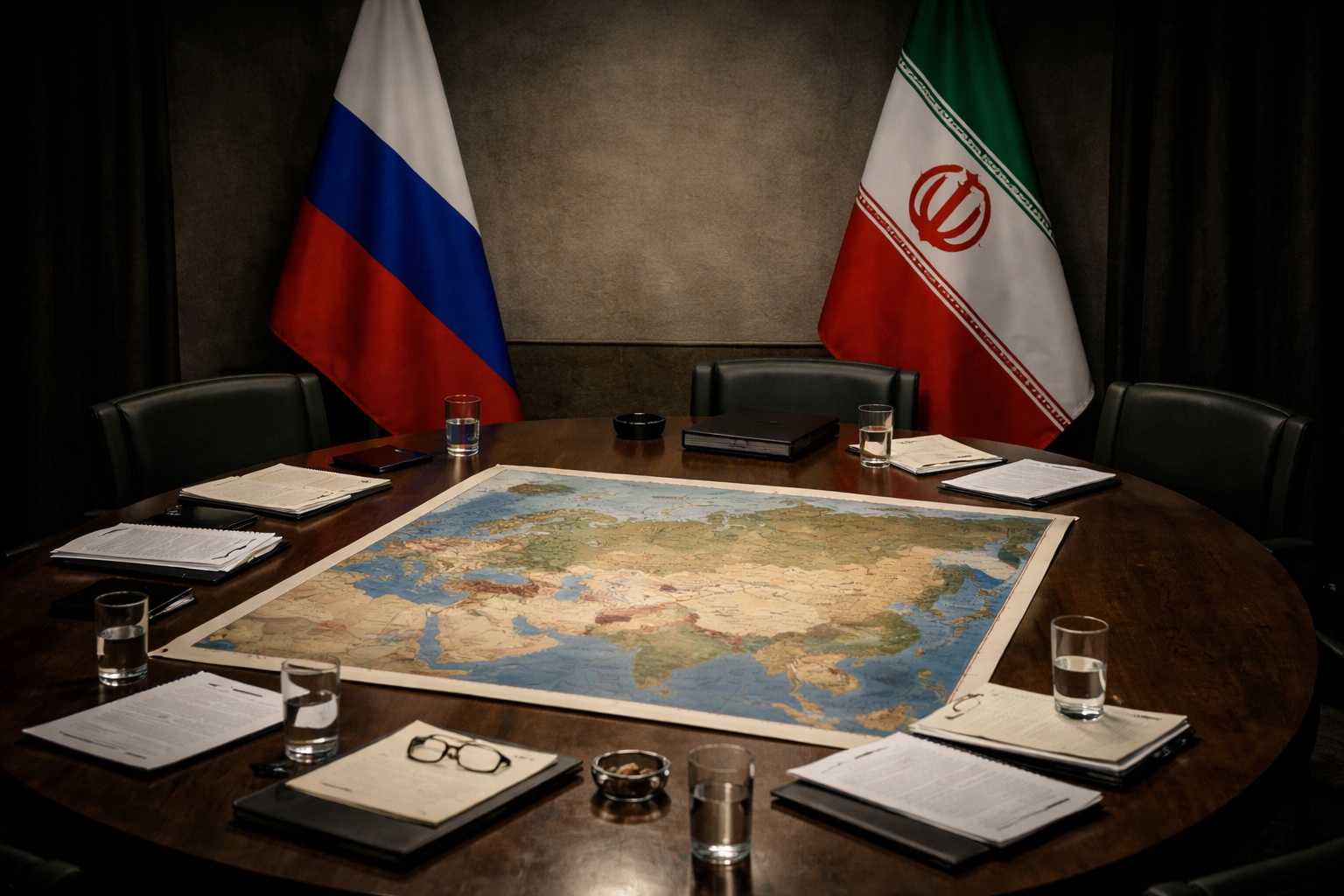


The war between the US/Israel with Iran and Iran’s lashing out at the Gulf Cooperation Council (GCC) members is generating complexity on the regional and international levels. Russia – an enduring partner of Tehran – seems to be retaining an ambivalent position when it comes to the crisis in the Middle East, by partially condemning the United States and Israel’s intervention, but at the same time remaining fixed on the sidelines.
Russia has long retained a positive relationship with Iran. Since the birth of the Russian Federation – following the collapse of the Soviet Union – Russia faced short periods of international integration and significantly longer periods of global isolation and enormous internal difficulties. At the same time, the Islamic Republic of Iran was grappling with sanctions imposed by the United States for supporting terrorist/insurgent groups and for its nuclear programme [1], pushing Tehran and Moscow to collaborate to prevent international isolation. The two countries have further aligned in the following thirty-years over the convergence of a number of interests, both in the international and in the regional chessboard, such as countering US/NATO influence in the region, economic necessity and nuclear and military cooperation. In January 2025, the two countries signed a strategic partnership agreement, expanding economic cooperation, and strengthening security and political coordination [2]. In contrast with similar agreements signed with Belarus and North Korea, Moscow is not obliged to intervene militarily in case of an attack on Iran.
On the other hand, Russia’s relationship with the Gulf countries is pragmatic and positive. For Moscow, ties with the Gulf provide an important diplomatic and economic outlet amid ongoing EU/US sanctions and isolation [3]. And, for the Gulf countries economic ties with Moscow underscore economic diversification and neutrality, safeguarding their own strategic autonomy, while opening to new markets for the Gulf economy. Still, there is limited trust and no deep convergence of long term interests. The relationship, while stable, is cautious [3] and based on issue cooperation rather than a long-term broader strategic partnership. Additionally, it should be noted that the Russian community in the Gulf region, particularly in the United Arab Emirates, is the most conspicuous one in the MENA region, comprising 100.000 Russian-speakers [4].
Russia’s Middle Eastern agenda has one keyword: balance. The relationship with Iran is important, but it’s not driven by fraternity but forged more out of necessity. After the fall of Assad’s regime in Syria (2024), Moscow lost a key foothold in the Middle East, forcing it to rely more on Tehran. If Iran becomes consumed by war, and if its capacity to deter the US/Israel continues to wane, Russia will lose its strategic depth [5]. At the same time, Russia aims at maintaining a positive relationship with the Gulf countries in light of the economic relationship and future possibilities of investment in the region. Russia is currently walking on a tightrope – backing Iran without alienating the Gulf – to safeguard national interests in the region including the development of the BRICS trade network.
Three points of analysis are relevant to look at when discussing Russia’s positioning in the Iran war:
- Ukraine – Russia is currently focused on advancing its invasion of Ukraine, started in 2022. European countries have provided an incredible amount of weapons to Kyiv, but with the conflict in Iran, Europe is cautiously shifting priorities to the Gulf, to secure European energy supplies, partly abandoning the Ukrainian front. Hence, it is plausible to expect an increase in the coming months in Russian attacks on Ukraine to pressure Europe.
- Energy – Russia is currently profiting from the Iranian war. The global oil price rose from $60 in January to over $103 by 13 March; natural gas prices have been affected as well, with a 50% increase [6]. Europe faces a sharpened energy crisis risk with the closure of the Strait of Hormuz; however, in an interview with Reuters, the EU’s Kaja Kallas underlined how there’s no appetite in Europe to normalise energy relations with Moscow [7].
- The Russian Muslim community – Islam is the second-largest religion in Russia, with approximately 26 million followers, or 15% of the total population. […] The majority of Muslims in Russia live in the North Caucasus republics, the republics of Tatarstan and Bashkortostan, and the capital city of Moscow [8]. Russia is closely watching the conflict, conscious that its fallout may resonate with the Muslim community in Russia and challenge domestic cohesion as it did during the 1979 Iranian revolution which prodded the USSR to invade Afghanistan.
Even if the Russian Federation profits by the closure of the Strait of Hormuz, the advantages for Moscow will not be long-term. In fact, closing such an essential choke-point has implications not only on the energy sector, but on all supply chains connecting East and West. Closing the Strait entails an international collective damage, such a shock to a crucial choke point impacts the international market, and Russia as well in the long-term. Reopening the Strait can prevent a global economic crisis, which is one of the top international priorities.
* * *
Russia is walking on a tightrope in the Iranian crisis, all the moving parts are pulling Moscow in different directions: on one hand, Russia benefits from the conflict due to the increase of energy prices and new opportunities in its war on Ukraine. On the other hand, Russia risks losing another crucial partner in the Middle East after Syria, a matter that might push Moscow to reevaluate its Middle Eastern strategy. Still, Moscow cannot fully support Tehran because it risks losing the Gulf countries as economic partners. For Russia, Iran is a conundrum, based on short-term and long-term calculations.
Sources:
[1] Osservatorio di Politica Internazionale. 2024. “Russia-Iran. Storia, direzioni e significato di una cooperazione in crescita”.
https://www.parlamento.it/application/xmanager/projects/parlamento/file/repository/affariinternazionali/osservatorio/approfondimenti/PI0221.pdf
[2] Wilson Center. 2026. “Russia’s Iranian Conundrum”.
https://www.wilsoncenter.org/article/russias-iranian-conundrum
[3] Gulf Research Centre. 2025. “Russia-GCC Relations”.
https://www.grc.net/documents/684e6aef7e97aRussiagccCountryProfileApril252.pdf
[4] TRT World. 2022. “Why are wealthy Russian exiles fleeing to Dubai?”
https://www.trtworld.com/article/12790599
[5] Chatham House. 2026. “The Iran war exposes the limits of Russia’s leverage in a fragmenting regional order”.
https://www.chathamhouse.org/2026/03/iran-war-exposes-limits-russias-leverage-fragmenting-regional-order
[6] The National Interest. 2026. “Is Russia the Winner of the Iran War?”
https://nationalinterest.org/feature/is-russia-the-winner-of-the-iran-war
[7] Reuters. 2026. “Exclusive: EU’s Kallas rejects Belgian PM’s call to normalise Moscow ties, get cheap Russian energy”
https://www.reuters.com/world/europe/no-appetite-eu-energy-deals-with-russia-kallas-says-2026-03-17/
[8] Emirates News Agency. 2024. “Islam in Russia: Unique Blend of History, Modernity”
https://www.wam.ae/en/article/13tpze9-islam-russia-unique-blend-history-modernity