




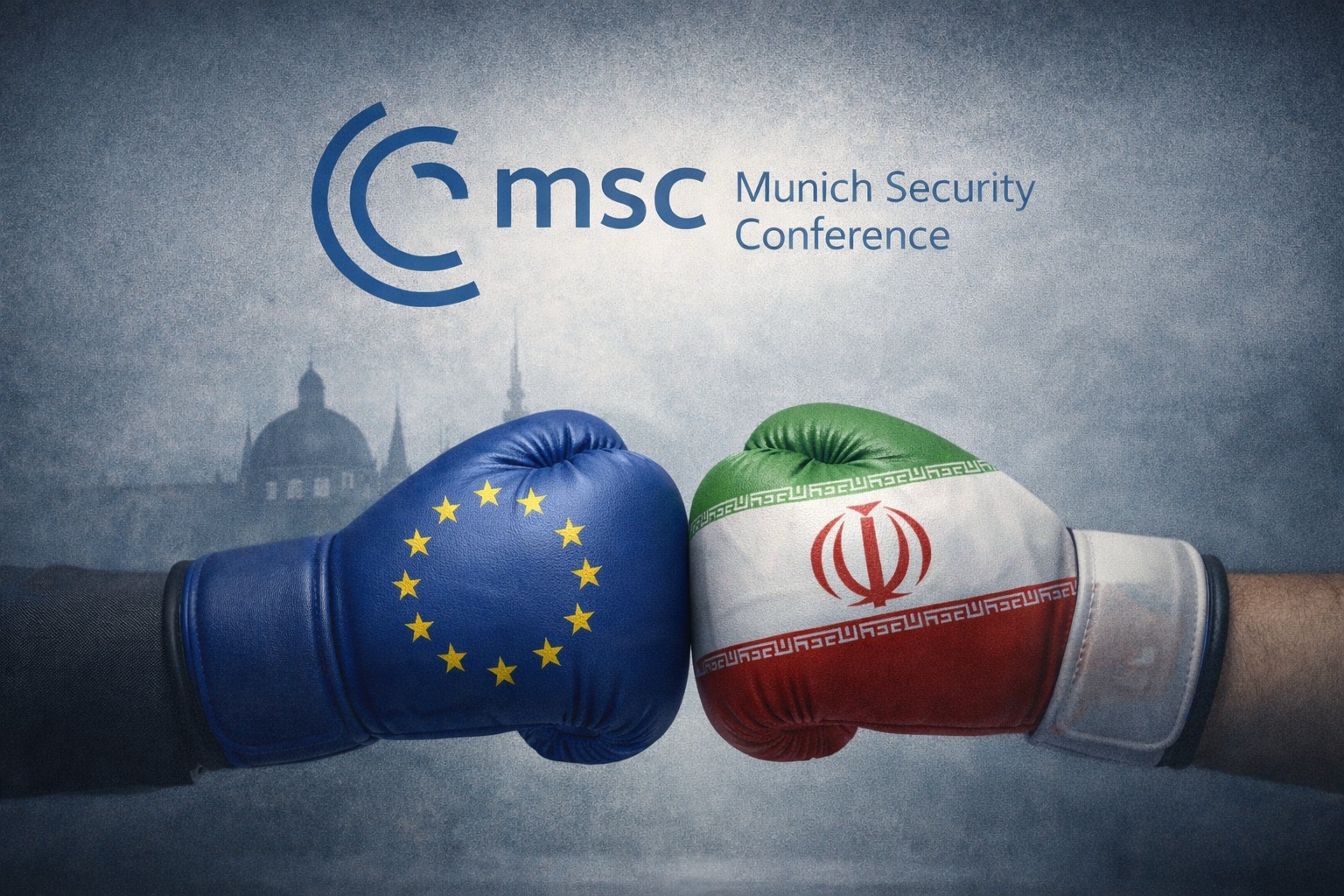


Examining the priority topics and selected speakers at the Munich Security Conference (MSC) is usually a reliable way to gauge Europe’s most urgent security concerns—and its posture. While Ukraine and transatlantic relations dominated discussions at this year’s 62nd MSC, there was a significant shift in Europe’s position towards the Islamic Republic of Iran. Against the backdrop of a violent crackdown against Iranian protesters by the regime’s security forces, rehashed Washington-Tehran negotiations, and the looming spectre of a major military confrontation with the US, it is important to assess the European vantage.
Two events at MSC 2026, dedicated to Iran, stood out and pointed to a recalibration and hardening of Europe’s approach to the Islamic Republic—from management and engagement to confrontation. While, in the past, Iranian state officials were often featured speaking at MSC, this year they were excluded and replaced with opposition figures such as Reza Pahlavi (son of the last Shah overthrown in 1979) and foreign EU and US officials — European Parliament President Roberta Metsola and Senator Lindsey Graham — openly critical of the regime. Rather than focusing on engagement and managing tensions with the regime, discussions centred on the future of Iran and what could come after the current regime. This dynamics prompted an outcry from Foreign Minister Abbas Araghchi and Iranian state media trying to ridicule the MSC.
This messaging was deliberate, signalling a wider shift in Europe. For years, many in Europe preferred to manage strained relations with Iran’s theocratic leadership largely due to the absence of a viable alternative and the associated risks and uncertainty. As a result, Europe largely looked away or downplayed the situation, despite Iranian-orchestrated attacks and assassinations on European soil and undermining European security interests abroad. Aware of this dynamics, Pahlavi presented his proposal for a roadmap for Iran’s political transition in Munich, which — as he foresees — would ultimately lead to a referendum where Iranian people could choose their political system. He also used the platform to call for increased international pressure to decapitate the Islamic Republic’s leadership.
The tone of these events was markedly different, mirroring a growing belief in European capitals that the regime is severely weakened. After its proxies were downgraded and its main ally in Syria deposed, many came to realise that managing the regime will not suffice this time. However, Europe’s shift was not sudden, but rather the culmination of a series of events including:
- Iran’s nuclear enrichment beyond civilian use levels,
- the Woman, Life, Freedom protests,
- assassinations and collaboration with organised crime groups in Europe (such as Foxtrot in Sweden),
- proxies, such as the Houthis and Hezbollah, undermining Europe’s security interests,
- executions and imprisonments of dual European-Iranian citizens,
- Iran’s hostage-taking diplomacy,
- European intelligence services sounding alarm at heightened Iranian-state linked activity across the continent, and
- Iranian military cooperation with Russia against Ukraine.
Particularly, the spotlight on Russian-Iranian military cooperation against Ukraine in 2022 made it increasingly difficult for European policymakers to ignore and more directly connected Iran to a key European security challenge.
This point was emphasised by Ukraine’s President Volodymyr Zelenskyy at MSC, where he condemned the Iranian regime and its drone supply to Russia for strikes on Ukrainian civilians. During his main speech, Zelenskyy endorsed the ongoing protests in Munich against the Iranian regime, saying ‘this regime has already done and can still do more harm than many other regimes could this century.’ Zelenskyy drew parallels between the Iranian protests and the Russian invasion, saying that today the people of Iran expect the same things from the world as Ukraine did on 24 February 2022: unity, determination and speed, and explicitly called for stopping the Ayatollah and the Islamic Republic regime.
Various European domestic intelligence agencies, including in Germany and Sweden, have been raising the alarm about intensified Iranian activity on their soils. In July 2025, 10 EU countries — Austria, Belgium, Czechia, Denmark, Finland, France, Germany, Netherlands, Spain and Sweden — together with Albania, Canada, the UK, and the US, condemned Iranian state-linked intelligence activity involving killings, kidnappings and harassment on their territory, citing Iran’s collaboration with international criminal networks to target journalists, dissidents, officials and Jewish citizens. Shortly after, following several failed diplomatic attempts, France, Germany and the United Kingdom triggered the snapback mechanism to reimpose United Nations sanctions on Iran for non-compliance.
For years, the European Parliament has been calling on the EU member states to designate the IRGC — tasked with protecting the Islamic Revolution domestically and advancing its ideological mission beyond Iran — as a terrorist organisation but it was the latest crackdown that ultimately led to the designation. First, President Roberta Metsola formally banned Iranian officials and representatives from the European Parliament’s premises. A group of EU countries, led by Germany and the Netherlands, have been mounting pressure and on 29 January 2026, after France, Italy and Spain lifted their opposition, the EU members unanimously agreed to designate the IRGC as a terrorist organisation. It was the first time that the EU used its terrorism legislation against a state-linked entity, a move that prompted retaliatory designation by the Islamic Republic against European armies. Metsola’s Munich message of solidarity with the Iranian people, ending routine diplomacy that legitimises the regime and stronger support from Europe for protesters so that it does not let them down as it did after earlier waves, has reinforced Europe’s political shift that looks beyond the Islamic Republic. Although, Europe’s response is likely to remain confined to statements, condemnations and economic pressure, mainly through sanctions.