



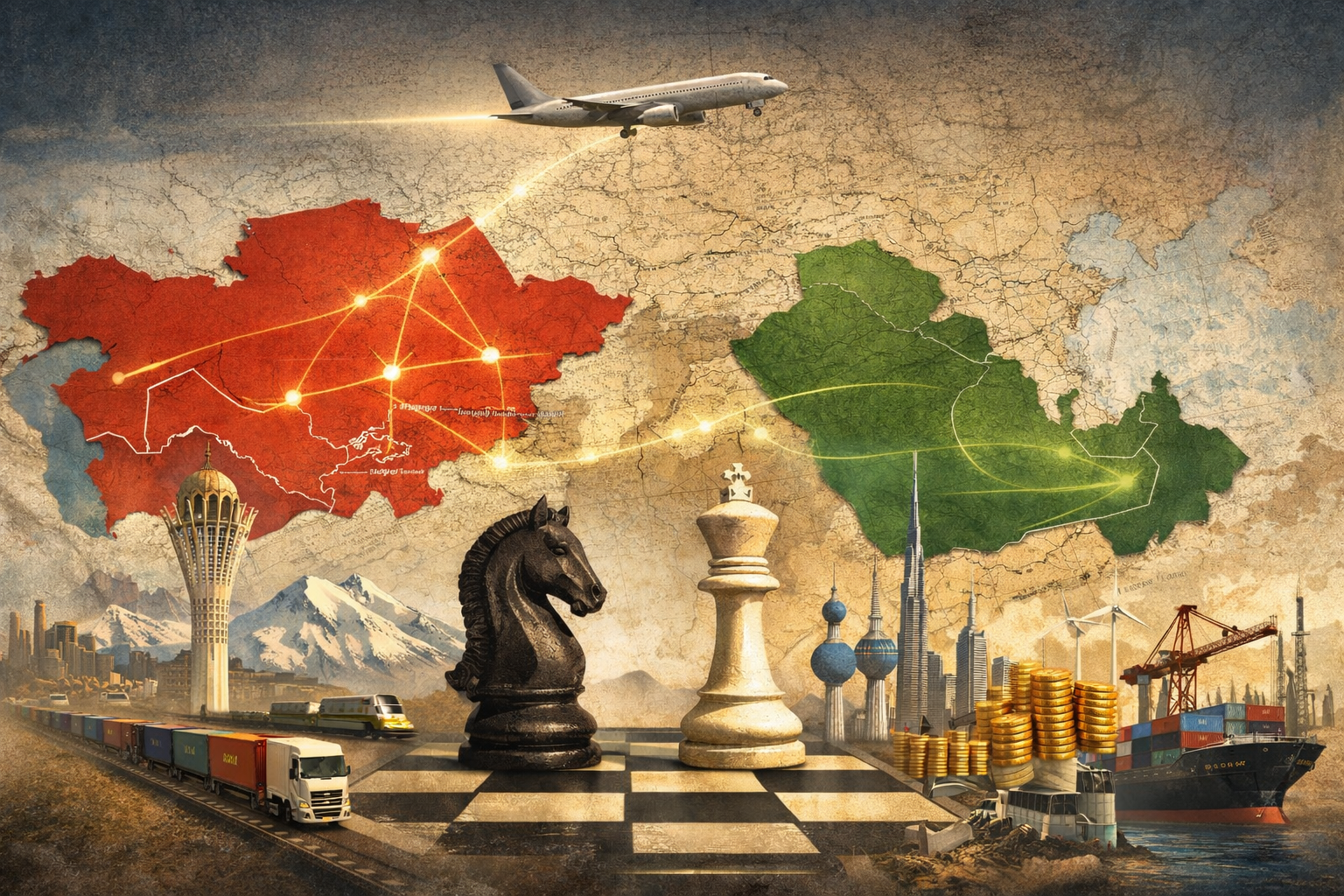


Mackinder’s Heartland and Rimland theory, outlined in his 1904 article titled ‘The Geographical Pivot of History,’ suggests that international power is directly influenced by geography. In general terms, he asserts that the actor that successfully controls the heartland, namely the Eurasian geographical area, possesses the capability to dominate the globe. With 122 years since the first development of the theory, its recalibration with current times is crucial to understanding the weight that it still holds. Specifically, the author asserted that from a geographical point of view, the combination of power and geography are likely to revolve around the pivot state [the Heartland] [1]. Some may have dismissed the theory as outdated, yet it is undeniable that the logic that drives it remains front and centre as the world of 2026 jumps from geopolitical crisis to crisis.
Three main elements define the strategic weight of the Heartland that hoist it to a central plane in strategic awareness of all the world powers:
1. the important reserves of oil, gas, coal, and rare earths found in the region
2. the major potential to develop renewable energy sources and,
3. the location at the crossroads between East, West, North and South.
The theory offers valuable insights on the Gulf’s – like others – interest in Central Asia. The GCC countries are highly aware of the strategic possibilities coming from it and, in fact, are currently seeking continuous cooperation between the two.
The five Central Asian republics – Kazakhstan, Turkmenistan, Kyrgyzstan, Tajikistan and Uzbekistan – are currently attempting to reduce over-reliance on the two main regional powers; Russia and China. Russia has been a dominant actor in Central Asia for centuries (they were sought after during Czarist Russia and were an integral part of the USSR). However, the Central Asian republics are seeking to distance themselves from Moscow and follow a path of independence, despite the struggle with the heavy Soviet cultural legacy that undoubtedly binds them to the Russian Federation. Russia has, for now, reduced its regional footprint and is currently over-focused on Ukraine. Aside from a brief support mission to Kazakhstan in January 2022, Russia has clearly taken a step back in the region. China, on the other hand, could provide a viable solution to non-Russian investments, thanks to the Belt and Road Initiatives (BRI). However, the Central Asian states remain wary of debt-trap diplomacy that has characterised China’s BRI investments in other regions. China’s challenging economic conditions domestically have also made its appetite for international investment increasingly uncertain [2].
The five post-Soviet republics have suffered politically and economically after the dissolution of the USSR, with continuous tensions brewing between them. Two main elements create tension: when the USSR fell, each newly independent state began to interpret discrepancies on old Soviet maps in its own favour, which exacerbated the issue [3] of the everlasting border tension between Kyrgyzstan and Tajikistan (present until now). Additionally, strained relations between the Kyrgyz and Tajiki leaders, overshadowed Central Asian Summits, and the border conflicts called into question the stability of the entire region [3].
An additional point of tension is water and resource scarcity: for centuries, the people of Central Asia have depended on their shared resources to support life and livelihoods. These resources are now under severe risk. […] This accelerated degradation, along with increasing water scarcity, could undermine community resilience and regional stability [4], created by competition over access and use of natural resources. Due to wariness toward Russia and China, and tension within the countries, the five Central Asian republics have found themselves looking outside their borders to attract new partnerships. For instance, in 2009, the Organization of Turkic States (OTS) was founded, comprising Kazakhstan, Uzbekistan, Kyrgyzstan, Turkey and Azerbaijan; with Hungary, Turkmenistan and Northern Cyprus as observer states [5]; while in 1997 GUAM (formerly GUUAM) was conceived between Georgia, Ukraine, Azerbaijan, Moldova and until 2005 Uzbekistan [6]. Nonetheless, a number of weaknesses have undermined the viability of the two projects, such as economic disparities between the countries, dependence on external trade partners, regional instability and security challenges. Until today, institutionalised frameworks for Central Asian integration have not been successful and hence new partners are needed from outside the region–a role that the GCC countries may fulfill.
Gas reserves in Central Asia and in the Caucasus account for 35% of the global total amount, with significant discoveries in Turkmenistan and Kazakhstan [7]. In fact, the Gulf countries are already investing in the sector. As an example, in June 2023 the TAQA – a UAE-based company – announced US$3 billion investments in gas-powered facilities and infrastructural development, while Qatar has announced a US$12 billion investment in Uzbekistan’s gas business [7]. However, the mining of rare earths still remains an untapped resource in Central Asia for the Gulf countries. Companies and governments alike view access to these resources – key to the production of complex electronics, renewable power sources, high-grade defense systems, and more – as essential to competing economically and militarily in the decades ahead [8]. Investing in the sector, for the GCC, could may possibly be a great opportunity for economic investment in order to have direct access to key resources, paramount in important sectors such as technology and defence.
Another area in which the GCC and Central Asian republics are already collaborating is in relation to renewable energy. Similarly to the Arabian Peninsula, Central Asia possesses extensive land areas, exceptionally high solar irradiation levels and strong wind speeds, making it a prime candidate for increased investment in the renewable sector. The two main Gulf actors operating in this area in Central Asia are Saudi Arabia and the United Arab Emirates, via Masdar and ACWA Power. Masdar, as of now, has the broadest range of projects: in Uzbekistan it has five operating solar parks, two wind projects and plans to explore a pumped hydropower plant; while there are currently no active projects in Kyrgyzstan or Kazakhstan, a series of agreements have been signed with both countries to develop solar parks and hydropower initiatives. ACWA Power, on the other hand, has invested mainly in Uzbekistan, with their regional assets composed of four wind parks and several solar parks [9].
A third area of collaboration between the two regions is in regards to connectivity and transportation. The scope of cooperation relates to the construction of strong trade routes and logistics in order to ensure swift product exchange between the countries and to increase interregional connectivity. As an example, in a Joint Statement released in April 2024, following the GCC-Central Asia Strategic Dialogue Second Ministerial Meeting, the GCC expressed interest in participating in the construction of a number of projects, including the Trans-Afghan railroad, connecting countries of Central Asia and the Gulf, the China-Kyrgyzstan-Uzbekistan railroad, the transport and energy corridor Turkmenistan-Afghanistan-Pakistan and Trans-Caspian International Transport Route [10]. Nonetheless, other than expressing interest, the actual development of the projects remain futuristic with no precise dates marked on the calendar.
The Gulf countries adhere to Mackinder’s assertion on the strategic importance of the Heartland, which may be seen in their investments into Central Asia which have grown steadily, nearly tripling since 2022 [11]. A number of projects are already in motion, mainly in the renewable energy sector, a fact that reflects the commitment of the Gulf countries to move from oil-centric economies towards green and renewable energy. Projects that can boost GCC commitments to the region are in the rare earths and the logistics sector. The Gulf countries are emerging as crucial partners in Central Asia, but cooperation needs to be deepened in order to reach its maximum potential.
Sources
[1] Mackinder, H. J. 1904. “The Geographical Pivot of History.” The Geographical Journal 23, no. 4, pp. 421–37.
https://doi.org/10.2307/1775498
[2] Arab News. 2024. “Central Asia emerges as a priority for Gulf states”.
https://www.arabnews.com/node/2568693
[3] Carnegie Endowment Russia Eurasia Centre. 2025. “Central Asian States Have Put Aside Their Territorial Disputes. Why Now?”
https://carnegieendowment.org/russia-eurasia/politika/2025/04/kyrgyzstan-tajikistan-border-deal
[4] United Nations Development Program. 2025. “ Climate, land and security risks go hand-in-hand in Central Asia”
https://www.undp.org/eurasia/blog/climate-land-and-security-risks-central-asia
[5] Trends Research and Advisory. 2024. “The Rise of the Turkic Bloc Marks its 15th Anniversary”
https://trendsresearch.org/insight/the-rise-of-the-turkic-bloc-marks-its-15th-anniversary/
[6] Geopolitical Monitor. 2022. “GUAM 2.0: Can Free Trade Revive the Forgotten Regional Bloc?”
https://www.geopoliticalmonitor.com/guam-2-0-can-free-trade-revive-the-forgotten-regional-bloc/
[7] Gulf Research Centre. 2024. “GCC-CIS Relations: Developing Regional Cooperation”.
https://www.grc.net/single-commentary/158
[8] Atlantic Council. 2025. “Rare earth mining could solve, not worsen, Central Asia’s water troubles”.
https://www.atlanticcouncil.org/blogs/econographics/rare-earth-mining-could-solve-not-worsen-central-asias-water-troubles/
[9] Bourse & Bazaar. 2025. “Central Asia Relies on Gulf as it Targets Energy Transition”.
https://www.bourseandbazaar.org/articles/2025/1/22/central-asia-relies-on-gulf-investment-as-it-targets-energy-transition
[10] Saudi Press Agency. 2024. “Joint Statement Issued Following GCC – Central Asia Strategic Dialogue Second Ministerial Meeting”.
https://spa.gov.sa/en/N2083189
[11] American Foreign Policy Council. 2025. “A New Central Asia Emerging: Opportunities and Challenges”.
https://www.afpc.org/publications/articles/a-new-central-asia-emerging-opportunities-and-challenges