

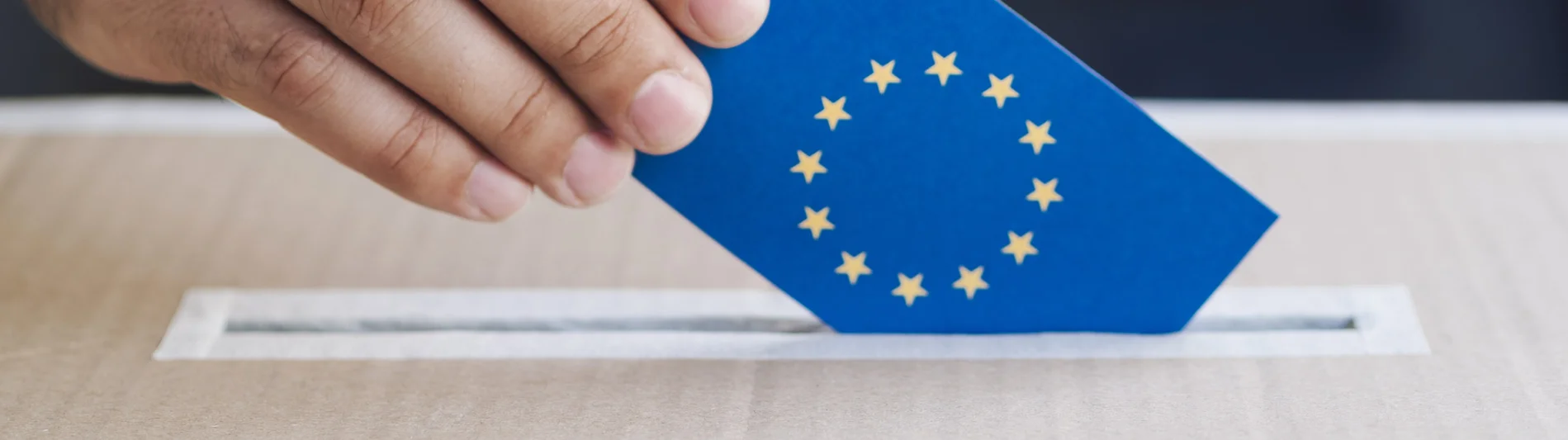


The dust has settled on the European Elections, and as newly elected Members of the European Parliament (MEP) prepare to take their seats next week, it is timely to assess the lay of the political land in Brussels. The results rendered by the European electorate present a complicated picture but one in which the centrist, liberal group (Renew) and all left-leaning political groupings saw their vote squeezed significantly, including the Socialists and Democrats (S&D), the Greens (Greens/EFA) and the far-left (The Left). The political forces of the right, including the mainstream centre-right European People’s Party (EPP), national-conservative European Conservatives and Reformists (ECR) and the newly emerged hard-right ‘Patriots for Europe’ all saw significant gains. The surprise announcement of an additional right-wing political group, ‘Europe of Sovereign Nations’ (ESN), saw the creation of a political home in Parliament for Germany’s ‘Alternative für Deutschland’ and a small caucus of likeminded eurosceptic and Russophile MEPs. However, if one considers the group barely made the minimum threshold requirement to form a political group, namely 23 MEPs, from at least seven EU member states (ESN has 25 MEPs from eight countries), this the smallest group in the 10th European Parliament mandate is also the most vulnerable to collapse.
While the ideological configuration of the European Parliament has shifted to the eurosceptic right compared to the previous five years, the recently announced allocation of key positions in the European Council and European Commission for 1 December this year looks likely to reflect a political status-quo attitude from the top, with the EPP, S&D, and Renew set to benefit the most. Ursula Von Der Leyen (EPP) has been renominated as President of the European Commission, current Estonian Prime Minister Kaja Kallas (Renew) put forward for EU High Representative for Foreign Affairs and Security Policy, and Antonio Costa already confirmed as the President-designate of the European Council. While the fate of the latter is sealed, the two European Commission positions remain subject to a vote of the European Parliament, so potential volatility and vote wrangling awaits.
*****
Having visited the Arabian Gulf just ahead of the EU-wide vote, I was surprised by the interest in the political fate of Europe during this election cycle and its impact on relations between Europe (both EU and non-EU actors), and the Gulf Cooperation Council (GCC). The 2019-2024 mandate of the European Parliament and European Commission was overwhelmed with external and internal institutional challenges, wether that be the UK’s exit from the EU, the Covid-19 pandemic, ‘Qatargate’, and Russia’s invasion of Ukraine. As a result, Europe’s political bandwidth was overwhelmed and exhausted. This fresh five year mandate however provides the opportunity for a welcome reset and renewal in relations between the EU and GCC in two key areas: trade and investment, and security and defence.
As the largest group in the incoming Parliament, a growth agenda has remained at the forefront of the EPP’s priorities, with President Von Der Leyen underscoring the need for competitiveness in the European elections main debate. The rationale for this is clear, economic growth in the EU has remained sluggish, sitting at 0.6% in 2023, and 1.1% thus far in 2024 and a forecast of 1.8% for 2025. This remains worse still for the Eurozone economies lagging slightly behind (IMF, Real GDP Growth). Bolstering trade and investment with the GCC offers a lever in the EU’s economic toolkit to utilise. The EU is the second largest trade partner of the GCC, representing 12.3% of the GCC’s total trade in goods with the world in 2020. EU-GCC total trade in goods in 2020 amounted to €97.1 billion and two-way trade in services between the EU and the GCC in 2019 amounted to €51.7 billion. Yet despite this, and the informal EU-GCC Dialogue on Trade and Investment launched in May 2017, any progression on restarting the suspended free-trade negotiations between the EU and the GCC remain yet to be seen. The new Parliament, and expected fresh leadership in the International Trade Committee offers the opportunity to put this back on the agenda. There remains an arguable rightward free-trade sympathetic majority in the incoming mandate, should the new Commission wish to test those waters.
As it relates to security and defence cooperation between Europe and Gulf, the aforementioned likelihood of continuity in the Commission’s leadership and the potential for left-right cross political group cooperation offers the opportunity to build on the deepening security relationship already in the works. It is just in the past couple of years we have seen the May 2022 Joint Communication on a strategic partnership with the Gulf, the first GCC-EU Regional Security Dialogue on 24 January 2024, and subsequent fora like the High-Level Forum on Regional Security and Cooperation between the EU and the GCC organised by EU Special Representative for the Gulf, Luigi Di Maio on 22 April 2024. In the context of the forum, EU High Representative for Foreign Affairs Josep Borrell underscored this commitment, ‘[the EU] very much welcome this vision [on regional security], that conveys a strong message of unity and lays the foundation for a strengthened cooperation of the GCC with its partners.’ Momentum exits in this area, it is for the next Commission and Parliament to keep progress on-track and build on it.
The European election campaign saw a lot of navel-gazing as it relates to domestic battles between the left and right, populist and globalist, eurosceptic and europhile, but what remains as the fog of political campaign clears is a cause for optimism for the EU-GCC relationship.
Endnotes:
1 European Parliament 2024 – 2029 Provisional results, European Parliament, 12July 2024, https://results.elections.europa.eu/en/index.html
2 Maastricht Debate 2024, POLITICO & Studio Europa Maastricht, 29 April 2024, https://www.youtube.com/watch?v=9lXgbp48gHI
3 Real GDP Growth, IMF, 1 July 2024, https://www.imf.org/external/datamapper/NGDP_RPCH@WEO/OEMDC/ADVEC/WEOWORLD/EUQ/EU/MAE/EURO
4 EU trade relations with the Gulf region. Facts, figures and latest developments, European Commission, 2 July 2024, https://policy.trade.ec.europa.eu/eu-trade-relationships-country-and-region/countries-and-regions/gulf-region_en
5 GCC: EU unveils Strategic Partnership with the Gulf, European Commission, 18 May 2022, https://ec.europa.eu/commission/presscorner/detail/en/ip_22_3165
6 GCC: first Regional Security Dialogue with the EU held in Riyadh, EEAS, 25 January 2024, https://www.eeas.europa.eu/eeas/gcc-first-regional-security-dialogue-eu-held-riyadh_en
7 EU- Gulf Cooperation Council High Level Forum takes place in Luxembourg on 22 April, 17 April 2024, https://www.eeas.europa.eu/eeas/eu-gulf-cooperation-council-high-level-forum-takes-place-luxembourg-22-april_en
8 EU-GCC: Opening speech by High Representative Josep Borrell at the High-Level Forum on Regional Security and Cooperation, EEAS, 22 April 2024, https://www.eeas.europa.eu/eeas/eu-gcc-opening-speech-high-representative-josep-borrell-high-level-forum-regional-security-and_en