

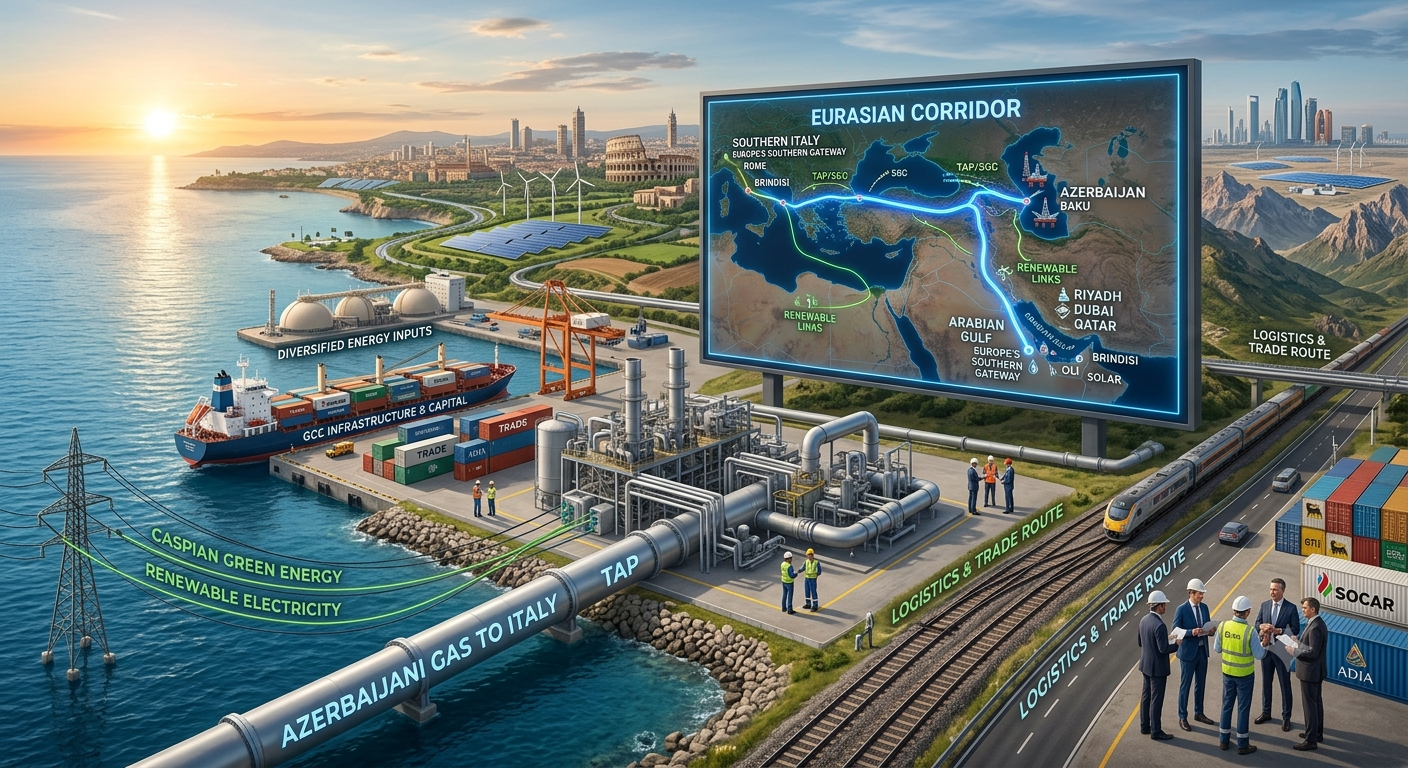


A new geopolitical corridor is gradually opening across Eurasia–connecting the Arabian Gulf, the Caspian Sea and Southern Europe. Until now, it is eclipsed by the India–Middle East–Europe Corridor (IMEC) and China’s Belt and Road Initiative, yet the emerging GCC-Azerbaijan-Italy axis is set to become a significant strategic node in the wider Euro-Mediterranean region.
At its core lies a convergence of interests among Gulf Cooperation Council (GCC) states. In 2025, Azerbaijan has sought to strengthen its ties with the GCC as part of a wider strategy to expand economic and diplomatic partnerships beyond Europe. On that occasion, the GCC’s Secretary-General, Jasem Mohamed AlBudaiwi, and Azerbaijan’s Ambassador to Saudi Arabia, Shahin Abdullayev, reviewed the Joint Action Plan for 2024–2028 to establish a framework for closer cooperation in political coordination, trade, investment and energy. The discussions emphasised the growing importance of Azerbaijan–GCC relations. Said so, the GCC countries are always seeking diversified investment opportunities and reliable access to European markets, and that plan is ideal for their strategy. Meanwhile, Italy is positioning itself as Europe’s southern gateway for energy, logistics and industrial investment. For this reason, the energy sector has to be seen as the main foundation of this relationship.
Since the 2022 eruption of war in Ukraine, European countries have been working to reduce reliance on Russian energy while increasing energy security. Disruption of gas flows from Russia, coupled with concerns over geopolitical vulnerabilities, has prompted the EU to seek alternative energy sources and routes.
Azerbaijan is a key strategic partner for Europe, notably through its involvement in the Southern Gas Corridor (SGC), a major infrastructure project intended to transport natural gas from the Caspian Sea region to European markets. A key part of the SGC is the Trans Adriatic Pipeline (TAP), which transports Azerbaijani natural gas from the Turkish-Greek border via Greece and Albania beneath the Adriatic Sea to southern Italy. Since becoming operational in late 2020, TAP plays a crucial role in Europe’s energy diversification strategy by providing a direct, reliable supply route that bypasses traditional transit corridors. Italy has become the main destination in Europe for Azerbaijani gas exports and currently imports the most Azerbaijani energy of any country in the EU.
The country serves as the main entry point for gas transported through TAP, with significant volumes entering the Italian market each year. Energy cooperation is key in relations between Italy and Azerbaijan.
The corridor’s importance extends beyond hydrocarbons. Azerbaijan’s ambition to become a green energy exporter, combined with Gulf expertise in developing renewable energy, creates opportunities for new forms of cooperation. The Gulf is already heavily involved in this transformation. For instance, many companies and sovereign wealth funds from Saudi Arabia and the UAE increased their involvement in Azerbaijan’s renewable energy sector and infrastructure projects–reflecting a broader strategic calculation: the Caspian region is becoming a bridge between the Middle East, Central Asia, and Europe. For Gulf investors seeking long-term returns and geopolitical relevance, Azerbaijan offers stability and connectivity. On its side, Italy has a unique position in this emerging landscape. Located at the centre of the Mediterranean, it is increasingly being seen as a logistics and energy hub with the potential to connect Europe with the Middle East and Eurasia. This European country has actively promoted partnerships with Gulf countries in energy, infrastructure, and advanced technologies, while deepening its strategic relationship with Azerbaijan.
One particularly important development is the shift from basic energy trading to integrated value chains. Azerbaijan’s state-owned energy company, SOCAR, has expanded its commercial presence in Europe, while investors from the Gulf are increasingly seeking to participate in transportation networks, ports, renewable energy facilities, and industrial assets. The consequence is a corridor distinguished not only by resource flows but also by capital flows. Geopolitically, the corridor offers all participants a degree of strategic diversification, and Europe gains greater energy resilience and access to alternative supply routes. The Gulf states are expanding their economic influence across Eurasia, reducing their dependence on traditional East-West investment patterns.
Significant challenges remain, however. The expansion of energy infrastructure continues to face political and regulatory obstacles, particularly in the context of the ever-changing European climate policy framework. The speed of development could also be influenced by long-term gas demand, which could undermine new climate-friendly policies. Azerbaijan has repeatedly emphasised the need for greater financial support and concrete, long-term certainty to enable further infrastructure investment. Despite these obstacles, the strategic logic of the GCC-Azerbaijan-Italy corridor is becoming increasingly compelling. Indeed, there is a growing talk of this new geo-economic space stretching from the Arabian Gulf across the Caspian Sea to the Mediterranean, and this very axis could become one of the defining strategic lines of Eurasia in the coming decade.
Sources
- https://www.specialeurasia.com/2026/05/10/italy-caspian-azerbaijan-kazakh/
- https://www.eunews.it/en/2026/06/03/the-energy-partnership-between-italy-and-azerbaijan-is-growing-ever-stronger-3-billion-invested-in-italy/
- https://socar.az/en/home
- https://decode39.com/14608/azerbaijan-italy-energy-axis-gains-strategic-weight-after-hormuz-crisis/
- https://natoassociation.ca/italy-anchors-azerbaijans-gas-push-to-europe/
- https://www.cesi-italia.org/en/articles/middle-corridor-connectivity-and-competition-in-the-euro-asian-space
- https://renewables.az/en/news/caspian-black-sea-europe-green-energy-corridor-will-allow-italy-to-benefit-from-the-electricity-transmitted-to-the-european-market
- https://azertag.az/en/xeber/azerbaijan_gcc_review_progress_of_2024_2028_joint_action_plan-3660559
- https://mfa.gov.az/en/category/regional-organisations/relations-between-azerbaijan-and-the-gulf-cooperation-council-gcc