



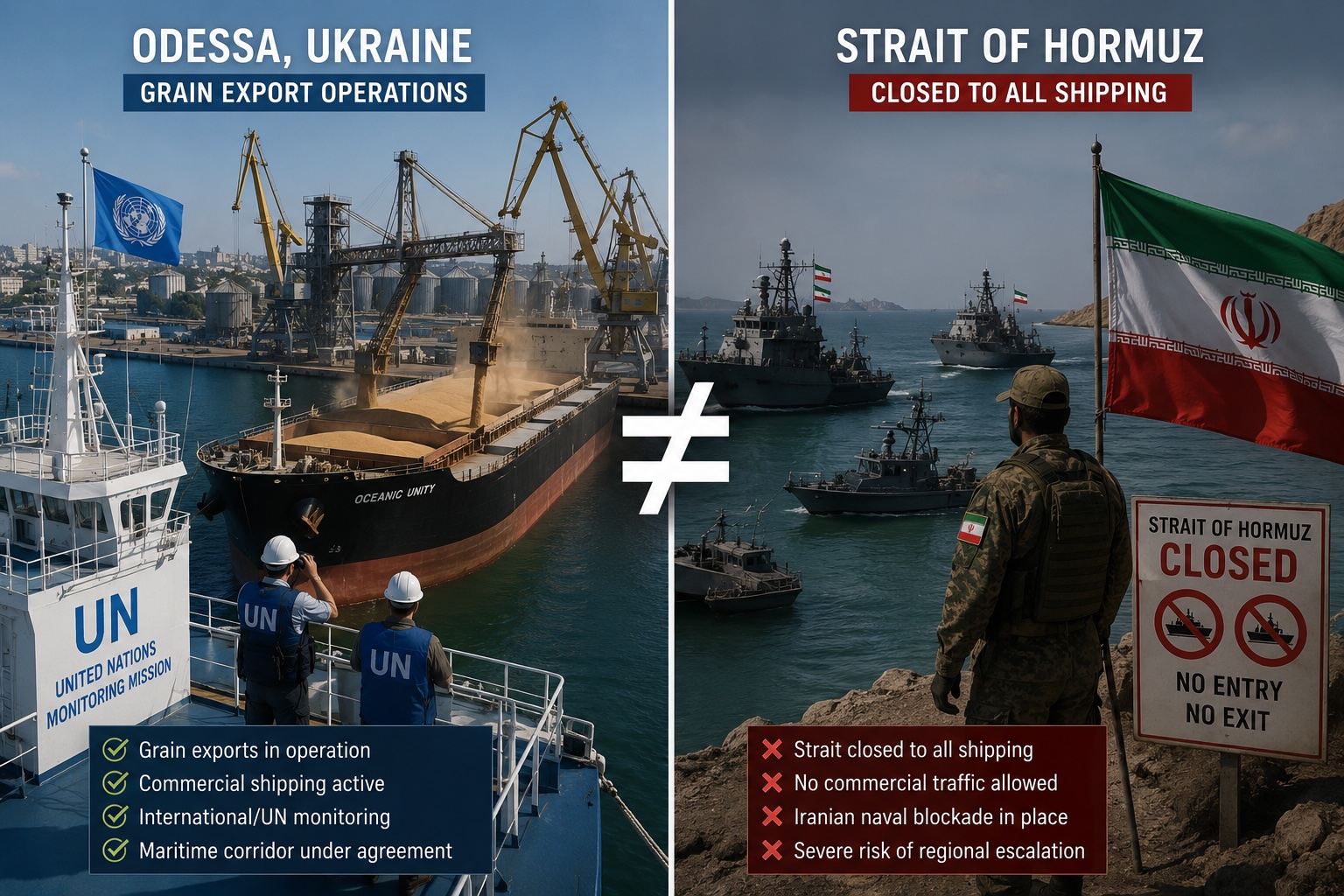


In recent months, the Black Sea Grain Initiative has become a reference point for European officials seeking a diplomatic path through the closure of the Strait of Hormuz. The analogy is a smart one, but another dimension must be more strongly considered alongside it. What works for exporting grain does not necessarily work for importing dairy and produce, and that is not a flaw in the Black Sea model, rather just a fact the new Gulf model would have to have an answer to.
Brokered by the UN and Türkiye in 2022, the initiative created a monitored corridor that, during its brief tenure of less than a year, shipped more than 33 million tons of Ukrainian grain to global markets, despite ongoing conflict. The corridor connected three Ukrainian ports to inspection areas in the Black Sea and Sea of Marmara off the Turkish coast. A buffer radius of 10 nautical miles surrounded each transiting vessel, a zone in which all military activity was strictly forbidden. From the Joint Coordination Centre in Istanbul, inspection teams comprising representatives from Russia, Ukraine, Turkey, and the UN, were dispatched to board each vessel and to verify cargo and crew. This process could take up to two weeks per vessel. By October 2022, more than 150 ships were waiting in line for inspection. The queue shrank and swelled over the following months as inspection teams varied their pace, but delays remained persistent. In July 2023, Russia withdrew, citing the initiative’s failure to deliver on its humanitarian promises, as it felt the stated goal of sending grain to developing nations had not been met. Within weeks, global grain prices had returned to pre-initiative levels.
In light of this, it is worth considering what is currently being proposed for the Strait of Hormuz. While the initiative in the Black Sea was composed of two warring parties, who, through neutral brokers, found a narrow point of mutual convenience, the environment in the Gulf is starkly different. What made the Black Sea deal work was, despite the large volume of grain, the modesty of the ask. That same logic of a modest, manageable task is now being applied to the Strait. The UN has outlined the current target to be fertiliser shipments. They have immediate global consequences for crop yields and food production, and they carry a clear humanitarian dimension that all parties could be willing to accept.
However, fertiliser is not food. And for countries in which seventy to ninety percent of food is imported through the Strait of Hormuz, the difference between the two is where the urgency lies. The Black Sea Grain Initiative had the advantage that grain is more delay-resistant, so a delay of weeks meant higher prices for distant countries but not empty shelves the next day. In the Gulf, exactly this could become reality.
The UN proposal does not mention perishable food imports. Neither does the International Crisis Group’s “Hormuz Initiative” or the European Union’s diplomatic statements. This is not an argument against a Hormuz corridor, or against one specifically for fertiliser. It is a sensible place to start. But the precedent of the Black Sea Grain Initiative that European officials have been citing was built for grain that could wait weeks for inspection. A Hormuz corridor would need to inspect ships in days, changing the calculation entirely. The people of the Gulf depend on worryingly perishable food and that simple fact deserves a place in the conversation.