

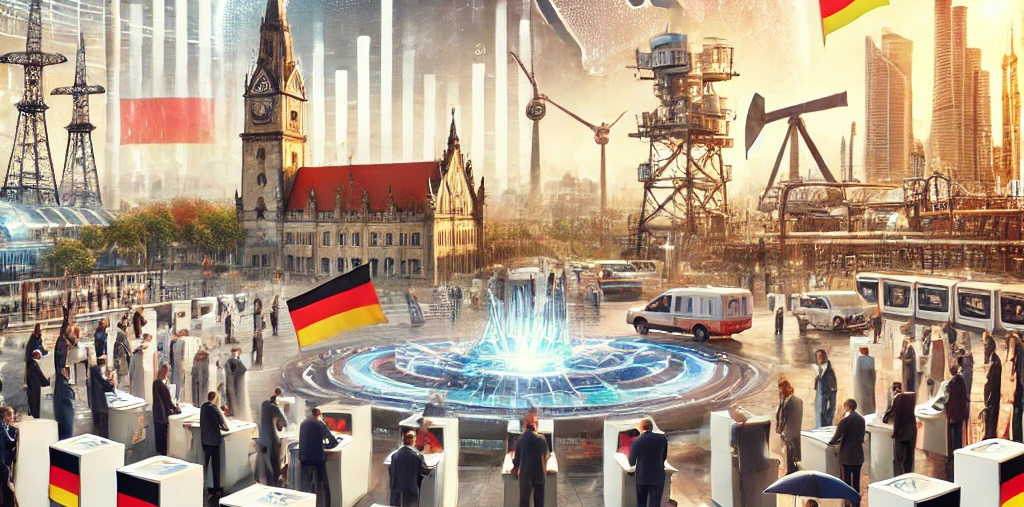


Germany is in the midst of negotiations for its next coalition government following February’s Federal elections. Europe’s largest economy is not only set for a new political chapter in its domestic politics, but it is also placed for a reset in its foreign policy outlook, with the potential for renewed vigour and optimism in its engagement with the Arab Gulf countries.
The snap election held on 23 February saw the conservative CDU/CSU alliance, led by Friedrich Merz, emerge as the largest bloc with 28.5% of the vote, while Chancellor Olaf Scholz’s SPD plummeted to just 16.4%, its worst result in over a century. While the hard-right AfD surged to an impressive second place (20.5%), a German ‘cordon sanitaire’ effectively sees it blocked from governance. The early election was triggered by the collapse of the previous SPD–Green–FDP ‘traffic light’ coalition in late 2024, and its outcome marks a shift in Germany’s political centre ground. A CDU/CSU-SPD grand coalition — a configuration mirrored on the Merkel era — is widely expected to take power pending ongoing negotiations. Despite holding only a narrow majority in the new 630-seat Bundestag, such a coalition could marry the pro-business, security-focused outlook of the conservatives with the internationalist but pragmatic approach of the social democrats. A centre-right pragmatism and centre-left continuity.
This new government is expected to place a premium on stable partnerships abroad to bolster Germany’s economy and energy security—and the Arab Gulf region stands out as a key area of opportunity. The Gulf Cooperation Council (GCC) countries remain a long-standing key economic and strategic partners for Berlin. Under the likely incoming government, Germany-GCC relationship is well positioned for deepening engagement, especially as it relates to economic ties and energy policy.
The exclusion of the Greens from government may also soften prior conditionality in foreign policy, in favour of a more realpolitik engagement with key partners like the Gulf states. Both the CDU/CSU and SPD agree on Germany’s need for reliable allies beyond Europe—a need accentuated by global uncertainties ranging from a more assertive China to a volatile second-term Trump Administration in Washington. The GCC, with its economic clout and energy resources, aligns well with these priorities. Germany’s foreign policy tradition emphasises stable trade routes, multilateral diplomacy, and regional stability – all areas where Gulf cooperation is indispensable. In the coming term, Berlin could double down on Gulf ties as it seeks to reinvigorate its economy, ensure energy security, and contribute to Middle East stability. The stage is set for a positive reset for a Mertz-led government to engage the GCC states with fresh urgency and openness.
Economic engagement should be at the forefront of Germany’s Gulf policy under the new government. Germany, as Europe’s largest economy and a manufacturing powerhouse, aligns naturally with capital-rich GCC markets. Under Merz’s pro-business direction, Germany could take advantage of enhanced trade and investment with the Gulf. GCC countries already boost considerable economic stakes in Germany; Kuwait’s sovereign wealth fund holds about 17.4 billion EUR in assets, including stakes in Daimler AG and GEA Group, while Qatar’s investments total approximately 25 billion EUR in well regarded German companies such as Deutsche Bank, Volkswagen, and Siemens. The nature of these deep investment ties are already testament to Gulf confidence in the German market, and can be built on by the next German government to encourage further capital to drive innovation and job creation.
German exports to the GCC showcase already deepening mutual economic interdependence. Saudi Arabia imported 6.57 billion EUR worth of German goods (2022), including automobiles and chemical products, with over 1,250 German companies operating across sectors. The UAE hosts around 1,200 German companies and approximately 25,000 German residents, reflecting its status as a regional business hub. Bahrain, notably through its expanding financial and logistics sectors, also holds promise; for instance, DHL maintains its Middle East regional headquarters in Bahrain, exemplifying successful German-Gulf business engagement. Gulf economies’ diversification agendas, notably Saudi Arabia’s Vision 2030 and the UAE’s Vision 2071, offer substantial opportunities for German involvement. The new German government can capitalise on these foundations, promoting increased trade missions and help facilitate investment flows. Following the momentum of the EU-GCC summit in October last year and calls to progress long-stalled EU-GCC free trade negations, Mertz could use the keys of the Chancellory and any fresh clout that should have with Brussels to push for closer Euro-Gulf economic integration.
Energy cooperation with the Arab Gulf countries is particularly well positioned to play a prominent role in Germany’s energy policy under the new government. After Russia’s illegal invasion of Ukraine, Germany’s commitment to diversify its energy sources has made Gulf states natural partners. Major contracts have already been signed, including a 15-year deal signed by QatarEnergy in November 2022 to supply Germany with two million tonnes of LNG a year from 2026. Oman LNG will deliver Germany 0.4 million tonnes per year from 2026 as well. Additionally, Abu Dhabi’s ADNOC delivered its first cargoes of LNG and blue ammonia to German ports in late 2022, highlighting the UAE’s increasingly important role in Germany’s energy diversification plans.
Hydrogen cooperation should also be considered beyond LNG, presenting a vessel for strategic partnership. Gulf countries’ ambitions to become global hubs for hydrogen align with Germany’s commitment to reach carbon neutrality by 2045. In 2021 Saudi Arabia and Germany launched the Energy Dialogue, which was followed in the next year by the launch of a Hydrogen Diplomacy Office in Riyadh. Likewise, the UAE and Germany signed the Energy Security and Industry Accelerator in 2022 to advance clean hydrogen and sustainable energy supply chains. This allowed the first cargo of UAE-produced blue ammonia to reach Hamburg—a significant step in demonstrating viable hydrogen trade routes. In addition, German companies, like Siemens Energy, are seeing active participation in Gulf renewable initiatives, with possible expansions in Saudi Arabia’s NEOM, highlighting opportunities for mutual investment and collaboration in sustainable power.
The potential for energy ties between Germany and the GCC to reach new heights is obvious. The immediate pressing requirement of energy security, with LNG and oil stability, and the long-term vision of sustainable energy, with hydrogen and renewables are two sides of the same coin. The GCC’s role in both is indispensable. The next German government will look to establish stability in global energy markets to safeguard its energy security, part of this formula will be through interaction with countries such as Saudi Arabia, the UAE and Qatar. An approach in this vein will not only support Germany’s own transition but also reinforce the Gulf’s emerging status as an energy partner for Europe beyond fossil fuels.
The new German Government should mark a turning point. The likely new grand coalition under Merz is positioned to embrace the GCC as an indispensable partner in achieving Germany’s economic revitalisation, energy security, and climate ambitions. Enhanced economic engagement—illustrated by investments from Kuwait and Qatar, robust trade relations with Saudi Arabia and the UAE, and expanding logistics partnerships with Bahrain— are all opportunities to build on mutual benefit.
Furthermore, energy cooperation through LNG agreements, in parallel with hydrogen initiatives in Saudi Arabia and the UAE, establishes a workable foundation for a sustainable energy partnership. Such a strategic posture offers welcome and vital alternatives to Russian energy dependency, while also positioning Arab Gulf countries at the heart of Europe’s energy transition.
A cooperative and pragmatic approach sets the stage for a new, promising era of Germany-GCC relations, propelled by the fresh governing mandate in Berlin, and built upon mutual economic interests, strategic alignment, and shared innovation in energy and climate policy.
Sources
- Trade exchange between GCC and Federal Germany, GCC-STAT, 19 February 2024
https://gccstat.org/en/statistic/publications/trade-exchange-between-gcc-and-federal-germany - German Foreign Policy towards the Global South in the Aftermath of the Federal Elections, GIGA, 4 March 2025
https://www.giga-hamburg.de/en/press/german-foreign-policy-towards-the-global-south-in-the-aftermath-of-the - Debriefing Germany’s federal elections, Atlantic Council, 25 February 2025
https://www.atlanticcouncil.org/event/debriefing-germanys-federal-elections-2025/