




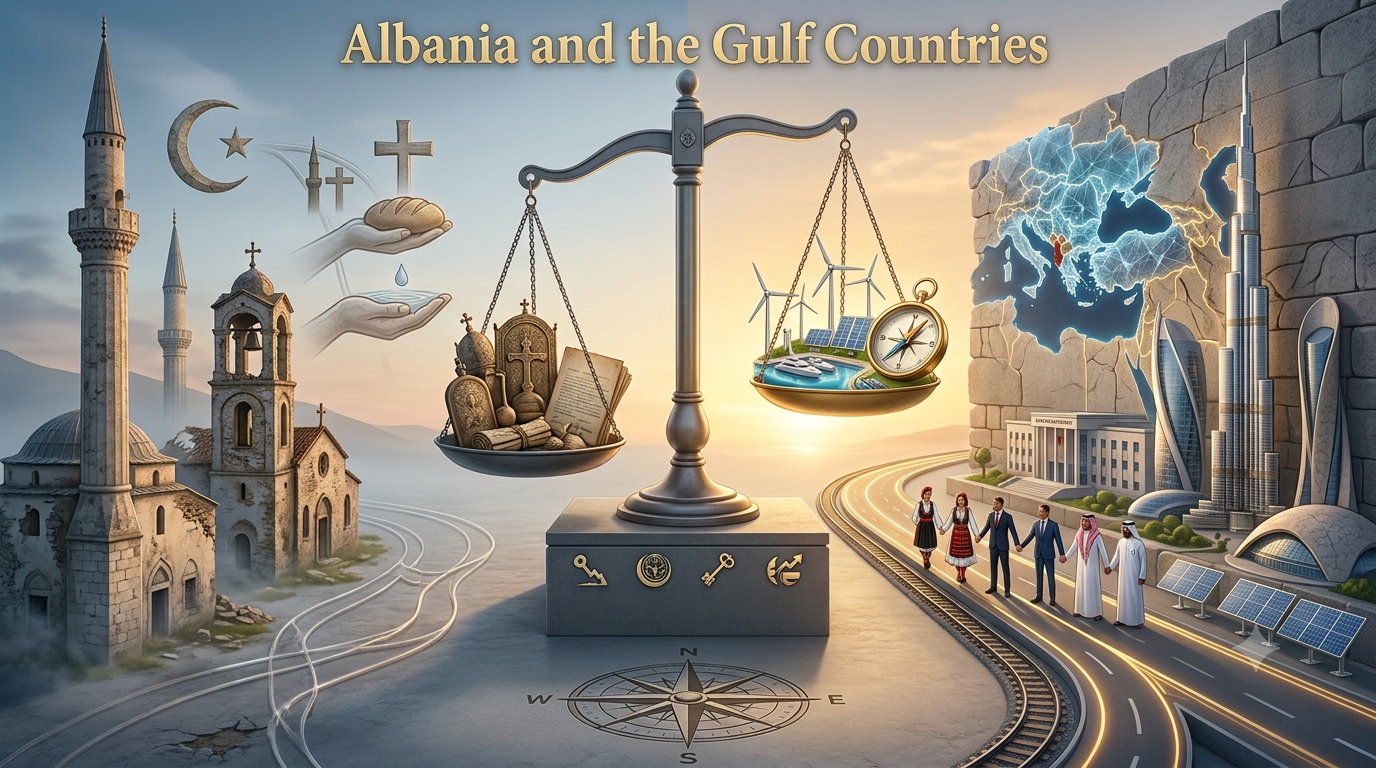


The relationship between Albania and the Gulf countries has undergone a profound transformation over the past 30 years, moving from a humanitarian partnership to an economic, strategic, energy, and tourism-based one. Especially in the past 10 years, investments from the United Arab Emirates (UAE) have revolutionised relations and investments in Albania. This partnership extends beyond economic cooperation and reflects a broader geopolitical convergence in which Albania offers Gulf investors a strategic gateway to the Adriatic, the Mediterranean, and the European market.
After the collapse of the communist regime in Tirana in 1991, Albania began a process of economic transition that culminated in the victory of the Albanian Democratic Party, led by Doctor Sali Berisha, in the 1992 parliamentary elections. As newly elected president, Berisha initiated a series of economic and political reforms that revolutionised Albania at the time. These reforms included the creation of a market economy through privatisation and liberalisation, as well as opening up to foreign capital and investment. In this context, given Albania’s entry into the Organisation of Islamic Cooperation (OIC) in December 1992, Gulf countries entered the country through religious humanitarian missions to help the local population overcome the crisis created by the communist regime, and thus the first contacts were established.
The election of Socialist Prime Minister Edi Rama in 2013 marked a turning point for diplomatic and economic relations between Albania and the GCC (Gulf Cooperation Council) countries, especially with the United Arab Emirates. Indeed, Rama’s foreign policy differed from that of his predecessor, Berisha, in that it was and remains more pragmatic and orientated toward realpolitik. In fact, during Berisha’s administration (1992-1997/2005-2013), Albania’s foreign policy prioritised its Euro-Atlantic partnership over cooperation with non-western countries in order to seek NATO and EU memberships. However, Edi Rama, while remaining a staunch Atlanticist and pro-European, proved to be more open to diplomatic and economic relations with the GCC countries and with Türkiye under President Recep Tayyip Erdoğan.
Albania and the UAE: an expanding partnership.
Among the GCC countries, the UAE has been the main economic and investment partner, thanks to the increasingly close ties between Prime Minister Rama and Emirati President Mohammed Bin Zayed. This collaboration between the two has enabled the creation and structuring of numerous investment projects in various sectors, such as energy, real estate, and tourism. The increase in UAE investments in Albania and throughout the Balkan region represents the development of a geopolitical strategy that seeks to diversify Abu Dhabi’s economic model.
The UAE seeks to transform itself into an economy capable of freeing itself from a model based solely on oil extraction and exports. The new strategy is based on investments in foreign countries in sectors such as energy, tourism, and real estate, enabling access to new markets. One of the most important projects concerns energy. On 25 January 2025, Italy, Albania, and the UAE signed an agreement worth approximately €1 billion for the creation and development of an integrated renewable energy system that could connect Albania to the Italian and European markets. The project envisions the construction of wind and solar farms in Albania, which could then transmit energy from Vlora, a city in southern Albania, to Puglia, a southern Italian region, via a submarine cable across the Strait of Otranto in the Adriatic Sea. The companies involved are among the most important in the international energy sector: Masdar (the main Emirati player in renewables), TAQA Transmission, and the Italian group Eni, which has signed agreements to become the preferred off-taker of the energy produced. Another key sector for the Albanian economy and for Emirati investments in the country is tourism and real estate.
The most important and well-known project is the transformation of the Port of Durrës into a large tourist and residential marina, making it a hub for luxury tourism. This project is led by the Eagle Hills group, linked to Emirati entrepreneur Mohammed Alabbar. The project aims to build a marina for yachts, luxury hotels, and restaurants, with a total investment value of billions of dollars. This Emirati modus operandi is not new, but it is an example of a precise diplomatic and economic strategy aimed at expanding its interests and influence through the creation of large luxury tourist centres. This project has been strongly contested and opposed by the opposition, the Democratic Party of Albania, which considers it dangerous for Albania’s commercial capacity.
The relationship between Albania and the Gulf countries is relatively recent, yet already very fruitful. Although some countries, such as Kuwait and Saudi Arabia, still have limited investment in the country, investments from the United Arab Emirates have been among the most important for the Albanian economy and its development. Over time, Albania is becoming a hub for investment and mass tourism, which the government is seeking to transform into luxury and selective tourism. The country’s development and its economy are increasingly dependent on tourism and foreign investment every year, making Albania the protagonist of an economic dynamism that brings significant opportunities while also exposing the country to economic and political risks.
Sources:
- Reuters – Energy agreement Albania, Italy, UAE (2025) https://www.reuters.com/business/energy/italy-albania-uae-sign-deal-energy-subsea-interconnection-2025-01-15/
- “Masdar Expands Renewable Energy Partnership in Albania.” https://masdar.ae/en/news/newsroom/masdar-and-kesh-sign-agreement-to-explore-renewable-energy-joint-venture-in-albania
- Eagle Hills. Durrës Yachts & Marina. https://www.durresyachtsmarina.com/
- Organization of Islamic Cooperation. Member States. https://www.oic-oci.org/en/members
- International Energy Agency. Albania Energy Profile. Paris: International Energy Agency. https://www.iea.org/countries/albania.