




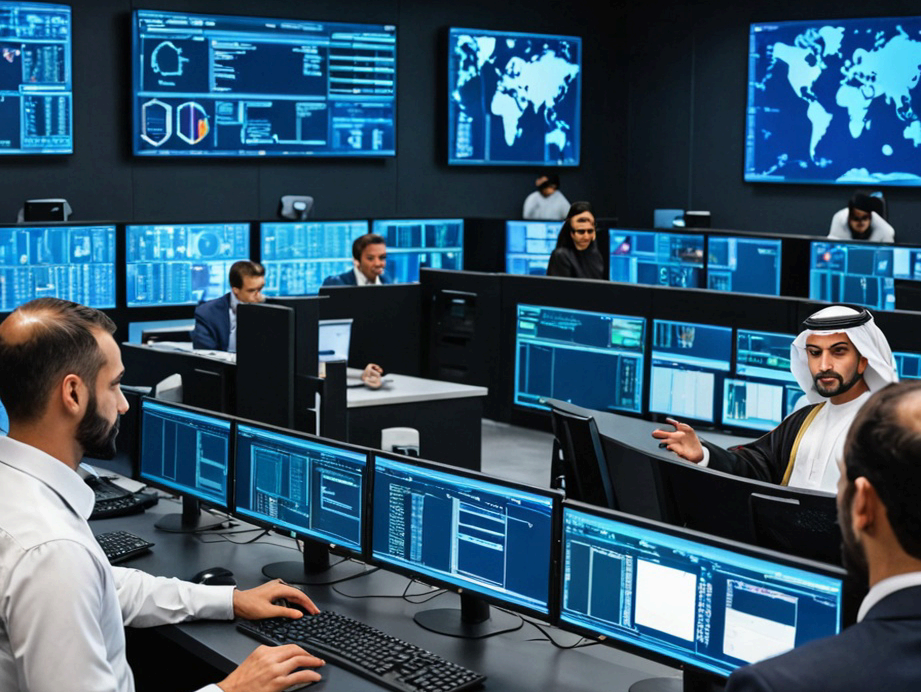


Abstract—Counterterrorism has entered a new phase in tandem with changing realities. Armed with high-tech capabilities, a new generation of would-be terrorists are emerging around the world. In the GCC, these are being challenged with data-driven approaches which tie kinetic and cyber capabilities together. This work provides a briefing of what the GCC is doing in counterterrorism to ensure citizens’ safety.
Keywords—cyber, GCC, big data, terrorism, counterterrorism, AI, privacy, safety
Counterterrorism efforts in the Middle East, particularly in the Gulf Cooperation Council (GCC) countries, are typically characterised by more orthodox means including border controls, intelligence sharing and robust internal security. However, as digital transformation spreads across the region, so do cyber threats. Terrorist organisations and extremist groups have moved to online platforms, using them for recruitment, radicalisation, propaganda, and even cyberattacks on critical infrastructure. The GCC countries (Bahrain, Kuwait, Oman, Qatar, Saudi Arabia and the UAE) have all recognised that counterterrorism now requires a multidimensional approach that includes cutting-edge technology to combat these online threats.
GCC countries are increasingly turning to artificial intelligence (AI) and big data as cornerstones of their counterterrorism strategies. AI systems can process and analyse vast amounts of data from various sources like; social media, financial transactions and encrypted communications, to detect patterns that might highlight terrorist activities.
Consider, for instance, that Saudi Arabia’s National Cybersecurity Authority (NCA) has adopted big data analytics as part of its broader strategy. Through partnerships with private cybersecurity firms, the NCA has implemented big data tools that monitor vast amounts of network data from financial, governmental, and critical infrastructure sectors. By correlating data from multiple sources, the NCA can quickly identify unusual financial transactions, log anomalies, or other digital traces that may show an imminent cyberattack or funding of terrorism. The use of big data has been particularly effective in showing suspicious financial transactions, as terror organisations often rely on low-profile but continuous funding streams. With AI-enhanced analytics, Saudi authorities can identify irregularities in transaction patterns and trace them back to potential sources linked to terror networks.
Another great example is found in the UAE which has pioneered the use of AI in social media surveillance, especially in monitoring online content that could promote extremist ideologies. Algorithms scan platforms for specific keywords, sentiment patterns, and behaviours that may indicate potential radicalisation. AI’s predictive analytics capabilities then assess which users are most at risk, flagging accounts for further monitoring by human analysts. This system allows UAE security agencies to counter online propaganda at its source, targeting recruitment efforts in real-time before they can influence vulnerable individuals.
Of course, the deployment of AI and big data in counterterrorism raises important ethical questions. Citizen’s and global human rights bodies are engaged in discussions with GCC governments to ensure that individual rights are protected since AI-generated surveillance can lead to potential overreach and unfair targeting. To address these concerns, Gulf countries are working on AI ethics frameworks that strike a balance between national and individuals safety.
*****
As AI technology continues to advance, the GCC members are expected to further integrate predictive analytics and machine learning models into their counterterrorism frameworks. Emerging technologies like Natural Language Processing (NLP) will be crucial in detecting coded languages and new slang that terrorists use to evade surveillance. Similarly, facial recognition technologies could bolster border security efforts by identifying individuals connected to extremist groups in real-time.
Regional cooperation in AI-driven counterterrorism is also likely to increase. The GCC countries have created a unified counterterrorism strategy for sharing information between member states, which will be particularly valuable in pooling resources for costly AI infrastructure and expertise. The GCC countries are leading the way in a new frontier of counterterrorism, harnessing AI and big data to counter increasingly digital terrorist threats. By adopting advanced cyber strategies, the Gulf region not only strengthens its defences, but also serves as a model for other countries facing similar challenges. As these nations continue to refine the use of AI, balancing ethical concerns with security imperatives will be critical to creating an effective and accountable counterterrorism framework.
Resources
- Global Terrorism Database, https://www.start.umd.edu/gtd/
- UAE National Cybersecurity Strategy, https://tdra.gov.ae/userfiles/assets/Lw3seRUaIMd.pdf
- Saudi Arabia’s National Cybersecurity Authority, https://nca.gov.sa/en/
- Soliman, Mohammed, “The UAE and US Elevate Tech to a Cornerstone of Their Relationship.” Middle East Institute, October 10, 2024. https://mei.edu/publications/uae-us-elevate-tech-relationship
- “Countering Terrorism & Extremism.” Middle East Institute. Accessed November 14, 2024. https://mei.edu/programs/countering-terrorism-extremism
- “Strategic Technologies and Cyber Security Program.” Middle East Institute, November 14, 2024. https://mei.edu/programs/strategic-technologies-cyber-security