

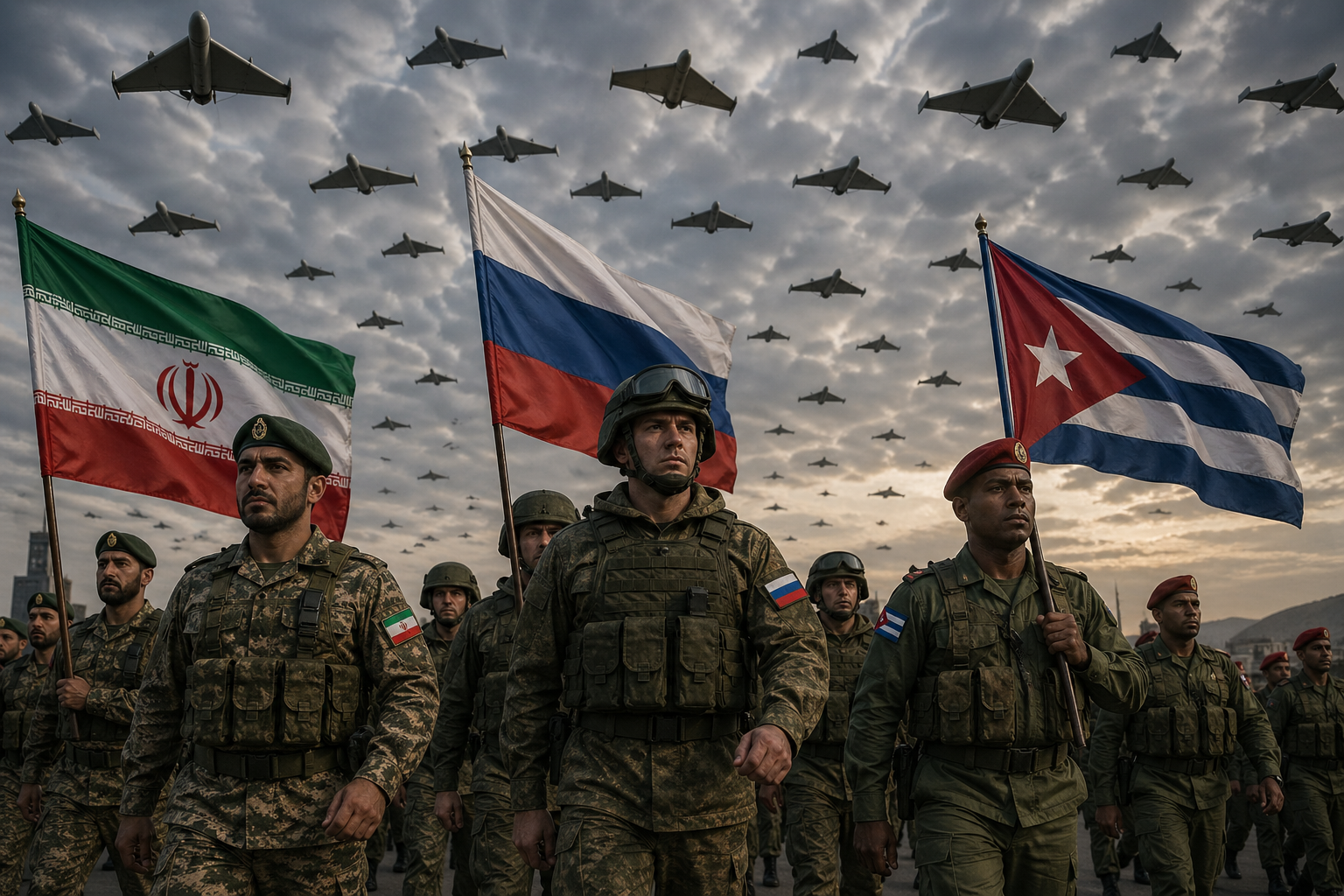


Iran’s war against its Arab neighbours has revealed something deeper than ability to disrupt; it exposed a political ecosystem that helps fuel the Islamic Republic, an axis of influence stretching from Moscow to Havana, created around the concept of permanent crisis whereby its succeeds by making other fail. Iran, Russia and Cuba like to portray themselves as embattled guardians of sovereignty against the West—reflected in their mythology at the UN, in state controlled media and through sympathetic political networks overseas. But reality is far different. These are regimes that invoke sovereignty when they are sanctioned, then violate it when it suits them. They use the language of resistance while persecuting so-called ‘dissents’ at home and targeting expats abroad. They condemn ‘imperialism’ while exporting instability, disinformation and authoritarianism abroad. This is not a romantic front against the West, over-embellishing communist imagery, whether that be the hammer and sickle or Che Guevara pop-art. It is a partnership of regimes that have betrayed their own people, and now need enemies overseas to legitimate their own domestic failings.
Iran stands at the nexus of this network because it has transformed instability into statecraft. The Islamic Republic has spent decades nurturing influence not via good-will diplomacy or plentiful foreign inward investment, but through militias and missiles, and drones and terrorist proxies. From Lebanon to Iraq, Syria, Yemen and the Gulf, long before this war started, Tehran had perfected the art of operating in the shadows of conventual warfare, keeping entire regions under pressure. Its strategy is not one of virtue, but of leverage.
The current war has placed this under the microscope. Iran’s posture is not defensive. A regime that arms proxies, threatens shipping lanes, and fires drones and missiles unprovoked at regional neighbours, cannot be said to have been resisting aggression. Iran has opted for escalation as a strategy of political survival. Any external crisis allows it to mobilise supporters, silence critics and assure Iranians that pain, suffering, and death, is the cost of resistance.
Russia is among Iran’s most important partners in this web of disorder. The link between Tehran and Moscow has become deeper ever since Russia’s illegal war against Ukraine. Iran provided drones and military technology which enabled Russia to terrorise Ukrainian cities and and murder its citizens. In turn Russia then extends Iran diplomatic cover and military cooperation.
Russia needs partners to help combat European and NATO pressure. Iran requires allies that are willing to insulate it from the pains of isolation. Both regimes know that war, distraction and energy disruption drain Europe’s strategic resources. A wider Iran conflict suits the Kremlin because it diverts focus away from Ukraine, it adds pressure to Western defence stockpiles and at-time emboldens political division Europe and US about military overstretch and debate around interventionism. For Moscow, every crisis is useful if it makes the democratic and free world look tired and divided. The logic is clear—a missile interceptor needed in the Gulf region is one less readily available for Ukraine just as a Summit consumed by Iran is one less focused on Russia’s war of aggression.
Cuba’s role is different. While Havana is unable to provide Iran the same diplomatic and military muscle of Moscow, it offer timely and distracting political theatre, including revolutionary nostalgia replete with heavy anti-American and anti-Western narratives. It helps shape Iran’s aggression as resistance, and its repression as nationalist pride. Furthermore, the US State Department has alleged between 1,000 and 5,000 Cubans are fighting alongside Russian forces in Ukraine, describing Cuba as one of the largest foreign contributors to Russia’s war effort after North Korea. Cuban men recruited through networks promising money, work or Russian citizenship.
For the Gulf countries, Iran’s axis is not merely a geopolitical curiosity, it is a real security issue. Iran’s cooperation with Russia bolsters Tehran’s sense that it is capable of escalation while avoiding total isolation. Its connections with Cuba and other anti-Western countries allow it to claim a sense of international legitimacy that it does not have in practice.
The threat to Europe is ever-present from this authoritarian axis. Whether that be sanctions evasion, disinformation, energy coercion, and diplomatic obstructionism in international fora like the Security Council. The formula is clear, Tehran helps Moscow with Ukraine, and in turn, Moscow shields Tehran internationally. Havana helps to dress up both as victims of Western imperialism, supports them in intelligence operations and galvanises the Global South. The network may be messy, but it is alive and well.
European decision makers remain largely unaware of this network of influence. A glaring policy contradiction is that of how the EU continues to engage and financially support Cuba through its Political Dialogue and Cooperation Agreement with Cuba (PDCA), while Havana remains steadfastly aligned to Moscow and Cuban nationals fight side-by-side with Russians against Ukraine. In effect, the EU is supporting Ukraine against Russian aggression, while maintaining assistance channels, totalling up to 125 million EUR in earmarked projects to the Cuban regime that helps sustain Russia’s illegal war efforts.
Europe (particularly the EU27 and the UK) should respond cohesively; sanctions enforcement on Iran and Russia should be treated as a single strategic objective. Maritime defence in the Strait of Hormuz must be linked to European energy security and defence planning, and support for Ukraine must not be cannibalised by the crisis in the Middle East.
The Iran, Russia, Cuba axis is dangerous not because its strength, albeit limited, but because of its shamelessness. It shifts weakness into grievance, grievance into ideology, and exports it for the sake of geopolitical instability and chaos.