




The global oil market has spent the past several months pricing in war, sanctions, supply disruptions and tanker risk. It however, was not prepared to price in something far more consequential: the visible unraveling of the political architecture that governed petroleum for more than half a century.
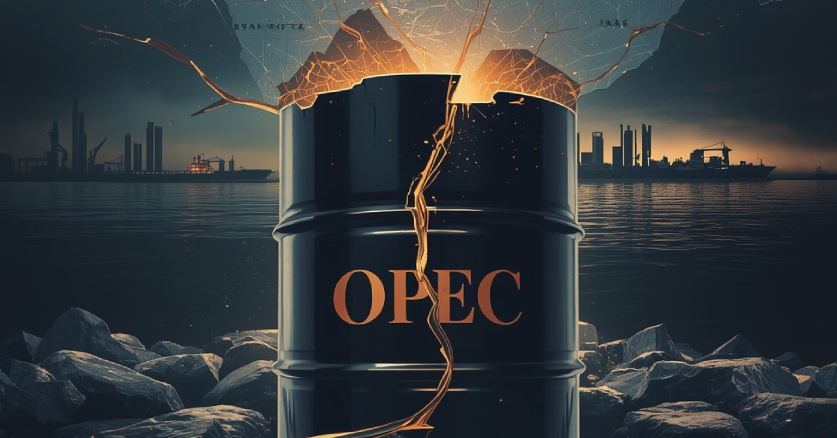
On May 1, the United Arab Emirates formally leaves OPEC and OPEC+, ending nearly six decades inside the world’s most influential oil cartel and delivering the most serious institutional blow to the oil pricing alliance in a generation. Abu Dhabi has presented the move as a sovereign economic decision designed to align production policy with its long-term strategic and economic vision. In practical terms, it means one thing: the Emirates no longer intend to subordinate their production ambitions to collective quota discipline. This is not simply the departure of another member from a fractious producers’ club. It is the first high-capacity, financially secure, technologically advanced Gulf producer to openly conclude that OPEC’s constraints now cost more than its benefits. And that changes the game.
Abu Dhabi’s Frustration Did Not Begin with the Iran War
The immediate geopolitical backdrop, the energy shock caused by the conflict around Iran, attacks on shipping and the prolonged disruption of traffic through the Strait of Hormuz makes the timing dramatic. But the divorce between Abu Dhabi and OPEC has been years in the making. The UAE has been one of the few OPEC states that actually spent the last decade preparing for a world of intensified competition, not managed scarcity. Through ADNOC (Abu Dhabi National Oil Company) and a broad network of partnerships with international majors, the country poured tens of billions of dollars into upstream expansion, enhanced recovery, export infrastructure and petrochemical integration. Its production capacity approached 4.8 million barrels per day and is designed to reach 5 million by 2027. Yet under OPEC+ arrangements, Abu Dhabi remained effectively handcuffed to quotas calibrated for a very different production era and the resentment was never hidden.
Already in 2021, the UAE publicly blocked OPEC+ negotiations, calling its baseline quota unfair and outdated. In late 2023 and again through 2024–2025, Emirati officials returned to the same argument with increasing bluntness: why should a state that invested massively in productive capacity continue to absorb disproportionate restraint so that OPEC can defend its preferred price corridor? That question has now been answered, it should not.
For most OPEC members, quota management remains tolerable because spare capacity is limited, foreign investor pressure is weaker, and domestic fiscal systems are accustomed to cartel-style coordination. The UAE sits in a different category. Unlike other producers in the group, Abu Dhabi opened substantial segments of its upstream sector to international capital and technical partnerships. This creates a structural problem under quota uncertainty: investors finance capacity that the host government cannot guarantee it will be allowed to monetise. Every barrel left underground by cartel agreement is not just foregone revenue for the state, but a source of friction with multinational partners whose return assumptions depend on rising output. In other words, OPEC discipline has become increasingly incompatible with the Emirates’ hybrid model of state control plus globalised energy investment.
There is also a deeper strategic calculation. Abu Dhabi like other sophisticated hydrocarbon states understands that the issue is no longer whether oil demand disappears in the near future, it will not, but whether the premium years of easy monetisation are finite. If the global shift away from fossil fuels gradually makes oil less profitable and reduces producers’ ability to keep prices high, then countries with low extraction costs and available reserves have a clear incentive: pump sooner, convert geological wealth into sovereign financial assets, and redeploy that capital into logistics, technology, finance and industrial diversification. From that perspective, remaining inside a quota cartel begins to look less like prudence and more like delayed monetisation.
Why Did the UAE Jump Now?
Had Abu Dhabi made this move in a calm market, it would have triggered panic across futures curves and likely provoked a direct political confrontation with other OPEC and OPEC+ members. Instead, it chose the least painful moment. Oil prices remain elevated because actual physical supply is constrained by Gulf insecurity. Brent has been trading above $110, and every interruption in Hormuz shipping amplifies the perception of scarcity. Immediately after the announcement, markets briefly sold off on fears of eventual overproduction, only to rebound as traders recognised the more immediate reality: additional Emirati barrels cannot fully flood the market until export routes normalise. That gives Abu Dhabi strategic cover since the UAE gets to announce liberation from quotas at a moment when the world still desperately needs every stable producer it can find. It reassures customers that it remains a responsible supplier while simultaneously positioning itself to capture market share the minute logistics ease. It is, in effect, a pre-emptive exit executed under the camouflage of crisis.
Numerically, OPEC may survive, however politically, it is entering far more dangerous territory. For years, the organisation’s credibility rested less on the formal number of members than on the market’s belief that discipline could be enforced among the few countries possessing meaningful spare capacity. The UAE was one of those few. Its departure means that there are now fewer actors both willing and able to modulate production in service of collective price management.
This weakens the cartel in three simultaneous ways:
- It reduces actual controllable spare capacity inside the alliance.
- It damages the psychological space of compliance and quota-cheating members gain a new precedent.
- It publicly exposes the limits of organisational leadership at precisely the moment it needs to project maximum cohesion.
As one widely shared comment on Reddit put it, OPEC just lost its group-chat discipline. Crude humour aside, the phrase captures an important truth: cartels function as much on fear of fragmentation as on formal agreements. Once fragmentation becomes thinkable, it becomes contagious.
Washington Sees an Opening
In Western media and policy commentary, Abu Dhabi’s decision is already being interpreted as an indirect strategic victory for the White House. US President, Donald Trump, has spent years accusing OPEC of artificially inflating global fuel prices and has an obvious domestic political interest in seeing cheaper crude translate into lower gasoline prices before November’s congressional elections. Since the start of the Iran conflict, US retail fuel costs have climbed sharply, intensifying pressure on the administration to find external mechanisms for softening the energy shock.
The next obvious test case is Venezuela. Caracas possesses the world’s largest proven oil reserves, but unlike the UAE it lacks true geopolitical autonomy. Following Washington’s deepening leverage over the Venezuelan political leadership, analysts have begun openly speculating that the country could eventually be encouraged to reassess the value of continued OPEC membership if doing so better aligns its export policy with US interests. Whether that happens soon is less important than the precedent itself. For the first time in decades, OPEC faces a dual destabilisation: centrifugal pressure from members who want production freedom, and external pressure from the US that would welcome any fragmentation capable of loosening the cartel’s grip on prices. That combination is potentially far more corrosive than any past quota dispute.
Post-OPEC Oil Market?
It would be premature to write OPEC’s obituary, since Saudi Arabia remains the single most important swing producer in the world, and Russia still gives OPEC+ geopolitical ballast. But the UAE’s exit introduces a structural precedent that cannot be reversed. For the first time, a serious producer with growth capacity has concluded that autonomous optionality is worth more than cartel solidarity. Others might now run the same calculation. Countries under fiscal strain will ask whether enduring cuts for collective price defence still makes sense. Countries with undeveloped reserves will ask whether future demand uncertainty argues for faster extraction. Countries increasingly tied to Washington, Beijing or private investors will ask whether bilateral energy diplomacy offers more than multilateral production discipline.
Even if no second defection comes immediately, the intellectual monopoly is broken: OPEC is no longer the unquestioned venue through which producers maximise national interest. That means the world may not be heading into a cleaner, cheaper oil era. It may be heading into something much harsher: an era in which fewer mechanisms exist to smooth price cycles, while more producers compete opportunistically for revenue in moments of geopolitical dislocation.