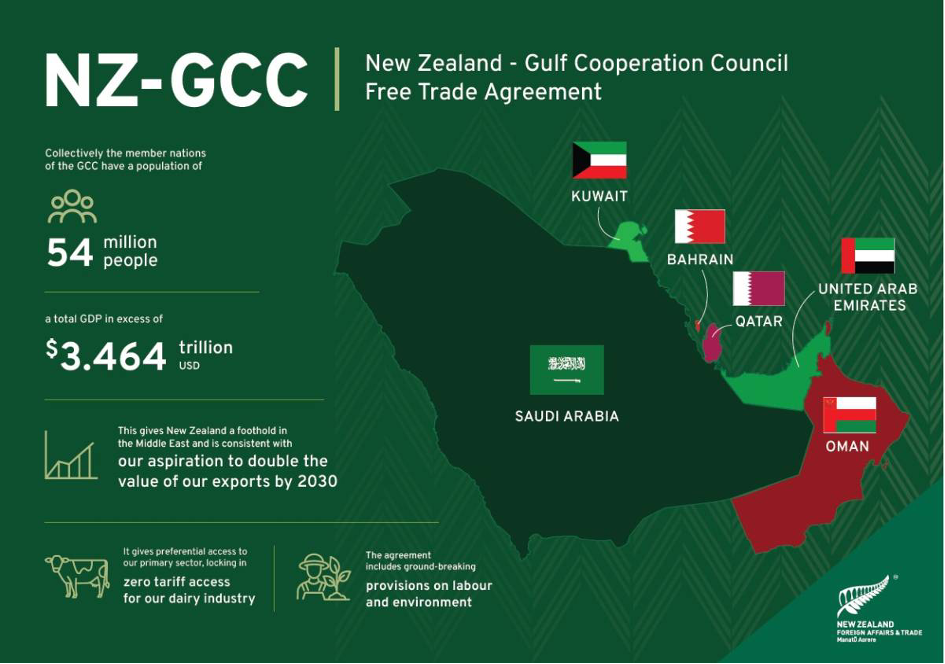




On 31 October 2024, the Free Trade Agreement between the Gulf Cooperation Council (GCC) and New Zealand was signed. The Treaty reveals the increasingly international projection of the regional organisation established more than 40 years ago to facilitate cooperation between the countries of the Gulf and considerably expands the trade borders of its six Member States.
Moreover, the GCC countries show a path of gradual diversification of the regional economy and a, albeit slow, move away from over-dependance on fossil fuels. This, in favour of renewable energy, high-tech and services sectors as, among other things, also reported in the GCC’s official documents adopted by the most recent Supreme Council composed of the leaders of the member countries.
The GCC is New Zealand’s 7th largest export market with over $2.5 billion in trade value (June 2024). The most significant activities are in the tourism sector, industrial production and food goods. In this direction, the Agreement will not only eliminate more than 90% of the existing tariffs but also facilitate the movement of people, thereby increasing the already significant tourism sector. The Agreement, moreover, if analysed in context with the one, signed in September 2024, between Auckland and the United Arab Emirates constitutes, in fact, a very relevant free trade area in terms of growth potential and profitability.
The Agreement will connect over 50 million people through trade in goods and services and as reported by the New Zealand Government, assumes that:
‘GCC countries are rich in oil and gas but lack farmland for food production and have high demand for imported food and drinks. New Zealand’s trusted meat and dairy exports meet some of that demand.’
While the European Union, the world’s wealthiest single market in terms of the number of inhabitants and capital involved has, for decades, been pursuing a policy of expansion through one-to-one agreements with other states, such as Canada, Japan, Vietnam and Singapore, among others, the GCC seems to be increasingly targeting emerging markets as geographically distant. This is the case of the Free Trade Agreement with South Korea, signed in December 2023, which anticipated the one with New Zealand and significantly reduced customs tariffs, giving access to an important new market for the six Gulf countries.
The GCC now represents the world’s 9th largest market for goods, services and capital, and is evidently destined to climb the rankings thanks to this new international vocation. From this perspective, the importance of multilateralism, repeatedly cited in the organisation’s documents, as an instrument of economic progress and intercultural dialogue emerges. The EU was the forerunner of this all-round integration policy, and it seems that the GCC is also pursuing this path. This is good news for those who consider trade an indispensable method of dialogue and bridge-building in a historical period increasingly dominated by turbulence.