

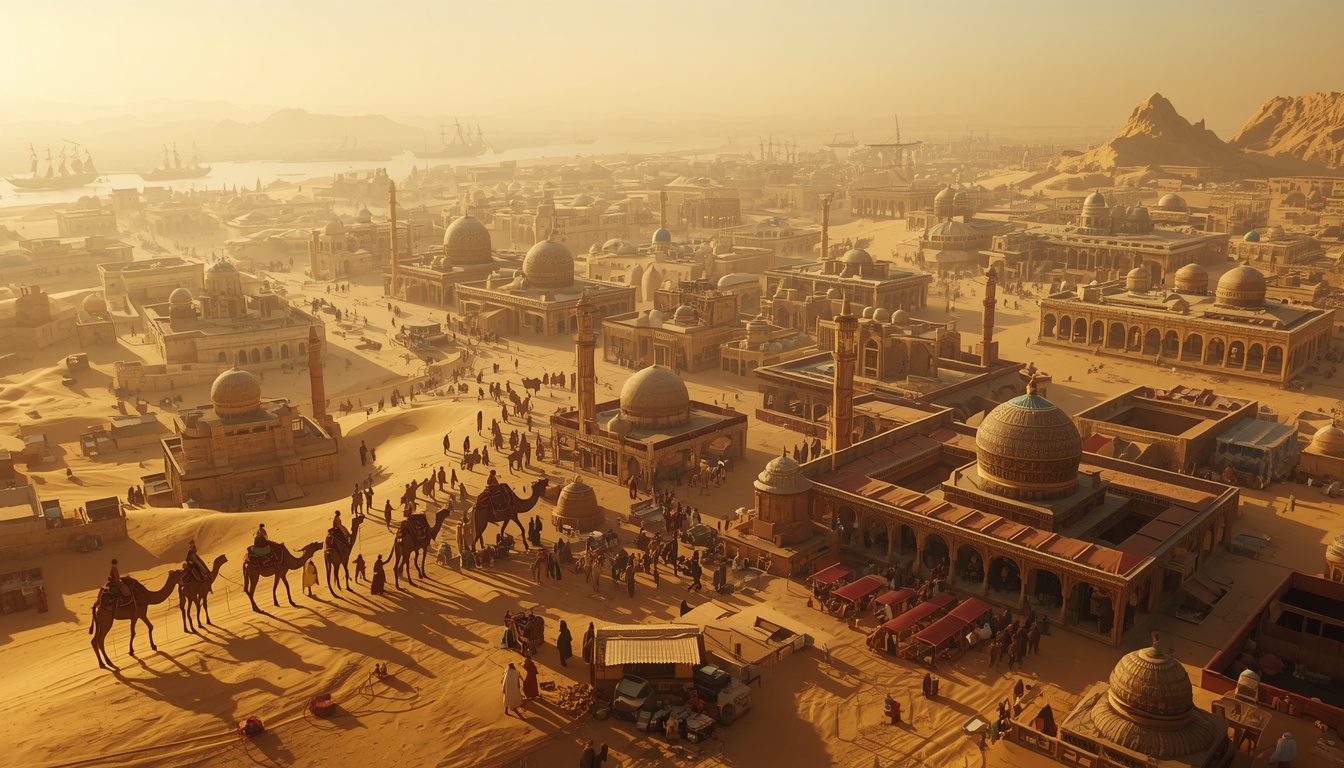


Across the centuries, certain land and sea routes have connected distant civilisations, radically transforming the economies, cultures, and politics of three continents. Known as the Silk Road, this route of trade and cultural exchange has shaped the world influencing commerce, the transport of goods, politics, religion, cultural artefacts, and even diseases and giving rise to events that would shape the course of history. The Silk Road is believed to date back to the 2nd century BC, when the Han Dynasty ruled China. It was the explorer Zhang Qian who established diplomatic and commercial contacts with Central Asia, leading the way for regular exchanges with the Western world. Regarding the name, the Silk Road was not a single road but a network of land and sea routes that crossed deserts, steppes, and mountain ranges.
These routes connected cities like Samarkand and Bukhara that were turned into cross-cultural centres where merchants, ambassadors exchange goods, ideas, technologies across civilisations. Silk was among the most wanted products on the Silk Road; the Romans, in particular, made silk a status symbol of their wealth and power. While Africa has been historically marginalised it still played a significant part in this global economy. Many of east Africa’s coastal towns including Mogadishu/Mombasa were key nodes in the Indian Ocean trade network. There, African traders traded gold, ivory, people and other commodities with Arabs,Persians,Indians and eventually Chinese. As mentioned above, this indicates that Africa was not disconnected from global events and actually played a part in creating premodern globalisation. Similarly, it could be argued that China’s current Belt & Road Initiative is comparable to the original Silk Road. Both link Asia, Europe, Africa and the Middle East via port, road and commercial investment. Even though the political framework is entirely new, both initiatives demonstrate how much strategic control over trade routes are critical to successful trade. Specifically, the current investments by modern Chinese in African ports and infrastructure indicate how Africa will continue to remain important in the global trade networks.
While the economic driving force of the Silk Road was, of course, goods, the true impulse behind that transformation would have been ideas like Buddhism, which originated in India and spread from there to China and Japan thanks to monks and nomadic merchants. The same happened with the spread of Islam along the trade routes connecting both Central Asia and East Africa, giving rise to cosmopolitan societies. Cities along the Silk Road were also hubs for the translation and exchange of knowledge, where Greek, Persian, Indian, and Chinese texts were studied and translated. This spread of information and knowledge changed Europe for good. From China, new technologies such as paper, gunpowder, and the compass, all developed in China, entered the Western world through these exchanges, which led to a gradual transformation of medieval European society. Despite the economic and cultural benefits, the Silk Road was also a vessel for crises such as the Black Death of the 14th century, which devastated Europe, killing about one-third of the population, and is believed to have spread from Asia through its trade routes into Europe. This was a turning point: the demographic and economic crisis intensified social and political events that led to the end of feudal society and the beginning of the modern era. Surprisingly, one of the most significant effects of the Silk Road was its own crisis; in fact, with the expansion of the Ottoman Empire in the 15th century, many overland routes became less accessible to European merchants, forcing the great naval powers, in particular Portugal and Spain, to find different routes to reach Asia. And so began an era of unprecedented exploration. Christopher Columbus’s voyage in 1492, motivated precisely by the desire to find an alternative route to Eastern resources, led to the discovery of the Americas and the beginning of the first true globalisation. Without the long tradition of trade and interconnections established by the Silk Road, this historical transition would have been far less possible.
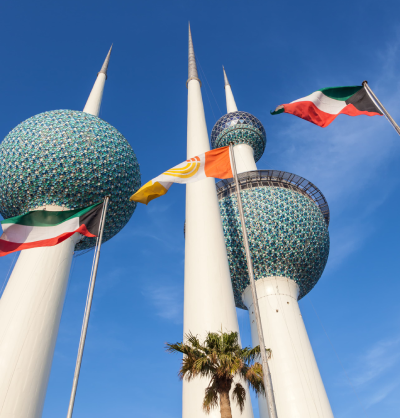
Nowadays the countries of the Gulf Cooperation Council (GCC) have emerged as strategic commercial centres linking Asia, Africa, and Europe, and have also, gradually, diversified their economies beyond oil, attracting foreign investment, and expanding international trade partnerships. Cities like Doha and Dubai, Manama, Kuwait and Riyadh have developed into internationally significant hubs for trade and transportation similar to the historical Silk Road cities from Central Asia. Moreover, the Belt & Road Initiative also supports long-term national development plans like Saudi Vision 2030 by encouraging industrial growth, tourism, and technological cooperation with China, while enhancing the Gulf region’s strategic importance in global supply chains and regional connectivity.
Nevertheless, recent tensions in the Strait of Hormuz illustrate that strategic trade routes continue to be critical to the world today, especially because of a large portion of global oil transport travelling through this corridor. The closure of the Strait is therefore more than a simple question of interrupting current trade flows–doing so runs against the historic spirit of the region and beyond. Conflicts and instability in the region are already influencing energy prices and global political relations. Ultimately, the Silk Road demonstrates that humanity can achieve prosperity, peace and unity through cooperation and dialogue.
Sources
- Abulafia David, The Great Sea: A Human History of the Mediterranean, Oxford University Press, 2011.
- Benedictow J. Ole, The Black Death 1346-1353: The Complete History, Boydell Press, 2004.
- Frankopan Peter , The Silk Roads: A New History of the World, Bloomsbury, 2015.
- Hansen Valerie, The Silk Road: A New History, Oxford University Press, 2012.
- Needham Joseph, Science and Civilisation in China, Cambridge University Press, 1954-2004.
- Whitfield Susan, Life Along the Silk Road, University of California Press, 1999.