

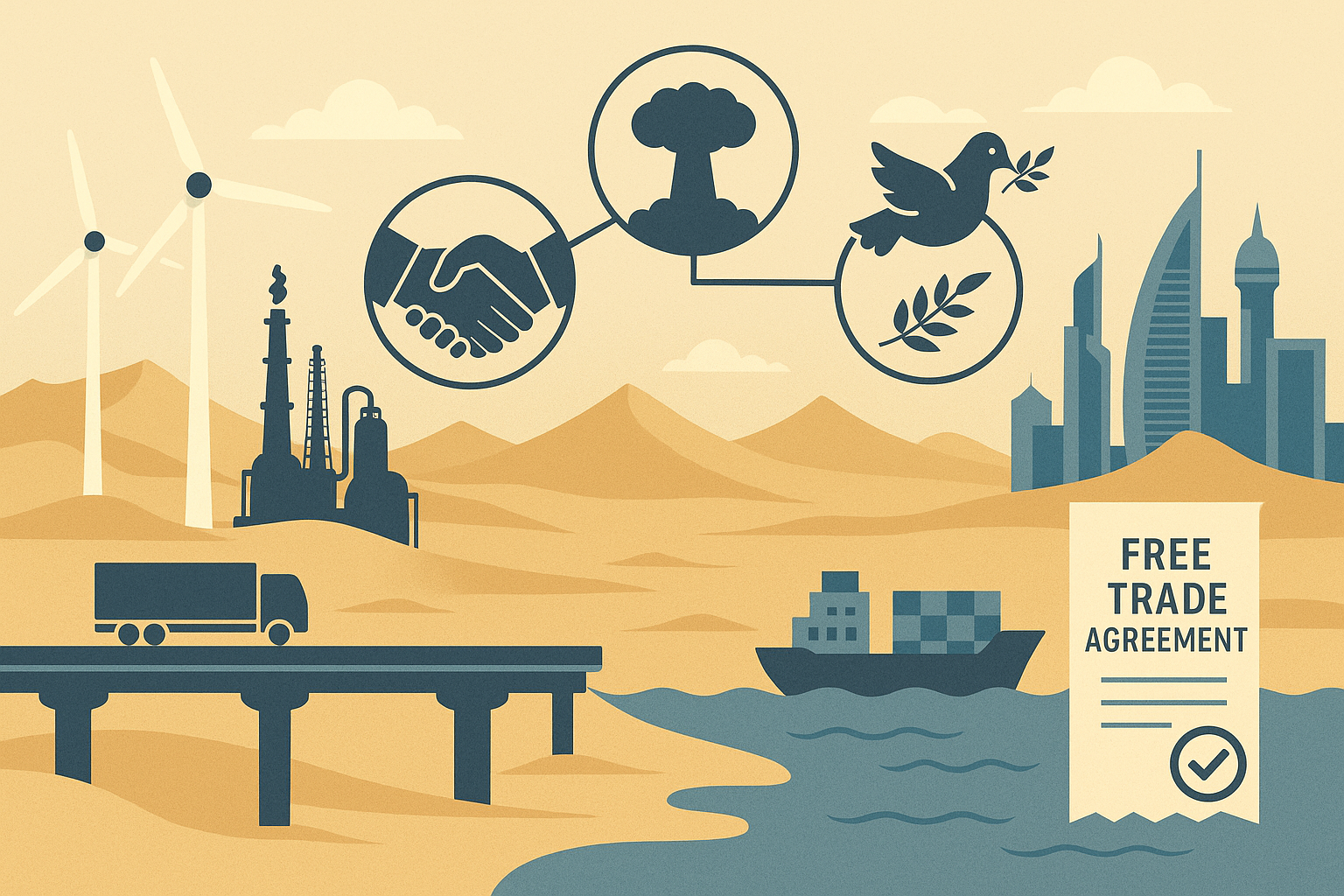


Abstract: Amid shifting geopolitical dynamics, Iraq is strengthening economic ties with the Gulf Cooperation Council (GCC) states, seeking energy diversification, infrastructure development, and financial integration, while Gulf countries view investment in Iraq as a means to bolster regional influence and stability. Simultaneously, Oman is facilitating renewed indirect nuclear talks between the US and Iran, leveraging its neutral diplomacy to mediate tensions with potentially far-reaching security implications. In parallel, the European Union and the United Arab Emirates have launched negotiations for a landmark Free Trade Agreement aimed at deepening bilateral economic cooperation, enhancing trade, and advancing green energy goals among wider strategic recalibrations.
Keywords: Iraq–GCC relations, Iraq Development Road, Iranian influence, Muscat negotiations, Joint Comprehensive Plan of Action (JCPOA), Non-Proliferation Treaty (NPT), US–Iran relations, EU–UAE Free Trade Agreement (FTA), Trade liberalisation, Comprehensive Economic Partnership Agreements (CEPAs).
Desert Diplomacy: The Economic Rebirth of Iraq-GCC Relations
Over the past decade, Iraq has emerged from a long period of instability with a renewed focus on rebuilding its economy and reasserting its role in the Arab world. Central to this transformation is the deepening economic relationship between Iraq and the Gulf Cooperation Council (GCC)—a partnership that highlights a strategic realignment both economically and geopolitically. Iraq’s outreach to the GCC comes against a backdrop of political recalibration and a desire to diversify its partnerships. Historically strained by ideological divides and geopolitical rivalries, relations between Baghdad and its Gulf neighbours began to thaw significantly just a decade ago. Today, economic pragmatism is taking precedence over past grievances, with Iraq seeking capital and expertise while the GCC countries pursue influence, security, and diversification of investment. Energy cooperation has become the cornerstone of Iraq’s renewed engagement with the GCC. Iraq has long depended on Iranian gas to power its grid, but the US sanctions regime has forced Baghdad to look for alternatives. In a significant shift, Iraq is now negotiating gas supply deals with Qatar and Oman and plans to lease a floating LNG terminal from the UAE.
The Gulf Cooperation Council Interconnection Authority (GCCIA) has partnered with Iraq’s Ministry of Electricity to build an interconnection system that would allow Iraq to receive over 4 million megawatt-hours annually from the GCC grid. This ambitious project not only addresses Iraq’s chronic power shortages but also represents a step toward regional energy integration. Also, Gulf states are also leading the charge in Iraq’s transition to renewable energy. Saudi Arabia’s ACWA Power and the UAE’s Masdar have committed to developing solar projects across Iraq.
Perhaps the most strategically significant initiative is the port of Grand Faw, a mega infrastructure project in southern Iraq intended to rival regional ports such as Jebel Ali and Khalifa Port. Connected to the ‘Iraq Development Road’, a trade corridor extending from the Gulf to Turkey and Europe, the port is designed as a regional trade hub, with potential GCC involvement in logistics, management and investment. As trade expands, so does financial cooperation. Gulf banks are entering the Iraqi market, with joint ventures and regulatory coordination taking place between central banks. Agreements to avoid double taxation and improve financial transparency are being negotiated to facilitate the flow of capital between Iraq and the GCC. Discussions are also underway on the creation of special economic zones (SEZs) in Iraq with the support of the Gulf countries. These zones would offer preferential conditions to investors, streamlining regulations and fostering cooperation.
For the GCC, investing in Iraq offers a way to counterbalance Iranian influence and promote a more stable regional order. For Iraq, on the other hand, it represents an opportunity to rebalance itself in the Arab sphere and reduce over-dependence on a single partner. Despite encouraging developments, several obstacles could hamper progress. Indeed, Iraq is still grappling with the country’s political instability, which could undermine investor confidence. However, the mutual benefits are substantial. As Iraq continues to stabilise and reform and the GCC states seek to assert their regional leadership through economic instruments, the drive for deeper cooperation appears lasting, based on a strategic recalibration of the Arab cooperation.
A new chapter in Middle East economic diplomacy is being written.
Oman’s Role in US–Iran Nuclear Diplomacy
As indirect negotiations between the United States and Iran quietly resume in Muscat, Oman has once again positioned itself as an essential player in the region’s most sensitive diplomatic undertakings. Oman continues to serve as a strategic backchannel in the efforts to reduce nuclear tensions between Washington and Tehran. This renewed round of dialogue highlights not only Oman’s indispensable role in regional diplomacy but also the complexities surrounding the current geopolitical landscape. While countries like Saudi Arabia and the United Arab Emirates have taken more confrontational stances toward Iran, Oman has consistently maintained cordial relations with both Iran and the United States. This neutrality has enabled the Sultanate to act as a bridge between adversaries at key moments. Its efforts in facilitating the secret discussions that led to the 2015 Joint Comprehensive Plan of Action (JCPOA) are widely acknowledged by diplomats and analysts alike.
Today’s negotiations, though indirect and heavily guarded, reflect a continuation of that legacy. The current talks in Muscat focus on limiting Iran’s nuclear program in exchange for a phased easing of US economic sanctions. These negotiations take place against a backdrop of deep geopolitical tension and strategic recalculations. Iran’s uranium enrichment activities have accelerated over the past year, raising alarms in Washington and among its regional allies.
At the heart of the deadlock is the US request that Iran rely exclusively on imported uranium for its civil nuclear energy needs; a proposal that Tehran has flatly rejected. Iranian negotiators argue that this condition violates their sovereign rights under the Nuclear Non-Proliferation Treaty (NPT). The US, on its side, remains concerned about the dual-use potential of Iran’s domestic enrichment capabilities. Both sides have expressed willingness to explore creative compromises, but mutual distrust remains a formidable barrier. Further complicating matters are the shifting alliances and power dynamics in the broader Middle East. In recent months, Iran has deepened its diplomatic and economic ties with Russia and China, a move that has strengthened its diplomatic negotiating position and diversified its strategic options. At the same time, the US is under increasing pressure from domestic political factions and regional partners, particularly Israel, which remains deeply sceptical of any nuclear deal with Tehran. Despite these obstacles, the choice of Oman as the venue for these sensitive talks tells a lot about the ongoing relevancy of Muscat’s quiet diplomacy. Unlike Geneva or Vienna, which have often hosted high-profile negotiations under international scrutiny, Muscat offers a more confidential and less politicised place.
The success of these talks could have far-reaching implications. Indeed, a revived agreement could help stabilise a region currently beset by conflicts and instabilities. It could also reaffirm global non-proliferation norms at a time when the international system is under considerable strain. For the United States, a diplomatic shift would enhance the credibility of engagement strategies over coercive containment. For Iran, it could offer a path to economic relief and international reintegration, though cautiously and conditionally.
As the negotiations unfold, the world’s attention will remain fixed on Muscat for the fine art of diplomacy that Oman has mastered for decades. At a time when geopolitical disputes are often played out in the open with rhetorical escalation, the facilitation of Oman behind the scenes is a reminder of the enduring value of quiet diplomacy.
EU and UAE Launch Free Trade Agreement Negotiations
The negotiation between the European Union (EU) and the United Arab Emirates (UAE) for the establishment of a Free Trade Agreement (FTA) was officially announced on 10 April 2025, following a phone conversation between European Commission President Ursula von der Leyen and UAE President Sheikh Mohamed bin Zayed Al Nahyan. This step marks a significant evolution in economic relations between the two sides, aiming to strengthen trade ties and promote cooperation in strategic sectors. Historically, the EU has not had a free trade agreement with the UAE. Previous attempts to negotiate an FTA with the Gulf Cooperation Council (GCC), of which the UAE is a member, began in 1990 but stalled in 2008, mainly due to disagreements over export duties and other economic issues. The UAE has pushed for a bilateral agreement with the EU, an approach that gained support from several EU Member States. In 2024, the UAE expressed its intention to restart trade talks with the EU, even while pursuing parallel initiatives like a potential deal with the Eurasian Economic Union.
The announcement on 10 April 2025, confirmed the launch of negotiations for a bilateral FTA, described as a “positive step forward” for EU-UAE relations and a potential catalyst to strengthen ties with the broader GCC. Von der Leyen highlighted the EU’s expertise in high-level trade agreements, noting that negotiations would focus on trade liberalization of goods, services, and investments, aiming to reduce or eliminate tariff and non-tariff barriers, and on cooperation in strategic areas such as renewable energy, green hydrogen, and critical raw materials, reflecting both sides’ priorities for a transition to more sustainable economies. The UAE President emphasized the importance of the “strong and long-standing” ties with the EU, describing the agreement as a “comprehensive economic partnership” to promote regional prosperity.
The UAE is a significant trade partner for the EU, with a diversified economy where the non-oil sector now contributes over 70% of GDP. The UAE also serves as a key financial and commercial hub in the region, with economic growth of 4.3% in the last quarter of 2023. For the EU, the FTA aims to capitalize on the UAE’s market potential, enhancing access to a rapidly growing economy and reducing reliance on other regions amid global uncertainties, including tensions driven by protectionist policies. For the UAE, the agreement aligns with its economic diversification strategy and geopolitical multi-alignment. The UAE has already signed Comprehensive Economic Partnership Agreements (CEPAs) with countries like India, Israel, Turkey, and South Korea, using these instruments to access new markets and enhance its economic and political influence. The agreement with the EU is seen as complementary to these initiatives, without undermining other strategic partnerships, such as the defense relationship with the United States. Both sides have expressed optimism about proceeding “with speed and ambition,” but challenges may arise.
Technical issues related to tariffs, regulatory standards, and intellectual property protection will need to be addressed, as seen in past EU-GCC talks, and it is likely that concerns about civil rights and migrant workers’ condition will be raised by the European Parliament. Moreover, the UAE’s relations with partners like Russia and China could raise concerns among some EU Member States, despite reassurances from UAE Minister of Foreign Trade Thani Al Zeyoudi about the country’s openness to global collaboration. Anyway, there is a general optimism about a successful result, as the FTA would represent a strategic opportunity for both parties at a time of growing global economic uncertainty.
Resources
- https://arabcenterdc.org/resource/current-iraq-gulf-relations-economics-over-politics/
- https://www.meri-k.org/
- https://www.reuters.com/business/energy/after-us-move-iraq-iran-power-trade-baghdad-looks-replace-iranian-gas-2025-03-10/
- https://www.arabnews.com/node/2490501/%7B%7B
- https://www.arabnews.com/node/2490501
- https://www.reuters.com/world/middle-east/gulf-arab-states-test-waters-with-iraq-investment-2024-04-03/?utm
- https://english.shabtabnews.com/2024/12/30/iran-denies-us-iran-message-exchange-via-oman-during-fms-tehran-visit/
- https://www.washingtonpost.com/national-security/2025/04/24/iran-nuclear-talks-trump/
- https://www.reuters.com/world/iran-proposes-talks-with-european-powers-us-nuclear-negotiations-proceed-2025-04-24/
- https://apnews.com/article/iran-us-nuclear-talks-oman-8cba4d7101195408a127e8c3b89eda3d
- https://ec.europa.eu/commission/presscorner/detail/en/read_25_1043
- https://gulfbusiness.com/eu-uae-launch-free-trade-agreement-talks/
- https://www.thenationalnews.com/business/economy/2025/04/10/uae-eu-free-trade-talks